

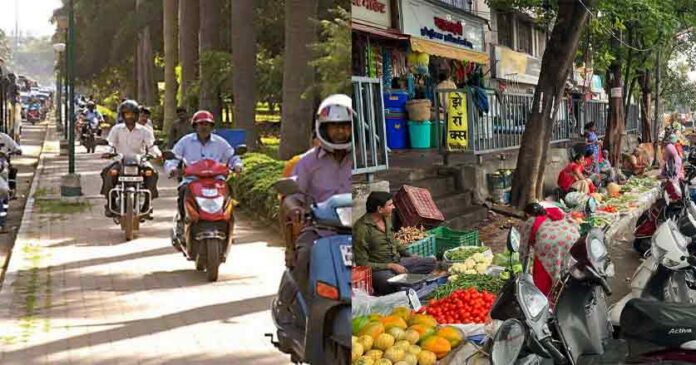
In a landmark judgment delivered on Friday, the Supreme Court of India declared that the right to walk safely on demarcated footpaths is a fundamental right, which takes priority over the movement of motorised vehicles. The Court held that this right flows from the freedoms guaranteed under Articles 19 and 21 of the Constitution, encompassing the right to freedom of movement and the right to life and personal liberty.
A Bench comprising Justice PS Narasimha and Justice AS Chandurkar observed that if a road exists, there is a corresponding enforceable duty on public authorities to ensure that a footpath is demarcated and maintained for pedestrians. “The citizen’s fundamental right to walk on a demarcated footpath is primary and shall have priority over movement by motorised vehicles,” the Court stated emphatically.
The judgment underscored that Indian cities and towns have historically been designed with a disproportionate focus on vehicles, often at the expense of pedestrians. The Bench highlighted how urban planning gradually prioritised motorised transport, marginalising walkers and treating them as a nuisance. “The absence of safe and comfortable footpaths to walk on, and even when they exist, their subjugation to motor transport, has been a civilizational problem,” the Court remarked.
The bench observed that the Motor Vehicles Act does not recognise the fundamental right to walk, and added that it undermines the rights of walkers. The Court clarified that the freedom to walk is subject to reasonable restrictions, but added that it must be ensured that common spaces are not monopolised by vehicle drivers alone.
The bench in its judgement stated, “The right to walk is a fundamental right under Part III of the Constitution. It is integral to the right to movement guaranteed under Article 19(1)(d), read with Article 19(1)(a), Article 19(1) (b), Article 19(1) (c) and Article 21 of the Constitution of India. The fundamental right to walk will take within its sweep the right to demarcated footpaths. These rights are primary and shall have priority over movement by motorised vehicles.”
Tracing the evolution of this neglect, the judgment noted that wheels had eclipsed the imagination of planners, with municipal authorities focusing on roads suited for vehicles. It pointed out that as motor vehicles became more accessible, they dominated the roads, pushing pedestrians aside to the extent that drivers routinely encroach upon footpaths. “This should stop from now on as we declare the fundamental right to walk on demarcated footpaths alongside motorised roads,” the Court declared.
The Bench made it clear that urban development authorities, municipal corporations, municipalities, and even panchayats have the obligation to provide, construct, maintain, and safeguard footpaths. Citizens whose right to walk safely is violated can seek constitutional remedies against these duty bearers for restitution and compensation, independent of claims under the Motor Vehicles Act, the bench added.
The observations came in a case stemming from a tragic road accident in which a five-year-old child was killed by a tanker while walking to school with his father, in an area lacking a footpath or pedestrian crossing. The Court enhanced the compensation awarded to the child’s family to ₹11.44 lakh and set aside a High Court order that had reduced it. Additionally, it converted the matter into a separate proceeding to examine broader issues relating to pedestrian rights and infrastructure, seeking assistance from the Union government.
To strengthen enforcement, the Supreme Court suggested the establishment of a regulatory body and directed that a copy of the judgment be forwarded to the concerned Ministries and the Law Commission for consideration of appropriate legislation to define pedestrian rights, duties, and enforcement mechanisms.
This ruling is expected to have far-reaching implications for urban planning and road safety across the country, reinforcing the primacy of pedestrian rights in public spaces. Advocate Mamidipudi V Mukunda assisted the Court as amicus curiae.
