

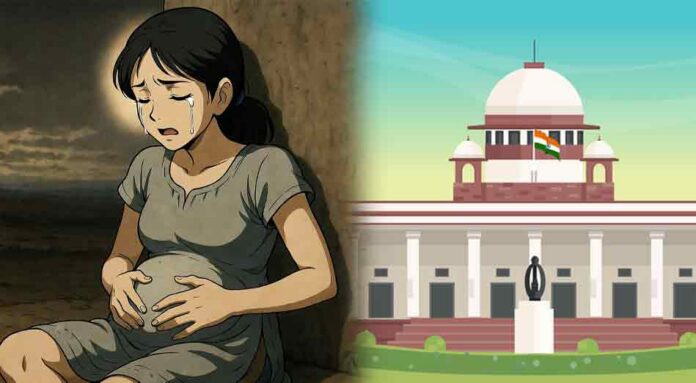
The Supreme Court on Thursday (30 April 2026) urged the Central government to amend the law and eliminate gestational time restrictions for abortions in cases of pregnancies resulting from rape, emphasising the need for the legal framework to evolve in line with societal changes and prioritise the dignity and mental health of rape survivors.
A Bench comprising Chief Justice of India Surya Kant and Justice Joymalya Bagchi made the remarks while rejecting a curative petition filed by the All India Institute of Medical Sciences (AIIMS). The plea sought reconsideration of the Supreme Court’s recent order permitting the termination of a pregnancy beyond 30 weeks in the case of a 15-year-old rape survivor.
“Please amend your law… that when there is pregnancy due to rape etc., the time limitation will not be there. The law needs to be organic and in sync with evolving time,” observed CJI Surya Kant.
The Court highlighted that an unwanted pregnancy cannot be forced upon a minor, particularly a child rape victim who would carry lifelong trauma. “Unwanted pregnancy cannot be thrust on a person. Imagine, she is a child. She should be studying now. But we want to make her a mother… This is a case of child rape. Victim will have lifelong scar and trauma… It is now a fight between foetus vs child… Minor child cannot be forced to bear a pregnancy,” the CJI remarked.
During the hearing on the case yesterday, the bench had said, “It is strange that the review petitioner-All India Institute of Medical Sciences (AIIMS) is not inclined to obey the order of the Supreme Court and instead, is assailing the order of this court, in order to defeat the constitutional rights of the minor daughter of the appellant herein.”
AIIMS then filed the curative petition, which was taken up today. Additional Solicitor General Aishwarya Bhati said that the foetus is now 30 weeks old, and by waiting for four more weeks, the newborn can be given up for adoption.
However, the Bench expressed concern over excessive focus on the foetus at the cost of the mother’s well-being. CJI Kant noted, “Too much focus on the child (foetus) and not the mother who has gone through such pain.” Justice Bagchi added that full medical information should be provided to the parents, but the final decision must rest with them, not the State or medical institutions. “Give respect to your citizen… Let us not make a fight between State and its citizens. We will not allow the institution to choose,” he stated.
Earlier this month, the Supreme Court bench comprising Justice BV Nagarathna and Justice Ujjal Bhuyan had allowed the termination of the minor’s over 30-week pregnancy, observing that she could not be compelled to carry it to term against her will. AIIMS, however, raised concerns that the procedure at this stage could result in a live birth with severe deformities and pose long-term health risks to the minor, including potential infertility. The institute suggested continuing the pregnancy for a few more weeks to improve the child’s survival chances before placing it for adoption.
Additional Solicitor General Aishwarya Bhati, appearing for AIIMS, argued that termination was not medically advisable at this stage and sought counselling for the minor and her family. The Bench, however, maintained that the choice lies with the victim and her parents after full disclosure of medical risks. The Court said that AIIMS cannot impose its decision on the mother, and that the woman should have the option of taking an informed decision.
Under the Medical Termination of Pregnancy (MTP) Act, abortions are generally permitted up to 24 weeks, with exceptions in certain categories, including rape survivors. The Supreme Court’s observations signal a push for legislative reform to address late-term pregnancies in cases of sexual assault, particularly involving minors.
