

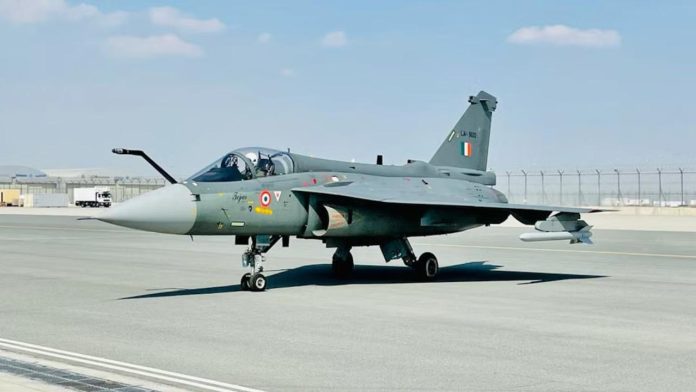
Hindustan Aeronautics Limited (HAL) has sought to calm fears after the fatal crash of a Tejas fighter jet during an aerial display at the Dubai Air Show, terming the incident an isolated event and denying any wider fallout on its operations or defence commitments.
In a fresh statement issued on Monday, the state-run aerospace major asserted that the mishap would not affect its business continuity, financial health, or committed delivery timelines. The company said it is extending full cooperation to the authorities investigating the incident and assured that it would keep all stakeholders informed as the probe progresses.
HAL STATEMENT:
— Rahul Shivshankar (@RShivshankar) November 24, 2025
We would like to bring to your attention that the recent incident during the aerial display at the Dubai Air Show is an isolated occurrence arising out of
exceptional circumstances.
We would like to assure that there is no impact on the Company’s business…
The crash occurred on 21 November at Al Maktoum International Airport, where the indigenously developed Light Combat Aircraft (LCA) Tejas was performing a low-altitude manoeuvre as part of the air show display. Disturbing visuals from the venue show the fighter jet abruptly losing altitude before smashing into the ground in a blazing fireball, sending thick plumes of black smoke into the sky.
The pilot, IAF Wing Commander Namansh Syal, lost his life in the accident, delivering a major blow to the Indian Air Force and the country’s defence fraternity.
The UAE Ministry of Defence confirmed the incident, while the Indian Air Force has ordered a Court of Inquiry to establish the precise cause of the crash. Early assessments by defence observers suggest the possibility of a “G-force blackout”, a condition where extreme gravitational forces cause temporary loss of consciousness during high-intensity aerial manoeuvres, although officials are yet to confirm this theory.
The statement comes amid a coordinated negative online campaign driven by Pakistani and Chinese social media bots and troll networks, falsely claiming that the crash has shaken the confidence of potential buyers of the indigenously developed Tejas fighter jet.
What this propaganda deliberately ignores is that such mishaps have occurred repeatedly across the world, including with American and Chinese fighter aircraft, especially during air shows where jets are pushed to their visual and aerodynamic limits. These flights are not routine point-to-point operations but tightly choreographed, high-stress manoeuvres carried out at low altitudes and critical speeds, leaving pilots with razor-thin margins for error and recovery.
Market jitters, but fundamentals remain intact
The incident triggered sharp reactions in the stock market, with HAL’s share price plunging nearly 9% intraday to ₹4,205 on the BSE as investors reacted to fears of reputational damage and potential export setbacks.
However, by mid-session, the stock recovered part of its losses and was trading around Rs 4,430, down approximately 3.6%, indicating that the initial sell-off was driven more by sentiment than fundamentals.
Market analysts described the stock movement as panic-driven rather than performance-linked, pointing out that HAL continues to sit on a strong order book, including large pending contracts for Tejas Mk-1A fighter jets. Experts believe that unless the investigation uncovers a serious systemic design flaw, the company is well-positioned to weather the temporary turbulence.
Isolated mishap, not a systemic failure
While the tragedy has reignited debates around India’s indigenous defence manufacturing ecosystem, experts caution against knee-jerk narratives that seek to discredit home-grown platforms over a single unfortunate incident.
With the Court of Inquiry underway, all eyes are now on the findings that will determine whether the crash was caused by human factors, extreme flight conditions, or technical anomalies.
The crash was a tragic but isolated event, and India’s flagship light combat aircraft programme remains firmly on course.
