

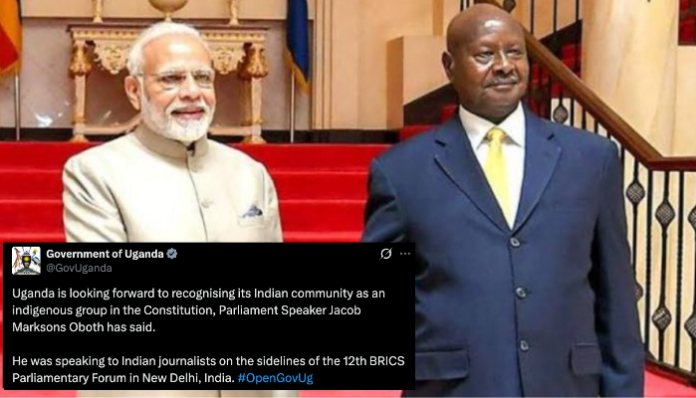
Uganda is considering a proposal to recognise its Asian community, largely made up of people of Indian origin, as an indigenous tribe. If approved, the community will become the 57th officially recognised tribe in the country. The move comes decades after former dictator Idi Amin expelled thousands of Asians, primarily Indians, from Uganda in 1972, forcing many families to abandon the homes and businesses they had built over generations.
Uganda is looking forward to recognising its Indian community as an indigenous group in the Constitution, Parliament Speaker Jacob Marksons Oboth has said. He was speaking to Indian journalists on the sidelines of the 12th BRICS Parliamentary Forum in New Delhi, India. #OpenGovUg
— Government of Uganda (@GovUganda) October 30, 2026
The proposal has brought renewed attention to the community’s long history in Uganda and its contribution to the country’s economy. Kenya had taken a similar step in 2017 by recognising its Indian population as the country’s 44th tribe.
Diwali celebrations brought the demand into focus
According to a report by New African Magazine, the demand for official recognition gained momentum in 2017 when President Yoweri Museveni hosted the Hindu festival of Diwali at State House. During the celebrations, members of the community requested that he recognise them as a native Ugandan tribe.
Patel Sanjiv, a leader of the Indian Association in Uganda, raised concerns about the difficulties faced by young Asians born and brought up in the country. He said they often faced questions about their identity while applying for national identity cards and passports.
The community repeated its request during later Diwali celebrations hosted by Museveni, including those in December 2021 and October 2025. The proposal has now received support from Parliament Speaker Jacob Oboth. Speaking in New Delhi, where he attended the BRICS Parliamentary Forum on 26th and 27th October, Oboth said, “We are looking forward to recognising them [Asians] as indigenous groups.”
He also highlighted the community’s contribution to Uganda’s development and its representation in political institutions, including Parliament and the Cabinet. Uganda’s current Trade Minister, Sanjay Tanna, is of Asian origin, while his nephew is a Member of Parliament.
What happened to Indians in Uganda?
The community has been part of Uganda’s history for generations. However, its presence took a dramatic turn in 1972, when dictator Idi Amin ordered nearly 80,000 Indians and other Asians to leave the country within 90 days.
Amin accused them of controlling the country’s wealth and exploiting local people. Families were forced to leave behind their shops, factories, banks, sugar mills and other businesses. Many settled in Britain, Canada and India, often with very little of their earlier wealth.
The expulsion caused serious damage to Uganda’s economy. At the time, the Indians controlled nearly 90% of the country’s businesses and contributed a major share of its tax revenue. Their sudden departure disrupted trade networks, weakened industries and created shortages of essential goods.
Uganda’s manufacturing sector also suffered heavily. When Yoweri Museveni came to power in January 1986, he reversed Amin’s policy and invited the community to return. His government began restoring properties seized during the expulsion. The move helped many families reclaim their businesses and lives in Uganda.
Indians have been part of Uganda for centuries
The roots of the Asian community in Uganda go back to at least the late 19th century. Traders from Gujarat and Kutch travelled to East Africa, where some moved inland and established businesses in Ugandan kingdoms.
During the late 1890s, the British colonial government also brought thousands of Indian workers, many from Punjab, to build the railway connecting Mombasa in present-day Kenya to Uganda. After completing their contracts, several workers chose to remain in East Africa and entered trade, construction, education, medicine and other professions.
Over time, Indian-origin families became an important part of Uganda’s commercial and industrial life. Today, the community is estimated to number around 35,000 to 37,000 people. Despite making up less than one per cent of the population, it continues to play a major role in manufacturing, banking and trade.
The proposal to recognise the community as an indigenous tribe could therefore mark an important step in acknowledging their long-standing connection with Uganda.
