

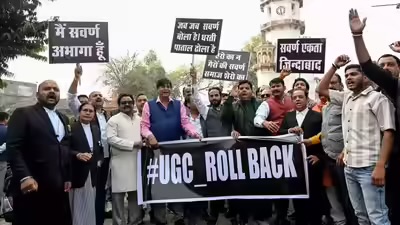
The University Grants Commission’s (UGC) 2026 regulations, framed under the banner of “promoting equity” in higher education, are facing pointed academic criticism, not merely for being vague, but for containing internal contradictions that could end up excluding the very groups they claim to protect.
In a detailed essay, IIM Udaipur professors Kunal Kamal Kumar and Gyanesh Raj argue that the regulations lack conceptual coherence, especially in how they deal with Economically Weaker Sections (EWS). Their critique suggests that the problem is not cosmetic or technical, but structural.
Released on January 13, 2026, the regulations explicitly list EWS as a vulnerable constituency in their objectives. However, the authors note that this recognition collapses at the operational level. Regulation 3(1)(e), which defines “discrimination,” limits its scope to religion, race, caste, gender, place of birth, and disability. Economic disadvantage, the very basis of EWS classification, is missing altogether.
According to the essay, this omission is not a drafting oversight but a design failure. EWS is acknowledged in principle but never converted into an actionable category. In practice, this would have made it nearly impossible for economically disadvantaged students to file complaints based on poverty, fee-related exclusion, or class-based humiliation. Such grievances, the authors argue, would only be admissible if they could be awkwardly reframed under another recognised ground, such as caste.
The essay also draws attention to a glaring inconsistency within India’s broader reservation framework. Eligibility for OBC reservations already hinges on the “creamy layer” exclusion, which is explicitly based on socio-economic indicators. Indian law, therefore, already accepts economic status as relevant to vulnerability and entitlement. Yet, the UGC regulations abandon this logic when it comes to EWS, even while naming it as a protected group.
This contradiction, the authors warn, sends mixed signals and weakens the regulations’ equity claims. By failing to recognise class-based exclusion as a cognisable harm, the framework risks making economic discrimination institutionally invisible, leaving EWS students without meaningful remedies.
Titled From ‘Constable’ to Fraternity: Ambedkar’s Design Lens for the UGC Regulations, 2026, the essay goes further to argue that the regulations deviate from B.R. Ambedkar’s emphasis on fraternity and substantive justice. While much public debate focused on the exclusion of general castes from caste-based discrimination clauses, the authors suggest that anomalies like the EWS gap point to deeper failures in regulatory design.
The Supreme Court of India stayed the regulations on January 29, citing vagueness. But as the essay cautions, unless such internal contradictions are resolved, future equity frameworks may continue to fail, not because of bad intent, but because of a flawed legal imagination.
