

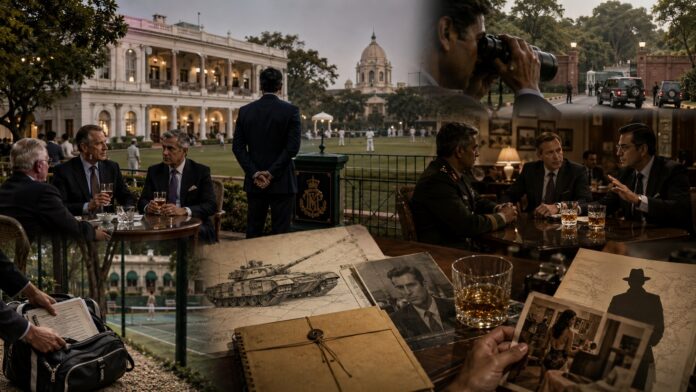
If someone wants to breach the national security of a nuclear-armed nation or an emerging global superpower, there is no need to drop bombs on its military bases. It is enough to simply obtain membership of that country’s most influential colonial-era elite club, where, as soon as evening falls, the country’s policymakers dissolve their security and dignity in pegs of Scotch.
These are stories based on real events. They show how an elite club located right in the heart of India’s capital, Delhi, remained a playground for foreign spies for decades. At the centre of this entire saga is the Delhi Gymkhana Club (DGC), which its influential members have been fighting hard to save with all their power.
Chapter 1: Lutyens Delhi’s ‘Drinking Den’ and the National Security Alarm
The year 2026 began with a major jolt for the Delhi Gymkhana Club. The Land & Development Office (L&DO) of the Government of India issued a strict order directing the 113-year-old club to vacate its premises. Behind this firm step were grave reasons – national security, strengthening defence infrastructure, and public interest.
The club is spread over 27.3 acres in an extremely sensitive and strategic area, located just a few metres away from the Prime Minister’s residence at 7 Lok Kalyan Marg. For the common public, it may appear to be merely a den of entertainment for the wealthy, but for the Government of India, it has always been a major national security risk.
In 2020, the Ministry of Corporate Affairs had given a very sharp statement in court regarding the club’s functioning, saying, “This club has turned from a gymnasium into a drinking den.” It had become a sort of ‘princely state’ where there was such unrestricted mingling of the country’s elite bureaucracy and foreign diplomats that it was sufficient to throw dust in the eyes of the security apparatus.
During the Cold War, the Delhi Gymkhana Club functioned as a contact zone where foreign spies operating under diplomatic cover could easily meet Indian generals and bureaucrats, bypassing government rules forbidding contact with foreign nationals. They did so without coming under the scrutiny of government restrictions or intelligence agencies like the Intelligence Bureau (IB).
Chapter 2: T-72 Tank and the Magical ‘Drop’ at the Tennis Court
This incident dates back to 1978. The Indian Army had, for the first time, procured the then most modern and lethal T-72/T-72M tanks from the Soviet Union. This 41-ton steel behemoth had become a major mystery for the US Department of Defense (Pentagon) and the CIA. What exactly was it about this tank that had robbed America of its sleep? There were three main reasons:
- Strong Front Armour (Glacis Armour): It was not merely a sheet of steel but a sloped protective shield made of multiple layers of high-carbon steel and polyurethane, which was considered extremely difficult to penetrate.
- Laser Rangefinder and Auto-loader System: The tank could automatically measure target distance and load shells, enabling it to engage the enemy with great speed and eliminating the need for a fourth crew member.
- 125mm Smoothbore Gun: In that era, this was counted among the world’s deadliest tank guns, capable of reducing enemy tanks to scrap metal within seconds. It fired kinetic energy rounds at 1,800 meters per second, several hundred meters per second more than Western tanks.
The Cold War was then at its peak, and the CIA was determined to acquire complete details of this tank, which was referred as ‘SOVMAT’ (Soviet military manuals) in intelligence parlance. They had even planned to bribe an Indian military officer to smuggle the tank across the border to Pakistan, but the attempt failed.
It was then that CIA’s cunning field agent Robert Baer, stationed at the US Embassy in New Delhi, stepped in. Baer has recounted this dangerous episode in detail in his famous 2002 autobiography See No Evil.
One of Baer’s Indian agents had stolen highly confidential T-72 manuals from an army locker, but there was a critical condition, the manuals had to be returned to the military safe within just two hours, before the sergeant’s duty changed and the theft was discovered. Baer fled with the duffel bag filled with the manuals and drove straight to the American Embassy. He asked his agent to meet him in two hours behind guest house number three at Delhi’s Gymkhana Club.
At the embassy, he copied the T-72 tank manuals, and hurried back to the club. Time was ticking away rapidly, with only 17 minutes remaining. However, he was followed by five cars, indicating that IB was tailing him. Showing great presence of mind, Baer drove his car straight through the gates of the Delhi Gymkhana Club. The IB vehicles followed close behind. Without stopping, Baer drove the car onto the narrow gravel pedestrian path running between the tennis courts, a route where the IB vehicles would not follow. The IB officers started to follow him on foot.
Without stopping the car, he quickly pulled the duffel bag with original manuals from the tennis bag and threw it towards the agent, who was hiding in the bushes near Guest House Number Three, behind the tamarind trees. The agent was waiting at the exact place where he was asked to be, and Baer saw that he picked the bag and walked away.
To confuse the pursuing IB officers, Baer then walked straight into the club’s bar. There, he sat down next to a highly respected and completely innocent-looking Indian gentleman dressed in a three-piece suit and ordered two double Scotches from the waiter.
When the panting IB officers burst into the bar, they found Baer engaged in serious conversation with the distinguished Indian. Their entire attention shifted to the innocent Indian gentleman, wondering what urgent matter had brought Baer to him in such haste. This little drama gave the CIA agent enough time to safely return the manuals to the army sergeant to bring it back to the locker.
As a result of this theft, in 1982 the CIA concluded from the manual that the early versions of the T-72 had limited night-fighting capability compared to their Western counterparts. The CIA immediately shared this strategic weakness with the US defence industry and its frontline partner, the Pakistani Army.
Chapter 3: Punjab Jungles, the ‘Back Door’ and Illegal Peacock Hunting
Rules for military officers were extremely strict. They could not meet foreign nationals directly and were required to report any such meeting to the government immediately. This made it almost impossible for the CIA to directly entrap military officers.
On page 75 of his book, Robert Baer wrote that he discovered a ‘back door’ in this rigid system. He learnt that Indian military officers had a great passion for hunting.
Baer then created a hunter’s identity for himself, purchased a military jeep with civilian number plates, and set up camp in the jungles of Punjab. There, he met an influential Indian military officer named ‘Singh’, who was strongly opposed to Indo-Soviet friendship. Their friendship grew deep. On weekends, they began illegally hunting India’s national bird, the peacock, in the Punjab jungles and even inside the private estate of the then Prime Minister Indira Gandhi.
Baer gifted Singh an expensive Italian Browning double-barrel shotgun. Later, the CIA Station Chief in New Delhi, ‘Wild Bill’, was also included in these hunting expeditions, and ‘Singh’ was fully recruited. Unwittingly, Singh then passed on all sensitive information regarding Indian Soviet military equipment and defence vulnerabilities to the CIA.
Chapter 4: Honeytrap and the Bitter Reality of the Madras Cafe
The CIA’s elite network was not confined to Delhi or Punjab alone. In the mid-1980s, when the Sri Lankan civil war was at its peak, K.V. Unnikrishnan was the head of RAW’s Madras station.
During his posting in Colombo, Sri Lanka, the CIA cleverly trapped Unnikrishnan in a honeytrap using an air hostess. They recorded compromising photographs and videos of him, after which a prolonged blackmail operation began that inflicted deep wounds on India’s national interests.
Unnikrishnan worked for the CIA for nearly two years. He handed over complete files containing India’s most secret policies, including training given to Tamil militants (LTTE) and the Indian government’s strategy regarding the Sri Lankan peace accord.
The CIA passed this sensitive information to the Sri Lankan government, which later caused heavy military and human losses to the Indian Peace Keeping Force (IPKF). By the time IB’s counter-intelligence wing arrested him in Mumbai, massive damage had already been done. He was subsequently dismissed from service and sent to Tihar Jail. Unnikrishnan had confessed to the high treason.
This incident was depicted in the movie Madras Café.
Chapter 5: Other Favourite Haunts of Spies and the Karachi Connection
National security agencies had not only the Delhi Gymkhana Club on their radar. Several other elite venues of this culture were also favourite spots:
- Delhi Golf Club: Spread over 170 acres in the heart of Lutyens Delhi, this golf club has long served as an informal meeting point for retired generals, intelligence chiefs, and bureaucrats. Here, through ‘soft cultivation’, foreign diplomats would extract national policy secrets over games.
- Jaipur Polo Ground (Delhi): Located right in front of the Prime Minister’s residence, this ground was a major centre where sports and power intersected. The Modi government recently took strong action here on national security grounds.
- Karachi Gymkhana Club (Pakistan): Like its Delhi counterpart, this colonial-era club located in the heart of Karachi was used by American and Western diplomats to influence local officials and military personnel and build intelligence networks through social networking.
In addition, bungalows in elite Lutyens Delhi areas such as Golf Links have always remained primary centres of intelligence surveillance. Former RAW officer Malay Krishna Dhar revealed in his book Open Secrets how, during Rajiv Gandhi’s government, even Rashtrapati Bhavan was bugged to record the tensions between President Giani Zail Singh and the Home Minister.
However, it is not that India never adopted such tactics. Dhar writes that liquor was often used as a tool to extract information from militants in Manipur and even from a police constable.
Exploiting this lax elite security system like the Gymkhana, in 2004, RAW Joint Secretary Rabinder Singh, with the help of CIA agent David Vakala, successfully escaped to America via Kathmandu on a fake passport. He had escaped after he was discovered acting as a double agent for the CIA. This incident has been described in detail by former RAW Special Secretary Amar Bhushan in his well-known book Escape to Nowhere.
Why are these Elite Clubs Sensitive for National Security?
Why have elite clubs like the Gymkhana remained the biggest ‘soft targets’ for foreign powers? There are three main strategic reasons:
- No Fear of Protocol: In a government office, there are strict rules for meetings with foreign diplomats, but on the green lawns of the Gymkhana or Golf Club, with a glass of Scotch in hand, diplomats and defence officials freely share sensitive security policies without any written permission.
- Soft Cultivation: Foreign agencies gradually make officers indebted to them by using personal hobbies such as tennis, polo, golf, or hunting. It starts with borrowing golf sticks or gifting guns and often ends in treason.
- Strategic Proximity: All these elite clubs are located right next to the Prime Minister’s residence and sensitive defence headquarters in the heart of Delhi. Allowing unrestricted movement of foreign nationals in such sensitive areas without security audits is suicidal for any country.
This is precisely why, in 2026, the Indian Government took this major decision to terminate the lease of this colonial-era privileged safe haven and have it vacated. After all, for any sovereign nation, national security is far more important than the entertainment and drinking parties of a few chosen elites. No privilege can be greater than the country’s security.
This article is a translation of the original article published in Hindi


