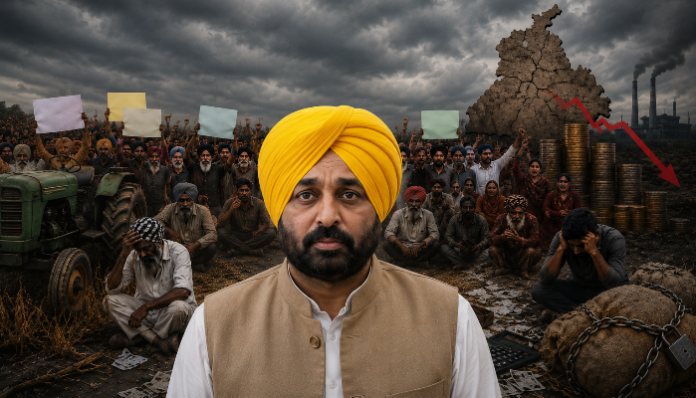
Punjab Chief Minister Bhagwant Singh Mann has declared that 52 lakh women in the state are set to receive ₹1,000 each month starting from 1st July. Beneficiaries belonging to the scheduled caste community will be granted an increased amount of ₹1,500. “No one should mislead the women of the state that this will run for just a few months. It will be a long-term scheme for the economic upliftment of women,” he stated while talking to the media.
The announcement has transpired following a prolonged series of economic hardships, while government staff were denied payments in a timely manner because of empty state coffers. The salaries for March were postponed by several days, as employees in Chandigarh received the amount on 7th April, while those in field postings were paid only by 15th April.
The government blamed procedural complications associated with the financial year-end. However, the incident reignited reservations regarding the state’s economic health. The concerns have intensified as people have repeatedly faced such challenges under the Aam Aadmi Party (AAP) rule. The issue of non-payment of dues is not only recurring but also deteriorating with time.
On 2nd June (Tuesday), Mahatma Gandhi National Rural Employment Guarantee Act (MGNREGA) employees at Phagwara’s Block Development and Panchayat Office commenced an indefinite pen-down strike in support of their long-standing demands, which include the release of outstanding salaries and the regularisation of their services.
The protesters were recruited on contractual terms for the previous 10 to 12 years and complained that the government had ignored their problems. They unveiled that they are unable to manage family expenses because they have not received any money for the last 6-7 months. Hence, many have been compelled to take out loans to support their basic needs.
They mentioned that AAP had promised to regularise them during its assembly election campaign. Nevertheless, the government has not honoured its commitment, even as it approaches the conclusion of its five-year term. On the contrary, the workers have been deprived of their salaries for several months. They urged the government to uphold its word and requested the immediate delivery of their outstanding wages. The demonstrators vowed to continue the strike until their demands were met.
Constant delays in salaries for state government employees
Similar agitations were seen in 2025 and the years before that. In an official letter to the vice-chancellor, the Punjabi University Teachers Association (PUTA) demanded that their salaries should be released by 20th August, last year. The step was taken after faculty members were not paid for the month of July.
“If the government ignores this serious issue, PUTA will be forced to adopt a more stringent approach. In case the situation does not improve, we will be compelled to launch a large-scale protest,” the communication emphasised. PUTA threatened to boycott courses starting on 21st August if their submission was not addressed.
Governor Gulab Chand Kataria was also given a letter from the Punjab State Aided School Teachers and Other Employees Union encouraging his intervention to distribute unpaid salaries in September of last year. According to the group, they had not been reimbursed for at least 6 months, which has put them in dire financial straits. “The government often speaks about bringing an educational revolution in Punjab, but how can that be possible when teachers themselves are struggling to meet their basic needs,” it conveyed.
A few months later, the Punjab and Chandigarh College Teachers Union (PCCTU) confirmed that a protest would take place in Dirba on 12th December. Harpal Singh Cheema, Punjab’s Finance Minister, represents this constituency. The purpose of the protest was to draw attention to the protracted hold-up in the transfer of salaries to state-aided colleges.
The agitators pointed out that staff are struggling financially because some government-aided institutions have not received the money since July while others have been waiting since February. They asserted that it was especially troubling because, the current government constantly stressed that health and education were its top priorities, but higher education was actually being neglected.
The salaries for the month of August were likewise pushed back shortly after AAP was elected to power in 2022. Employee organisations in Punjab questioned the development, but the government insisted that there were no shortage of resources and the treasury granted nearly Rs 3,400 crore for salaries and other expenditures.
On the ground, however, situation was different and the Democratic Teachers Front accused the government of “mismanagement.” Sukhchain Singh Khaira, chairman of the Punjab Civil Secretariat Staff Association, also voiced that staff members were still waiting for their earnings.
For a considerable amount of time, the computer teachers in the state’s government schools have been similarly protesting their exclusion from vital service perks and the excessive delay in their salaries. They are paid in the third or even final week of the month. They charged that the government alleges to have brought about a revolution in education, but it is unable to handle basic procedural problems such as salary backlogs.
According to the Punjab and Haryana High Court, these teachers hired by the Punjab Information and Communication Technology Education Society (PICTES) are government employees and therefore subject to Punjab Civil Services regulations and related benefits. However, many teachers shared that real implementation has halted despite their best efforts and there isn’t a structural framework to guarantee equity.
Regular protests over non-payment of DA, pensions, low wages and more rock the state
On 2nd June (Tuesday), thousands of teachers moved towards Mann’s Mohali house in protest of several unfulfilled demands, including reinstatement of the Old Pension Scheme (OPS), the opposition to dearness allowance’s (DA) de-linking from central rates, release of 18% pending DA, clear salary arrears and promotions, regularise contract employees and fill vacant teaching positions, among others.
On 1st June (Monday), hundreds of government workers similarly rallied in Mohali to begin a march towards the chief minister’s residence, but the police used lathi charge on them. These people reminded that AAP had pledged to resolve their complaints before elections but had not met any major demand in the last four and a half years. The demonstrators charged exploitation because they were refused the 18% pending DA and the elimination of 37 other reimbursements, including rural and border area benefits.
They highlighted the inconsistency in the AAP government’s stance, which rejected the centre’s recent pay pattern for Chandigarh employees and was enforcing even lower salaries (₹31,000) on fresh recruits in Punjab, leading to a reduction of about 40%. The also urged for the release of long-awaited Sixth Punjab Pay Commission report and the enactment of the 1972 regulations for the (General Provident Fund) GPF-based old pension.
On Tuesday, 2,300 workers at Sewa Kendras around Punjab also continued their strike against the government, asking for improved wages, job regularisation and a stop to exploitation of private companies appointed to oversee the centres. The agitation started on 26th May. As a result, public services remained badly disrupted. Visitors were left stranded as the release of certificates and the revision of identity cards, among other crucial functions, could not proceed.
The association accused that the workers are overworked under the “equal pay for equal work” premise, yet their compensation has remained extremely poor over the years. Neither the full DC rate nor the ESI (Employees’ State Insurance) benefit is provided to these workers. They also decided to boycott the job fairs that would be held around Punjab on Wednesday.
A similar agitation transpired in January when several unions of employees declared a statewide strike against the government over long-standing financial demands. They wanted Punjab pay scales to be put into effect, salaries to be fixed in accordance with the Sixth Punjab Pay Commission with a 15% increase, the Old Pension Scheme to be reinstated under the 1972 regulations, the revocation of the Unified Pension Scheme, release of outstanding 16% DA, the restoration of 37 abolished allowances and revival of the Assured Career Progression (ACP) initiative.
These events pertaining to the inability to meet such financial obligations by the government have repeatedly unfolded in Punjab. In protest of the “non-payment of four instalments of DA totalling 15% of their basic income,” almost one lakh workers from more than 50 government departments throughout the state went on a two-day mass leave in 2024 under the umbrella of the Punjab State Ministerial Services Union (PSMSU).
10,000 workers from various government agencies at the Punjab Civil Secretariat and directorates in Chandigarh left their desks at 2:00 pm in observance of “Black Diwali.” The Democratic Teachers Front of Punjab also asked that the Punjab government promptly release 15% of the pending DA in accordance with the centre.
PSMSU announced similar strikes in 2023 regarding the implementation of the old pension scheme (OPS), the release of outstanding instalments of DA and the regularisation of contractual workers. This also jeopardised the timely disbursal of salaries for over 2 lakh employees as the funds were managed by the agitating ministerial staff. The protestors also received support from various other groups, including Punjab State Power Corporation Limited (PSPCL) and the Punjab Civil Medical Services Association (PCMSA).
Punjab and Haryana High Court intervenes
The Punjab and Haryana Court ordered the state to disburse the arrears, DA, and Dearness Relief (DR) in accordance with the central government pattern in April. It termed the Punjab government’s staggered payment scheme to employees arbitrary and in violation of Article 14 of the Constitution. The state had been directed to satisfy the pension amount and the updated DA/DR per the 6th Punjab Pay Commission by 30th June.
The state’s claim of financial limitations was dismissed by the court, which concluded that DA/DR are inflation-linked payments that are required to preserve the real worth of income and are not optional. The latter stated that retirees cannot be discriminated against for pension payments because the budgetary restriction is a state-created issue.
The court then overturned the state’s 18th February 2025, liquidation plan and told it to release the arrears and other obligations to all employees and pensioners within two months. Furthermore, it instructed the Chief Secretary to submit a compliance report by 2nd July, and it might impose interest on late payments if the dues are not released. The verdict created a liability of about Rs 15,000 crore for unresolved DA arrears.
Hence, the cash-strapped he Punjab government was preparing to seek relief by recommending a staggered payment structure rather than instant settlement of dues, reported The Indian Express. The government believed that “forcing payment of nearly 10% of the state budget within two months borders on the realm of impossibility and could cripple the government’s ability to pay regular salaries, pensions, and social sector commitments.”
The substantial fiscal burden on PSPCL
Not only government employees but also the Punjab State Power Corporation Limited (PSPCL) has been grappling with a severe economic downturn. Last month, the state’s power tariffs for 2026-2027 were lowered by 50 paise to Rs 1.50 per unit for all customer groups. However, the order of the Punjab State Electricity Regulatory Commission (PSERC) was contested by the Punjab State Electricity Board Engineers Association in the Appellate Tribunal for Electricity (APTEL). The petition has been accepted by the tribunal and would probably be heard in July.
It has contended in its appeal that the utility’s operational and financial stability is seriously threatened by the updated Annual Revenue Requirement (ARR) and information that Punjab State Power Corporation Limited (PSPCL) provided to the PSERC. The plea mentioned that the Net Revenue Requirement had been reduced by Rs 1,259 crore to Rs 48,996 crore for FY 2026–2027.
This resulted in an “illusory” revenue surplus of Rs 7,851.91 crore, much less than PSPCL’s initial figure of Rs 52,365 crore and even below its updated calculation of Rs 51,106 crore. Furthermore, it minimised the target government subsidy from Rs 22,250 crore to Rs 15,200 crore. The petitioners argued that such a drastic decline in income availability could have a negative impact on supply quality, infrastructure investment and statutory requirements, putting PSPCL under tremendous budgetary constraints and possibly endangering its operational and financial viability.
Sunil Jakhar, the president of the Bharatiya Janata Party Punjab unit, earlier highlighted how PSPCL seemed to undergo a major transformation during the tariff hearings before the PSERC in March. However, the improvement was only on paper as the utility continued to struggle in reality.
“The Punjab State Power Corporation’s claim that it had a deficit of Rs 1,713 crore on 28th November 2025, which through some magic trick turned into a surplus of Rs 7,851 crore on 6th March. One thing is certain: one of these figures must be incorrect. Chief Minister Bhagwant Mann must be held accountable for this,” he wrote on social media.
The BJP leader added, “If the earlier figure was wrong, then action should be taken against those responsible. And if the new figure is correct, then the person capable of such black magic should be made the Finance Minister of Punjab, at least on paper, he would be able to fill the Punjab government’s treasury.”
The Punjab State Power Corporation’s claim that it had a deficit of ₹1,713 crore on November 28, 2025, which through some magic trick turned into a surplus of ₹7,851 crore on March 6, 2026.
— Sunil Jakhar (@sunilkjakhar) March 17, 2026
One thing is certain: one of these figures must be incorrect.
Chief Minister Bhagwant…
The utility’s economic challenges mounted earlier as well when the government failed to pay the bills in February 2025. The government settled Rs 13,841 crore of the roughly Rs 20,400 crore power subsidy as of January of that year, leaving an outstanding balance of Rs 1,800 crore. Furthermore, there were Rs 3,600 crore in remaining electrical bills from different government divisions.
“Around Rs 7,000 crores subsidy is yet to be cleared till the end of the current financial year (2024-25),” stated Ajay Pal Singh Atwal. He serves as the general secretary of Punjab State Electricity Board Engineers Association. According to him, the power firm experienced a serious cash flow congestion as a consequence, which had a grave effect on its capacity to operate efficiently.
He conveyed, “This delay in payments not only exacerbates operational challenges but also compounds financial losses, which will ultimately result in higher power costs for consumers across the state.”
The critical condition of PSPCL can be assessed by the intervention of the Punjab and Haryana High Court, which took place when it planned to sell vital public assets to cover the economic shortfall.
A petition was submitted in the court arguing, “Public properties are long-term national assets held in trust for future generations and cannot be sold for short-term fiscal management, particularly when recoverable dues of nearly equal magnitude remain unpaid by the state itself.”
It had accused, “The Government of Punjab has failed to discharge its moral, ethical and statutory obligation to pay electricity dues, thereby pushing PSPCL into a severe financial crisis.” The plea further asked the court to order PSPCL to swiftly collect the Rs 2,582.24 crore default sum from government departments that are in default, together with interest and penalties.
The petitioner opposed the state’s “Optimum Use of Vacant Government Land Scheme” (OUVGL) policy of selling coveted public properties, including prime PSPCL land to survive a “self-created and avoidable” financial catastrophe.
When Mann wanted special package to mend the derailed economy
In his first meeting with Prime Minister Narendra Modi after taking office, Mann demanded a special aid from the centre for the state’s economic revival in addition to holistic development in the state. He informed the prime minister of the state’s gloomy financial condition and pointed out that the previous administrations had left a staggering debt of Rs 3 lakh crore
“We, the Aam Aadmi Party (AAP), are working towards nailing the mafia and fill the coffers of the state. We want that we get a special package of Rs 50,000 crore each for two years so that Punjab can be self-reliant after two years. I am hopeful that he will discuss it with the finance minister and help Punjab, a state that was at the forefront in the battle of independence,” he stated.
Mann compared Punjab to a stone set in India’s ring, but he criticised how the state’s “ill-conceived decisions” to elect particular governments had caused it to gradually lose its lustre over time. The official statement added, “If Punjab make rapid strides of development, then India would also eventually prosper.”
He wanted a similar financial package of Rs 20,000 crore from the centre to compensate for the damages incurred by the floods last year. He had even demanded “stuck” funds of 60,000 crores, claiming that Punjab lost Rs 50,000 crore owing to GST (Goods and Services Tax). Mann’s remarks illustrate the extent to which the state has been reeling from crippling financial setback and, as he pointed out, is laden with enormous debt.
The surging debt and the election dole-out
Punjab’s debt is expected to increase to approximately Rs 4.47 lakh crore in the upcoming fiscal year, having already surpassed Rs 4 lakh crore. Furthermore, debt servicing, or the return of prior borrowings, now accounts for a sizable amount of the state’s revenue. In the upcoming year, the government is projected to pay Rs 13,725 crore toward repayment and Rs 28,755 crore in interest, which will restrict its spending on infrastructure, health and education. Additionally, the debt per person has increased to almost Rs 1.04 lakh.
Importantly, possible threats to economic sustainability in the future were identified by the 2023-34 audit. Punjab’s subsidy burden surpasses its Rs 21,955 crore revenue deficit. Thus, economists raised alarm about the fact that borrowing accounts for a major portion of government budget. They outlined that large subsidies and growing debt suggested systemic fiscal stress which could impact the region’s long-term stability.
Now, Mann has claimed, “We started this scheme when we had a proper budget for it,” after the roll-out of the latest scheme. Therefore, the question arises: is it feasible for a state already encumbered by substantial debt to impose further strain on its treasury when it evidently lacks the financial means to support such initiatives independently?
The AAP government is aware that it cannot, but prioritising such dole-outs takes precedence over the long-term financial welfare of the state and its citizens. The ominous timing of the announcement further indicates the underlying motive behind the action. Punjab is expected to hold assembly elections next year, likely in February, leaving less than a year for the democratic process.
The APP is poised to confront a formidable challenge from the opposition in Punjab, and this action is aimed to attract voters. While it is true that all parties engage in these tactics, it is undeniable that the fragile financial state of Punjab further complicates matters for the region.
Conclusion
The state is unable to pay salaries or other dues punctually and has to be reprimanded by the high court to meet its obligations. However, the availability of resources for these programs provokes several questions. How can short-term political objectives take precedence over the state’s future? How long will Punjab’s debt economy be able to sustain itself?
If the AAP government can gather funds for these schemes, why does it not demonstrate the same commitment to addressing the rising issues of law and order, drug crisis and other similar that have plagued the state for decades? It could redirect resources to at least try to resolve these matters.
However, the government might have come to the conclusion that these giveaways could place them in a better position for the upcoming elections than any authentic efforts for the citizens. Ironically, AAP entered the political arena with a declaration of moral integrity and alternative politics. However, it seems that those who sought to reform the political system have themselves morphed into what they once criticised, if not worse.