

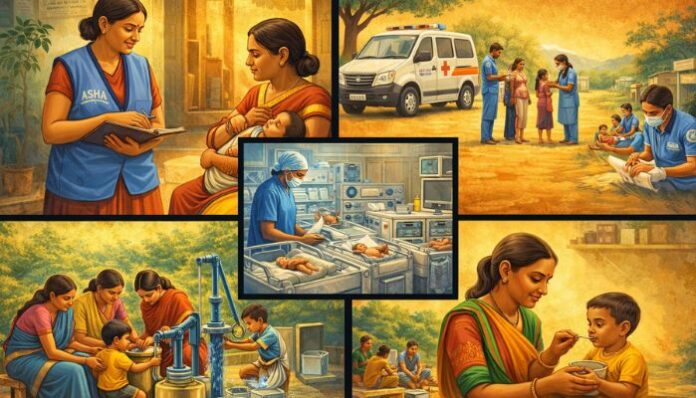
On 17th March, United Nations Inter-agency Group for Child Mortality Estimation (UNIGME) released its report for the year 2025 in which it lauded India for a sharp dip in child deaths in both neonatal and under five categories. The decline has been made possible due to large scale public health interventions and improved last mile delivery.
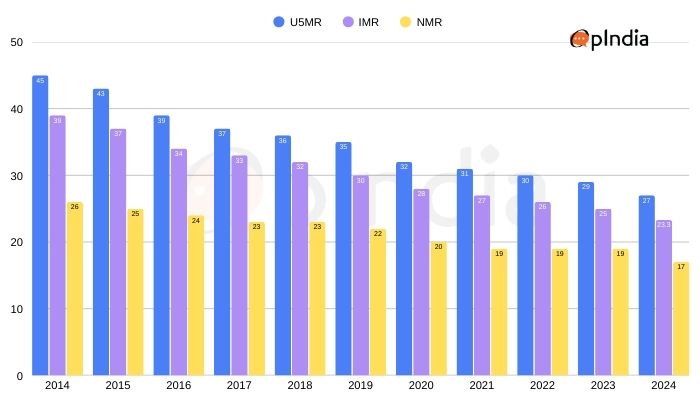
Sharp fall in neonatal and under five mortality
According to the UNIGME report, India’s neonatal mortality rate has declined by 70%, dropping from 57 deaths per 1,000 live births in 1990 to 17 in 2024. The under-five mortality rate has fallen by 79%, from 127 in 1990 to 27 in 2024.
The report has attributed this sustained decline to a strong central and state-led public health framework that has translated policy intent into measurable outcomes on the ground.
India’s role in regional progress
Notably, India has played a central role in reducing child mortality across South Asia, a region that has witnessed a 76% decline in under five deaths since 1990 and a 68% drop since 2000.
𝐈𝐧𝐝𝐢𝐚 𝐢𝐬 𝐬𝐞𝐭𝐭𝐢𝐧𝐠 𝐭𝐡𝐞 𝐩𝐚𝐜𝐞 𝐢𝐧 𝐫𝐞𝐝𝐮𝐜𝐢𝐧𝐠 𝐧𝐞𝐨𝐧𝐚𝐭𝐚𝐥 𝐦𝐨𝐫𝐭𝐚𝐥𝐢𝐭𝐲!
— All India Radio News (@airnewsalerts) March 19, 2026
As highlighted in the UN IGME 2025 Report, focused interventions, digital systems like eVIN & UWIN, and strengthened primary care are ensuring a healthier start for every… pic.twitter.com/qylg3wbwkD
The regional under five mortality rate has fallen from 92 deaths per 1,000 live births in 2000 to nearly 32 in 2024. Despite still accounting for around % of global under five deaths, South Asia has recorded one of the fastest improvements globally, with India leading among high burden countries.
Targeted interventions driving outcomes
The UN report has highlighted that India’s focused public health measures have significantly reduced deaths caused by preventable conditions such as pneumonia, diarrhoea, malaria, and birth related complications.
Key interventions include expansion of the universal immunisation programme, strengthening of facility based newborn care, and integrated management of neonatal and childhood illnesses. These measures have improved survival rates, particularly in the most vulnerable populations.
Neonatal care improvements have been especially impactful, with South Asia witnessing nearly % decline in neonatal deaths since 2000, alongside over 75% reduction in mortality among children aged 1 to 59 months.
PIB data shows continued decline in mortality indicators
The UN findings complement the data released by the Government of India in September 2025. The Ministry of Statistics and Programme Implementation released a report titled “Children in India 2025” that showed continued improvement in mortality indicators.
India’s infant mortality rate declined from 44 in 2011 to 25 in 2023, with Sample Registration System data confirming an improvement from 26 in 2022 to 25 in 2023.
The under-five mortality rate stood at 29 in 2023, down from 30 in 2022. Rural areas recorded a higher rate of 33 compared to 20 in urban areas, indicating persistent disparities even as overall outcomes improve.
Most child deaths preventable, says report
The report reiterates that a large number of child deaths remain preventable. It highlights the importance of sustained investments in primary healthcare systems and early life interventions. The report has cited India’s ability to scale these interventions to the last mile as a key factor in achieving consistent gains.
India among fastest improving high burden countries
The report has highlighted India’s position as a leading example among high burden countries in reducing child mortality through sustained policy focus and scalable public health interventions.
Government schemes driving decline in child mortality
India’s sharp reduction in child deaths has been supported by a combination of large scale public health schemes targeting maternal, neonatal, and early childhood care. The National Health Mission has strengthened primary healthcare delivery and expanded institutional births through schemes like Janani Suraksha Yojana and Janani Shishu Suraksha Karyakram, ensuring free and safer deliveries.
The Universal Immunisation Programme, along with Mission Indradhanush, has improved vaccine coverage against life threatening diseases. Facility based newborn care systems, including Special Newborn Care Units, have helped manage high risk births and complications. At the community level, ASHA-led home based newborn care has enabled early detection and treatment of illnesses. These interventions, combined with nutrition and sanitation efforts, have played a crucial role in reducing preventable child deaths across the country.
