

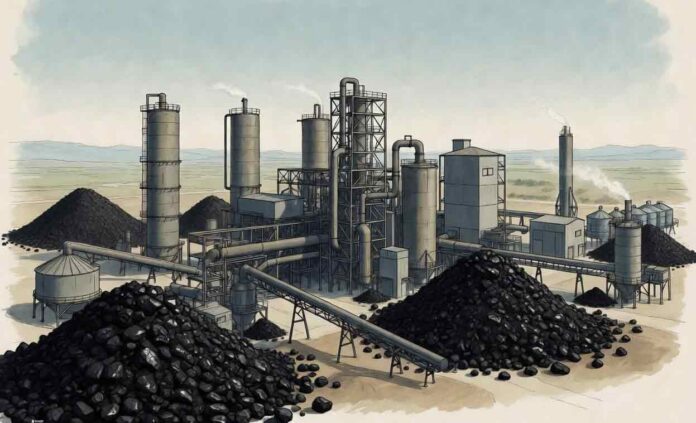
In a timely boost to India’s energy self-reliance at a moment when the West Asia crisis and the prolonged blockade of the Strait of Hormuz have disrupted global oil and gas supply chains, the Union Cabinet chaired by Prime Minister Narendra Modi today approved a landmark Scheme for Promotion of Surface Coal/Lignite Gasification Projects with a total financial outlay of ₹37,500 crore. The initiative is designed to accelerate domestic production of syngas from India’s abundant coal and lignite reserves, targeting the gasification of 100 million tonnes of coal by 2030 and substantially cutting the country’s dependence on imported LNG, urea, ammonia and methanol.
The scheme will incentivise new surface coal and lignite gasification projects through a transparent competitive bidding process, offering financial support of up to 20 per cent of the cost of plant and machinery. Incentives will be disbursed in four equal instalments linked to project milestones, with clear caps to ensure broad participation: ₹5,000 crore for any single project, ₹9,000 crore for any single product (except synthetic natural gas and urea), and ₹12,000 crore for any single entity group.
The government has also extended coal linkage tenure up to 30 years under the “Production of Syngas leading to Coal Gasification” sub-sector of the Non-Regulated Sector linkage auction framework, providing long-term policy certainty for investors. The programme is technology-agnostic and lays special emphasis on the adoption of indigenous technologies.
The govt has described the decision as a major step towards Atmanirbhar Bharat in the energy sector. India holds some of the world’s largest coal reserves, yet currently imports over 50 per cent of its LNG, nearly all of its ammonia, and 80-90 per cent of its methanol, with the total import bill for these substitutable products touching approximately ₹2.77 lakh crore in FY 2025.
The ongoing geopolitical turmoil in West Asia, particularly the US-Iran conflict that triggered the closure of the Strait of Hormuz earlier this year, has sharply exposed this vulnerability. The blockade has choked nearly one-fifth of global seaborne oil and LNG trade, forcing Indian refiners to scramble for alternative supplies, pushing up crude import costs and triggering shortages in fertiliser and petrochemical feedstocks that directly affect farmers and industry.
By converting domestic coal into syngas, a versatile feedstock that can produce synthetic natural gas, urea, methanol and other critical chemicals, the scheme will insulate the economy from such external shocks. India holds one of the world’s largest coal reserves (around 401 billion tonnes) and lignite reserves (around 47 billion tonnes), and therefore, gasification can reduce import dependency substantially.
It is expected to mobilise private investment of ₹2.5-3 lakh crore, generate around 50,000 direct and indirect jobs in coal-bearing regions, and yield annual revenue of ₹6,300 crore to central and state governments from the gasification of 75 million tonnes of coal under the programme, in addition to downstream GST collections. The move builds on the National Coal Gasification Mission launched in 2021 and an earlier ₹8,500 crore scheme cleared in January 2024, under which eight projects are already under implementation.
The Cabinet’s decision could not have come at a more opportune time. With tanker traffic through the Strait of Hormuz remaining severely restricted for over two months, India has already seen its Middle East crude imports plummet and has had to ramp up purchases from Russia and other distant sources at higher freight costs.
The new gasification push not only promises long-term substitution of these imports but also strengthens India’s negotiating position in global energy markets and advances the broader goals of energy security, import reduction and Make in India initiative. This comes days after PM Narendra Modi appealed to citizens to adopt several measures to reduce forex outgo.
