

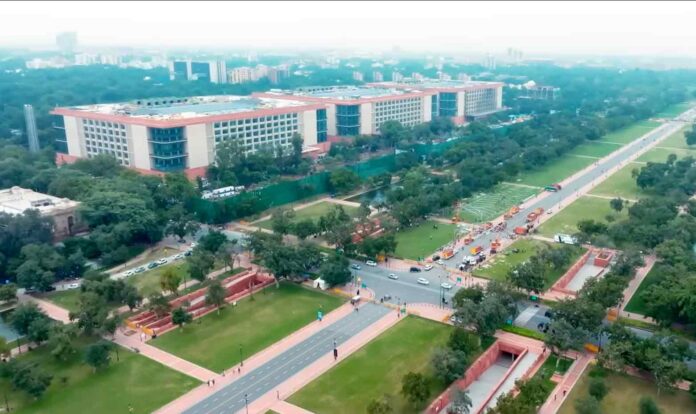
As the Central Vista project progresses at a rapid pace, the Union Cabinet on Friday approved the transition of government offices from the newly inaugurated Seva Teerth and Kartavya Bhavans from North Block and South Block. In the last cabinet meeting held in South Block, the cabinet also approved the proposal to make North and South Blocks part of the “Yuge Yugeen Bharat National Museum.”
Notably, Prime Minister Narendra Modi on February 13, 2026, inaugurated and dedicated the new Prime Minister’s Office (PMO) complex, named Seva Teerth, to the nation. This marks the first major relocation of the PMO since Independence in 1947, shifting it from the historic South Block on Raisina Hill to a state-of-the-art, integrated facility as part of the Central Vista Redevelopment Project.
Seva Teerth serves as the new headquarters for the Prime Minister’s Office, consolidating under one roof key entities previously scattered across locations: the PMO, the Cabinet Secretariat, and the National Security Council Secretariat.
Along with the Seva Teeth, PM Modi also inaugurated Kartavya Bhavan 1 and Kartavya Bhavan 2, two of the 10 Kartavya Bhavans that make up the central secretariat complex, where all ministries and departments of the central government will be located. Kartavya Bhavan 3 was already inaugurated last year.
Kartavya Bhavan-1 and 2 will accommodate several key ministries, including the Ministry of Finance, Ministry of Defence, Ministry of Health & Family Welfare, Ministry of Corporate Affairs, Ministry of Education, Ministry of Culture, Ministry of Law & Justice, Ministry of Information & Broadcasting, Ministry of Agriculture & Farmers Welfare, Ministry of Chemicals & Fertilizers and Ministry of Tribal Affairs.
Kartavya Bhavan 3 houses several ministries, including Home Affairs, External Affairs, Rural Development, MSME, DoPT, Petroleum and Natural Gas Ministries, and the Principal Scientific Adviser’s office.
Work on the rest of the secretariat buildings will start soon after the demolition of existing buildings like Shastri Bhavan, Krishi Bhavan, Udyog Bhavan, Nirman Bhavan and other non-heritage structures on both sides of the Kartavya Path.
The Union Cabinet, in its resolution, emphasised that the move paves the way for a modern, technologically advanced, environmentally friendly workspace that enhances productivity and reinforces a culture of public service over authority. The Kartavya Bhavans feature digitally integrated offices, structured public interface zones and centralised reception facilities.
Designed in accordance with 4-Star GRIHA standards, the complexes incorporate renewable energy systems, water conservation measures, waste management solutions and high-performance building envelopes. The building complexes also include comprehensive safety and security frameworks, such as smart access control systems, surveillance networks and advanced emergency response infrastructure, ensuring a secure and accessible environment for officials and visitors.
The historic North Block and South Block — British-era structures built around 1931 and used for governance since Independence — will now be vacated after nearly 95 years. The Cabinet resolved to make them as part of the Yuge Yugeen Bharat National Museum. This ambitious museum will celebrate India’s ancient cultural heritage spanning thousands of years, connecting the nation’s glorious past with its prosperous future, and inspiring generations by preserving the legacy of the buildings that witnessed pivotal moments, from colonial rule and the freedom struggle to post-Independence milestones.
The first phase of the Central Vista project was the improvement of the Kartavya Path and the construction of the new parliament. In the second phase, the Seva Teerth, Kartavya Bhavans, and new residences of the Vice President and the Prime Minister are being built. In the third phase, an underground transit system connecting all the new office complexes will be built, which will be connected to the Delhi Metro. The government has already approved the metro link as part of several new metro links, and the Delhi Metro Rail Corporation has invited bids for the same, including two underground stations — Central Secretariat and Kartavya Bhawan.
