

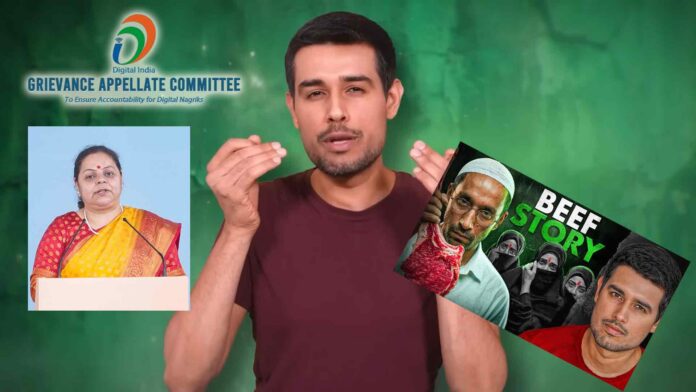
The Grievance Appellate Committee (GAC) under the Ministry of Electronics and Information Technology has directed YouTube to remove a video uploaded by YouTuber Dhruv Rathee, holding that the content has the tendency to hurt the religious sentiments of a community. YouTube has been asked to remove the video within 24 hours of receiving the order.
The 21-minute video, titled “Can Hindus Eat Beef? | Kerala Story 2 Exposed” was uploaded on Rathee’s official YouTube channel on March 21, 2026. It has garnered millions of views and over four lakh likes. Presented as a commentary on the controversial film The Kerala Story 2, the video examines food practices among Hindus, the sensitivity surrounding beef consumption, cultural diversity and social perceptions in India. Citing ancient texts, scriptures and modern surveys, Rathee claimed that figures from the Ramayana and Mahabharata, including Bhagwan Shriram, Bhagwan Shrikrishna and the Pandavas, consumed meat, including deer meat, and alcohol during their exile.
Advocate Amita Sachdeva had first approached the Cyber Crime Cell in New Delhi against the video on March 22, 2026, followed by a formal complaint to YouTube’s Resident Grievance Officer on March 23. In the complaint, Sachdeva argued that Dhruv Rathee used selective and distorted references from Ramayana and Mahabharata to claim that Srhi Ram, Shri Krishna and the Pandavas consumed meat, including deer meat, and alcohol during their exile. He also made statements mocking the notion of sattvic food for these deities and reference Sita Devi’s supposed vow.
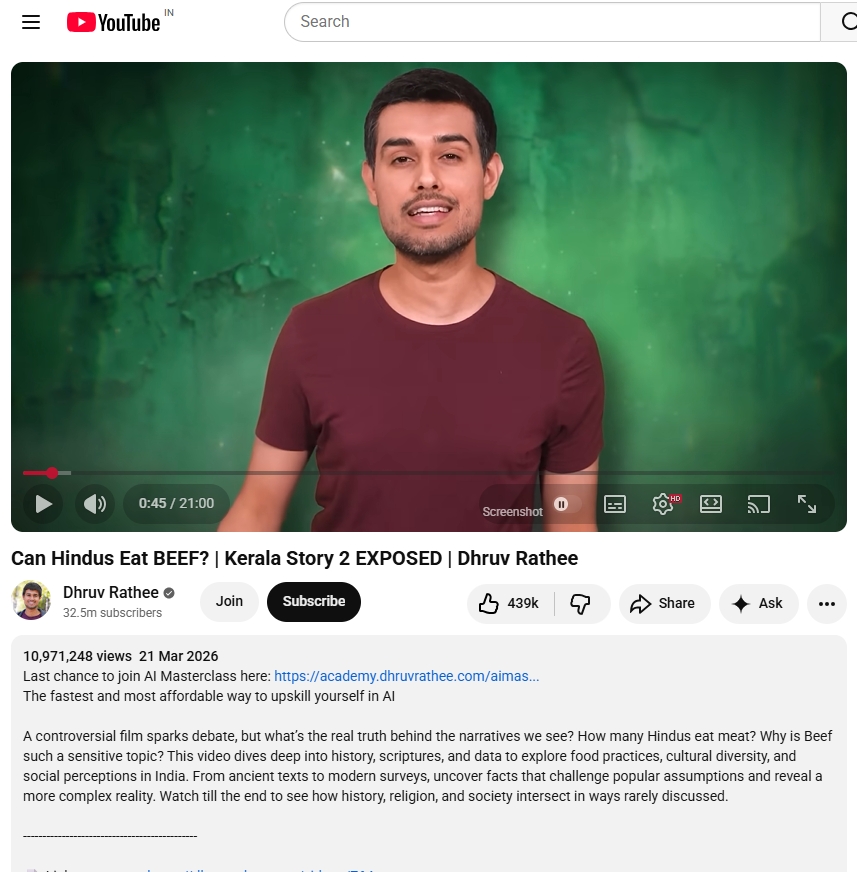
YouTube sought additional information the same day and, after review, rejected the request on March 25, stating that the content did not violate local laws or its community guidelines. The platform emphasised its commitment to free speech and the right to express unpopular views, while advising the complainant to block the user or obtain a court order if she believed the video breached Indian law.
Sachdeva then filed an appeal before the GAC on March 27, 2026. With the appeal pending for over two months, she approached the Delhi High Court through a writ petition. On July 3, 2026, the High Court directed the appellate authority to decide the matter expeditiously, preferably within 15 days of receiving a copy of the order, and to intimate the court.
In its order, the GAC noted that the intermediary had agreed the appeal fell within its purview. However, it rejected YouTube’s reliance on free speech arguments in cases involving religious sentiments. The Committee observed that an examination of the video revealed its potential to hurt the religious feelings of a community, which does not augur well for society at large.
It underlined that freedom of expression under Article 19(1)(a) of the Constitution is subject to reasonable restrictions under Article 19(2). The GAC further pointed out that Rule 3(1)(d) of the Information Technology (Intermediary Guidelines and Digital Media Ethics Code) Rules, 2021, requires intermediaries to exercise due diligence, and expressed surprise at the platform’s reluctance to do so without a court order.
🚨 BREAKING: Government of India Orders Immediate Takedown of Dhruv Rathee’s (@dhruv_rathee) Video.
— Amita Sachdeva, Advocate (@SachdevaAmita) July 19, 2026
The Grievance Appellate Committee (GAC), Ministry of Electronics & IT, Government of India, has passed an Order dated 15 July 2026 (Appeal No. 8321/2026) directing YouTube to… pic.twitter.com/hP4rpGmLVC
Concluding that the reported video may be taken down for hurting religious sentiments, the GAC directed YouTube to remove it within 24 hours of receiving the order and disposed of the appeal. Parallel criminal proceedings initiated by Sachdeva seeking registration of an FIR against Rathee remain pending before a magistrate’s court in Saket, with the next hearing scheduled for September 10, 2026. The GAC’s finding that the content hurts religious sentiments is expected to have a bearing on those proceedings as well.
Sachdeva, who shared the order on social media, described it as a step towards ensuring that faith cannot be mocked under the garb of content creation. She said, “Faith cannot be mocked under the garb of “content creation.” Justice is being delivered step by step.”
