

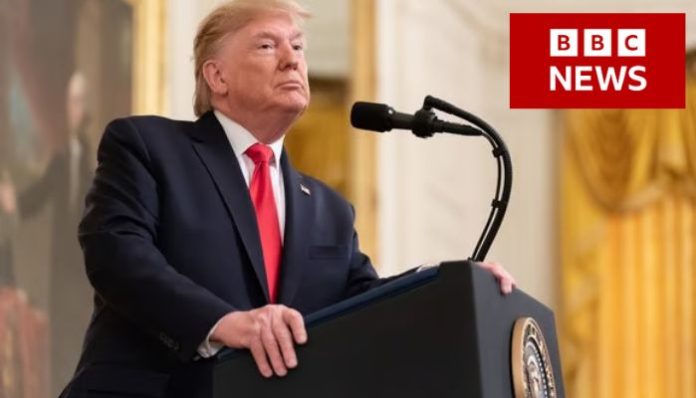
US President Donald Trump has said he will file a lawsuit of up to $5 billion against the BBC next week, after the broadcaster admitted it had incorrectly edited a video of his 6th January 2021 speech. Trump told reporters on Air Force One that the BBC had “cheated” by altering his words, and even publicly acknowledged it. He argued that the edit seriously hurt his reputation and finances, and that the BBC’s apology alone was not enough.
According to media reports, Trump’s legal team had earlier asked the BBC to withdraw the documentary, apologise, and pay damages by Friday (14th November). They warned that the broadcaster could face a lawsuit worth at least $1 billion if it didn’t comply.
BBC admits editing mistake but rejects defamation charge
The BBC has accepted that the video edit was wrong and called it an “error of judgment.” BBC Chair Samir Shah also sent a personal apology to Trump on Thursday (13th November), calling the mistake regrettable. The broadcaster confirmed that it will not air the documentary again.
However, it dismissed all allegations of defamation. The BBC said that although it regrets the edit, there was no intention to mislead viewers, and there is no legal basis for a defamation case.
Edited documentary sparked major political and public backlash
The controversy involves a BBC Panorama episode that stitched together three different parts of Trump’s January 6 speech. Trump’s lawyers say the edit wrongly made it look like he told his supporters to storm the US Capitol. They describe the edit as “false and defamatory,” arguing that it created a misleading narrative of Trump encouraging violence.
During an interview with GB News, Trump said the edit was “impossible to believe” and compared it to election interference. He said two different parts of his speech, nearly an hour apart—were joined together. One part made him look aggressive, and the other had been a calming statement, he said.
Crisis inside the BBC leads to High-level resignations
The BBC is now facing one of its worst editorial crises in years. The fallout from the documentary has already led to the resignation of two top executives, Director General Tim Davie and Head of News Deborah Turness. Accusations of bias, poor editorial checks, and politically motivated content have intensified pressure on the organisation.
UK Culture Minister Lisa Nandy said the apology issued by the BBC was “right and necessary.” Prime Minister Keir Starmer also commented on the incident, saying that while he supports the BBC’s independence, the corporation needs to fix its internal problems. He emphasised that trustworthy journalism is crucial at a time when misinformation spreads quickly.
The BBC has also begun reviewing other programmes, including Newsnight, for similar editing issues.
Since the BBC is funded mainly through the licence fee, there are growing questions about who would pay if Trump wins damages. Former media minister John Whittingdale warned that using taxpayer money in such a case would cause public outrage. The concern has triggered a wider debate about accountability in publicly funded media organisations.
Not the first BBC controversy
This is not the first time the BBC has faced criticism for its content. In early 2023, the broadcaster released a two-part documentary on Prime Minister Narendra Modi’s role during the 2002 Gujarat riots. India’s Ministry of External Affairs called it a “propaganda piece” pushing a “discredited narrative.” The documentary was widely criticised and taken down from some platforms after sparking public anger.
Background of the case
The controversy began when the BBC released an October 2024 Panorama documentary that included edited clips from Trump’s January 2021 speech. The broadcaster joined together separate portions of his remarks in a way that made it look like he urged his supporters to march to the Capitol and “fight like hell.”
Trump’s lawyers sent a legal notice to the BBC, demanding a full retraction, an apology, and financial compensation. They said that the edit gave a clearly false impression of Trump’s intentions on the day of the Capitol riot.
In its correction published in the “Corrections and Clarifications” section, the BBC admitted that the edit mistakenly created the impression of one continuous speech. The corporation clarified that this unintentionally made it look like Trump had directly called for violent action.
Although the BBC apologised for the way the clip was edited, it maintained that this did not amount to defamation. Along with its legal response, BBC Chair Samir Shah wrote a personal apology to the White House. The broadcaster also confirmed that the documentary would not be aired again.
Despite the apology, Trump has said he intends to move forward with a lawsuit seeking between $2 billion and $5 billion in damages.
