

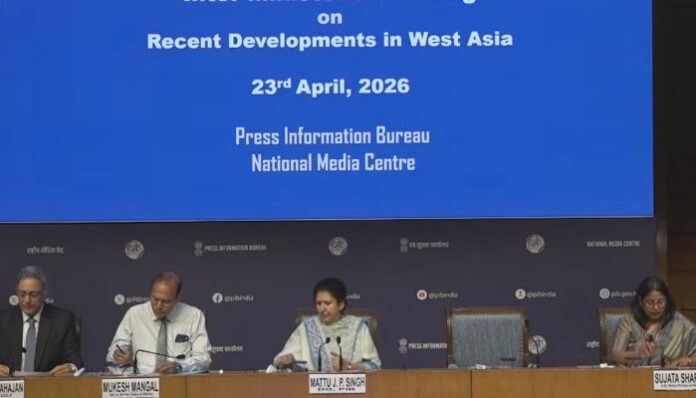
Senior officials from multiple ministries on Thursday, 23rd April, held a detailed inter-ministerial briefing in New Delhi to update the public on the government’s response to the ongoing crisis in West Asia. Representatives from the Ministry of Petroleum and Natural Gas, the Ministry of External Affairs (MEA), and the Ministry of Ports, Shipping and Waterways spoke about the steps being taken to protect India’s energy security, ensure the safety of Indian citizens abroad, and keep supply chains running smoothly despite rising tensions.
Officials made it clear that the government is closely watching the situation and has already activated backup plans to make sure there is no major impact on India. The focus of the meeting was on coordination across departments so that everything, from fuel supply to evacuation, runs without disruption.
Fuel and LPG supply remains stable
One of the biggest concerns during any Middle East conflict is fuel supply, and the government addressed this directly. Sujata Sharma, Joint Secretary in the Petroleum Ministry, said there is no shortage of LPG, petrol, or diesel in the country.
“Despite volatility in international crude and LPG prices, the Government has not increased consumer prices and has worked to keep them stable,” she said. She added that excise duty cuts have helped ensure that the burden is not passed on to common people.
Highlighting the contrast, Sharma noted, “Saudi CP for LPG has risen nearly 102% since July 2023, while domestic cylinder prices have declined by 17%, and by around 32% for PMUY beneficiaries.”
#Watch | Despite volatility in international crude and LPG prices, the Government has not increased consumer prices and has worked to keep them stable. Excise duty reductions were aimed at ensuring the burden is not passed on to consumers. Saudi CP for LPG has risen nearly 102%… pic.twitter.com/UgCQLfEoyY
— DD News (@DDNewslive) April 23, 2026
She also said the government has strengthened domestic LPG production, secured enough cargo supplies, and made advance arrangements to avoid any disruption.
Evacuation and movement of Indian nationals
The government has also been actively working to ensure the safety of Indians in the region. Aseem R Mahajan, Additional Secretary (Gulf) in the MEA, said that embassies and consulates are working round the clock.
“Our embassies and consulates in the region are operating round-the-clock helplines and proactively assisting Indian nationals. Updated advisories are being issued regularly,” he said.
Mahajan shared that around 12,000 passengers have already travelled from the region to India since 28th February, and flight operations are gradually improving. He also highlighted efforts in Iran, saying, “Our Embassy in Tehran has facilitated the movement of 2,428 Indian nationals out of Iran through Armenia and Azerbaijan for onward travel to India.”
#Watch | Our embassies and consulates in the region are operating round-the-clock helplines and proactively assisting Indian nationals. Updated advisories are being issued regularly, while missions remain engaged with the Indian community and local authorities. The welfare of… pic.twitter.com/LfZMlUCT8v
— DD News (@DDNewslive) April 23, 2026
He added that the government remains in constant touch with the Indian community and local authorities, and that the welfare of Indian citizens continues to be the top priority.
Seafarers’ safety and shipping operations
Shipping and maritime safety were also discussed in detail. Mukesh Mangal, Joint Secretary in the Ministry of Ports, Shipping and Waterways, said that all Indian seafarers in the region are safe.
“The control room has handled a total of 7,403 calls and over 15,600 emails so far, including 161 calls and 320 emails in the last 24 hours,” he said, showing how actively the system is responding to concerns.
#Watch | All Indian seafarers in the region are safe. The control room has handled a total of 7,403 calls and over 15,600 emails so far, including 161 calls and 320 emails in the last 24 hours. Through the Directorate General of Shipping, the Ministry has facilitated the safe… pic.twitter.com/LkScsGHZF8
— DD News (@DDNewslive) April 23, 2026
He added that more than 2,680 Indian seafarers have been safely brought back home, including 65 in just the last 24 hours. “Operations at all ports across India remain safe and normal, with no congestion reported,” he confirmed.
Giving more details, Mangal said, “One Indian seafarer aboard the foreign-flagged vessel EPAMINONDAS is safe, and we are in touch with the concerned authorities. On the vessel Euphoria, 21 Indian seafarers are onboard, and all are safe.”
#Watch | One Indian seafarer aboard the foreign-flagged vessel EPAMINONDAS is safe and we are in touch with the concerned authorities. On the vessel Euphoria, 21 Indian seafarers are onboard and all are safe. There are no Indian seafarers on the third vessel referred to. Since… pic.twitter.com/0JZGbPROS2
— DD News (@DDNewslive) April 23, 2026
He also noted that since the Iran conflict began, 10 Indian-flagged vessels, including nine LPG carriers and one crude oil vessel, have reached safely.
