

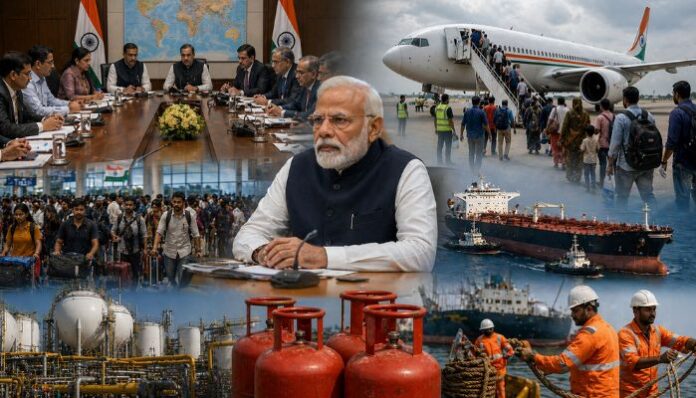
In the face of the intensifying conflict in West Asia, the Modi government has adopted a high-intensity, “war-footing” approach to ensure that the ripples of the crisis do not disturb the lives of ordinary Indians. One of the most visible signs of this seriousness is the frequency of high-level inter-ministerial meetings. Senior officials and ministers are gathering on a daily basis to review the situation in real-time.
These aren’t just routine discussions; they are strategic sessions designed to reassure the public that the nation is safe and that essential supplies, ranging from food to fuel, remain untouched by the chaos in the Middle East. By maintaining this constant rhythm of oversight, the government is sending a clear message: every potential risk is being monitored, and every contingency is already in place.
The Inter-Ministerial response
The complexity of the West Asia crisis requires more than just diplomatic statements; it requires a synchronised effort across the entire machinery of the state. The union government is conducting daily inter-ministerial press briefings to inform about the government’s response to the crisis and also to answer questions on the issue. The briefings in New Delhi are being conducted by representatives from the Ministry of External Affairs, the Ministry of Petroleum and Natural Gas, Ministry of Ports and Shipping, and other ministries.
These briefings serve a dual purpose: they streamline the government’s internal response and provide the public with transparent, factual updates to prevent panic and misinformation.
The latest of these crucial briefings took place on Wednesday, 22nd April. This particular meeting served as an important checkpoint as the region approached a critical juncture in the geopolitical timeline. The central theme of the session was unwavering: the safety, security, and welfare of Indian nationals living and working in West Asia remain the highest priority for the Prime Minister.
With the security situation evolving rapidly, the government utilised this meeting to fine-tune evacuation routes and support systems. It was emphasised that no Indian would be left behind, and the state’s resources are fully committed to protecting the millions of expatriates who form the backbone of India’s diaspora in the Gulf.
The massive evacuation effort: 11 Lakh passengers returned
Perhaps the most staggering achievement of the government’s intervention is the successful movement of over 11 lakh passengers back to India. As the two-week ceasefire window in West Asia draws to a close, the government has scaled up flight operations to a massive degree.
Aseem Mahajan, Joint Secretary (Gulf) in the MEA, confirmed that approximately 11,30,000 passengers have travelled from the region to India since late February. This wasn’t a simple task; it required navigating closed airspaces and shifting routes daily. For instance, while some airspaces remained restricted, the government coordinated with airlines to run over 110 flights from the UAE in a single day.
Similar efforts have kept channels open from Saudi Arabia, Oman, and Qatar, ensuring that families are reunited despite the regional tension.
Navigating blockades and ensuring safe passage
The government’s strategy has been remarkably flexible, finding ways through even the most difficult diplomatic and geographical terrains. In Iran, where airspace has been partially restricted to cargo, the Indian Embassy in Tehran has been working tirelessly to move citizens, including over a thousand students and hundreds of fishermen, through Armenia and Azerbaijan.
In Israel, where the situation is particularly volatile, India has facilitated travel through Jordan and Egypt. Even in countries like Kuwait, where the local airspace was closed, the government successfully coordinated with airlines to fly passengers out of nearby Dammam in Saudi Arabia. This level of granular, ground-level coordination shows that the Modi government is looking at every individual’s safety as a personal mission.
Diplomacy in action: NSA Doval and the MEA’s outreach
Beyond the logistics of evacuation, the government is engaging in high-stakes diplomacy to protect India’s long-term interests. MEA Spokesperson Randhir Jaiswal recently highlighted the strategic travels of India’s top leadership.
National Security Advisor Ajit Doval’s recent visit to Saudi Arabia focused on regional stability and the strengthening of bilateral ties during this period of “geopolitical realignment.” This follows visits by the External Affairs Minister to the UAE and the Petroleum Minister to Qatar.
#WATCH | We continue to closely follow developments in the West Asia region. We have also continued our outreach to countries in the Gulf region, in line with the directions of our Prime Minister @narendramodi.
— DD News (@DDNewslive) April 21, 2026
As you would have seen, two days ago, our National Security Adviser… pic.twitter.com/RCW3ou3N9g
By maintaining active contact with all stakeholders, including Israel, Palestine, and Iran, the Modi government is ensuring that India’s voice is heard and its strategic and economic interests are shielded from the fallout of the conflict.
Fueling the Nation: Ensuring LPG and petrol stability
For the average Indian household, the most pressing concern during a Middle East conflict is the price and availability of fuel and cooking gas. The government has addressed this head-on. During the recent briefing, Sujata Sharma from the Ministry of Petroleum and Natural Gas confirmed that the supply of oil and gas remains completely uninterrupted.
#WATCH | Despite volatility in global crude and LPG prices, the Government of India has ensured uninterrupted domestic supply. Household LPG availability remains normal, with no shortages reported and strong booking and delivery rates.Commercial LPG supply has been restored to… pic.twitter.com/3AQsxaWPTF
— DD News (@DDNewslive) April 21, 2026
On a single day recently, over 45 lakh LPG bookings were registered, and a massive 51 lakh cylinders were delivered to doorsteps across the country. This indicates that the domestic supply chain is not just surviving but thriving. Despite the wild swings in global crude prices, the government’s proactive management has prevented any shortages of petrol, diesel, or PNG at the local level.
Protecting the vulnerable and the workers
The government has also gone the extra mile to look after those who might be most affected by supply disruptions. Awareness camps and an expanded distribution of 5 kg cylinders have been rolled out specifically to support migrant populations who might not have permanent gas connections.
Furthermore, the welfare of Indian seafarers, the individuals working on the merchant ships in the Gulf, has been given high priority. Indian missions are in constant touch with local authorities to ensure these workers are safe and have the consular support they need to return home if they wish. The successful repatriation of 12 stranded seafarers from Iraq recently stands as a testament to the fact that no group is too small for the government’s attention.
Stabilising the seas: The ₹12,980 crore insurance shield
One of the quietest but most effective moves by the Modi government has been the stabilisation of shipping operations. When the Strait of Hormuz, an important passage for global trade, faced threats, the government didn’t just wait for things to settle.
The govt approved a massive ₹12,980 crore Maritime Insurance Pool on 18th April. This move was important because it lowered the skyrocketing insurance rates that shipping companies were facing due to the conflict, ensuring that goods continued to flow into Indian ports without a massive spike in freight costs.
#WATCH | Following initial disruptions due to the West Asia conflict, shipping operations have stabilized, with port congestion significantly reduced .Currently, port operations across India are functioning normally, with reduced yard occupancy and no reported congestion. All… pic.twitter.com/gBhNDkvFVS
— DD News (@DDNewslive) April 21, 2026
Today, port operations across India are functioning normally, congestion has been cleared, and the flow of trade remains steady, proving that the government’s economic planning is as robust as its rescue operations.
A 24/7 safety net for every Indian
At the heart of all these efforts is a dedicated, round-the-clock infrastructure. The MEA has set up a special control room that never sleeps, coordinating with missions and posts to answer every query and provide timely advisories.
Whether it is through the 120-plus flights running daily from the Gulf or the stabilisation of LPG prices at home, the Modi government’s response to the West Asia conflict has been defined by action rather than just words.


