

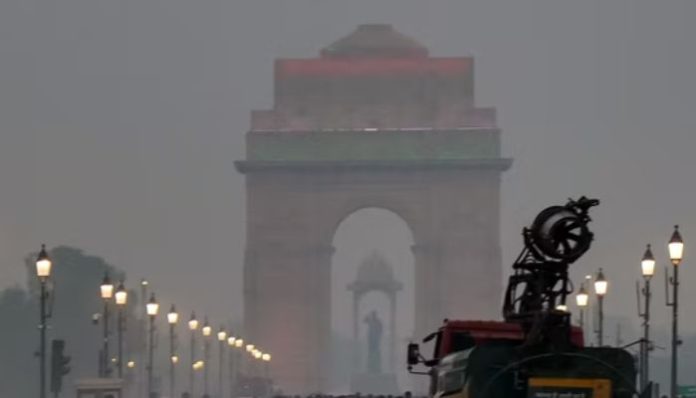
The air quality over Delhi and the nearby areas fell to the ‘Severe’ category for the first time this season, which brought into operation Stage 3 of the Graded Response Action Plan (GRAP). The decision came after the city’s average Air Quality Index (AQI) shot up to 425, indicating a sharp rise in pollution levels overnight.
According to the pollution control board, several areas in Delhi recorded extremely poor air quality. While Anand Vihar registered 412 AQI, Alipur touched 442, and Bawana recorded the maximum pollution level at 462. In central parts of the city, Chandni Chowk reported 416, while RK Puram and Patparganj logged 446 and 438, respectively.
STORY | Centre invokes GRAP Stage 3 curbs in Delhi-NCR
— Press Trust of India (@PTI_News) November 11, 2025
The Centre on Tuesday invoked stricter anti-pollution measures under Stage III of the Graded Response Action Plan (GRAP) in Delhi-NCR after the city’s air quality slipped into the ‘severe’ category.
READ:… pic.twitter.com/Uef3bRIFDi
Despite this sudden spike, government data shows Delhi’s overall air quality this year has been slightly better compared to last year. In a statement on Tuesday morning (11th November), the CAQM said, “The AQI of Delhi, which was recorded as 362 on 10th November, exhibited a sharp increasing trend and has been recorded 425 at 9 am on 11th November owing to calm winds, stable atmosphere and unfavourable meteorological conditions.”
“Keeping in view the prevailing trend of air quality, and in an effort to prevent further deterioration of air quality in the region, the Sub-Committee today has taken the call to invoke all actions as envisaged under Stage-III of extant GRAP – ‘Severe’ Air Quality (Delhi AQI ranging between 401-450), with immediate effect, in the entire NCR.”
What is GRAP?
GRAP is a system to control air pollution in Delhi-NCR, based on the severity of the situation. It classifies the pollution into four different levels: Poor or Stage 1, Very Poor or Stage 2, Severe or Stage 3, and Severe Plus or Stage 4. In case the air quality reached the ‘Severe’ category, as it has now, stricter restrictions are enforced under GRAP III.
Restrictions under GRAP III
When air quality reaches the ‘Severe’ category (AQI 401–450), the following restrictions enforced under GRAP III:
- Complete ban on all non-essential construction and demolition work, including earthwork, piling, trenching, and open-air operations of Ready-Mix Concrete (RMC) plants.
- BS-3 petrol and BS-4 diesel four-wheelers will not be allowed to operate in Delhi and NCR districts.
- Ban on the transport of construction materials like sand and cement, especially on unpaved roads.
- Closure of those stone crushers, mining operations, and hot mix plants which do not operate on clean fuel.
- Prohibition of diesel generator sets except for emergency and essential services.
- Restriction on interstate diesel buses entering or operating in Delhi.
- Advisory for private companies to implement work-from-home or hybrid work models to reduce vehicular emissions.
- Closure of schools up to Class 5, with classes shifted to online or hybrid mode to protect young children from the toxic air.
However, some essential projects such as railway, metro, airport, defence, sanitation, and healthcare-related work are exempt from the ban. These can continue under strict dust and waste management guidelines.
