

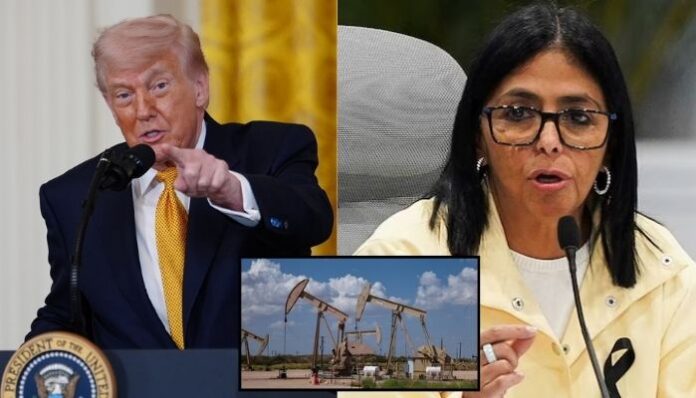
On Friday, 28th August, US President Donald Trump announced what he described as “The biggest oil deal in oil world history” involving Venezuela’s huge oil reserves. The agreement is expected to give the United States a major role in developing and purchasing Venezuelan crude. At the same time, Venezuela’s government says the deal could bring large investments into its struggling oil industry.
🚨 "BREAKING NEWS: The United States of America has just entered into an Agreement with the Country of Venezuela on, THE BIGGEST OIL DEAL IN WORLD HISTORY!" – President Donald J. Trump 🇺🇸 pic.twitter.com/AsQqX3Y0sy
— The White House (@WhiteHouse) August 28, 2026
The announcement has raised several questions because the full text of the agreement has not been made public. It is also unclear how quickly Venezuela can increase oil production, how much money will be needed to repair its ageing infrastructure and who will ultimately pay for those investments.
"THE BIGGEST OIL DEAL IN WORLD HISTORY!"
— Fox News (@FoxNews) August 28, 2026
President Trump announces the U.S. has entered into a sweeping oil agreement with Venezuela that he says gives America majority control of more than 65 billion barrels of proven Venezuelan oil reserves at no cost to taxpayers.
Trump says… pic.twitter.com/AwnBQLr9Wd
The deal comes after the dramatic US intervention in Venezuela earlier this year on 3rd January, when American forces captured then-President Nicolás Maduro and took him to New York to face federal drug trafficking charges. Venezuela is currently being led by acting President Delcy Rodríguez.
What is the US-Venezuela oil deal?
Under the agreement, the US government and an unnamed private operator in Venezuela have created a new company that has been given rights to develop previously untapped oil fields for 100 years.
According to a statement from Rodríguez, the agreement covers 17 oil fields with a proven potential of around 65 billion barrels. The Venezuelan government says the project could attract about $100 billion in investment into the country’s oil sector and generate more than $209 billion in taxes for Caracas.
Venezuela oil deal: $19 per barrel — $209 billion total
— Sputnik (@SputnikInt) August 30, 2026
Delcy Rodríguez just broke down the math behind the landmark US-Venezuela agreement.
Core insight: the country gets $19 for every barrel produced and sold — potentially $209 billion over 25 years.
🔸 17 strategic fields… pic.twitter.com/KmxL6nr7ye
Trump said the agreement was negotiated by US Secretary of State Marco Rubio, Defence Secretary Pete Hegseth and Rodríguez.
A US official, speaking anonymously because they were not authorised to discuss the arrangement publicly, said the deal would give the US an effective 55% share of the new company’s output. This includes an ownership stake as well as rights to purchase Venezuelan oil at cost.
Some of the oil bought by the US would reportedly be directed towards the American strategic petroleum reserves and the military.
If the figures provided by US officials and the Venezuelan government are realised, the new company could become one of the world’s biggest holders of proven oil reserves, second only to Saudi Aramco among corporations.
Why is the Venezuela deal important to the US?
Venezuela has some of the world’s largest oil reserves, but its oil industry has suffered from years of underinvestment, economic problems and deteriorating infrastructure.
Trump has presented the US-Venezuela oil deal as a way to bring more Venezuelan oil into production and eventually help reduce energy prices in the United States. The timing is significant because oil prices remain elevated amid disruptions to global supplies, including the impact of the Iran War on Persian Gulf oil shipments.
However, according to several media reports, the deal is unlikely to bring immediate relief to American motorists.
Venezuela’s oil infrastructure is in poor condition and would require billions of dollars of investment before production can rise significantly. Amy Myers Jaffe, director of the Energy, Climate Justice and Sustainability Lab at New York University, said the deal could be “helpful in the long run” but would not immediately affect petrol prices.
The average US petrol price was around $4.08 a gallon on Saturday, compared with $3.20 during the same period last year, according to AAA.
Energy analyst Kevin Book also warned that rebuilding Venezuela’s oil industry would take years. “It’s going to take time, many years, to deploy that much capital and produce the kind of incremental results that history suggests possible,” he said.
How will the deal benefit Venezuela?
For Venezuela’s acting government, the agreement is being presented as a way to revive the country’s economy and turn its enormous oil reserves into money for ordinary citizens.
Rodríguez said the country’s oil reserves would “cease to be an inert, cold statistic and will instead become concrete solutions. Housing is one of them.” She said the government wanted the project to create jobs and improve people’s access to basic services.
“What we are doing is for the development of the country, but above all, to serve the Venezuelan people, to provide them with more jobs, better wages, and access to public services such as water, electricity, hospitals, schools and adequate food,” Rodríguez said.
The government hopes investment in the oil sector can help rebuild infrastructure and provide revenue for housing and public services.
Why is the deal controversial in Venezuela?
Not everyone in Venezuela has welcomed the agreement. For decades, Venezuelan governments have maintained that the country’s natural resources should remain under Venezuelan control and should be used primarily for its own people. Some Venezuelans therefore see the new arrangement as a surrender of national resources to the United States.
Douglas Borjas, speaking at a market in eastern Caracas, criticised the agreement and suggested that it was aimed at helping Venezuela’s current leadership remain in power. “I think they’re doing it to cling to power,” he said. “It’s like, ‘I’m giving you a vast amount of petroleum as long as you leave me alone here in power.’”
Borjas added that Venezuela’s resources should benefit ordinary Venezuelans rather than political elites.
The deal has also been criticised by Harvard University professor and former Venezuelan planning minister Ricardo Hausmann, who called it a “shameful deal”. He questioned whether Rodríguez had the legitimacy or constitutional authority to make such a long-term commitment on behalf of Venezuela.
