

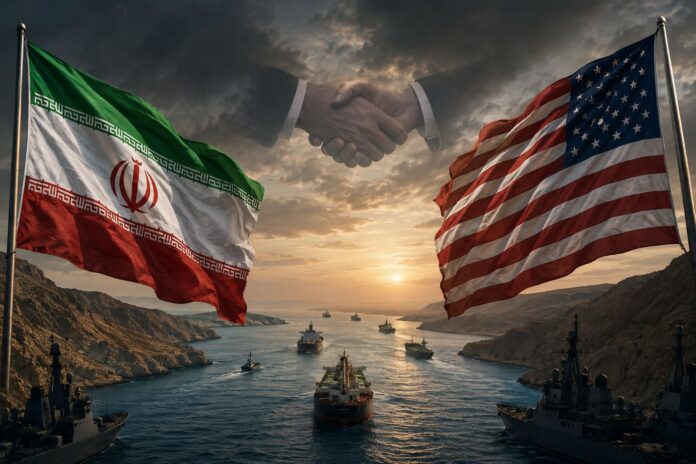
The White House on Wednesday strongly dismissed Iranian media reports suggesting that Washington and Tehran were close to striking a breakthrough agreement that could reopen the strategically vital Strait of Hormuz, calling the claims a “complete fabrication” and warning against relying on information released by Iranian state-controlled outlets.
The sharp denial came after Iranian state television reported that Tehran had received a draft framework from the United States outlining a potential path towards restoring commercial shipping through the Strait of Hormuz within a month. The report, which cited a proposed Memorandum of Understanding (MoU), claimed the arrangement involved the lifting of what Iran described as a US naval blockade and a possible withdrawal of American forces from the Gulf region.
However, the White House moved swiftly to reject the claims.
“This report from Iranian-controlled media is not true, and the MOU they ‘released’ is a complete fabrication. Nobody should believe what the Iranian state media is putting out. FACTS MATTER,” the White House posted on X, also criticising sections of the US media for amplifying the Iranian narrative.
This report from Iranian controlled media is not true and the MOU they “released” is a complete fabrication. Nobody should believe what Iranian state media is putting out. FACTS MATTER. https://t.co/agpTnBSgKu
— Rapid Response 47 (@RapidResponse47) May 27, 2026
The conflicting claims have further highlighted the deep mistrust that continues to define relations between Washington and Tehran, even as indirect negotiations remain underway.
According to the Iranian television report, the proposed framework envisioned a phased reopening of the Strait of Hormuz — one of the world’s most critical maritime chokepoints through which a significant portion of global oil trade passes. The draft reportedly stated that Iran would allow shipping traffic to gradually return to pre-conflict levels while retaining authority over shipping lanes, vessel inspections and service fees.
The report also suggested that Iran’s commitments would not extend to military vessels and that the strait would not be reopened without conditions attached.
Additionally, Iranian media claimed that the United States had agreed to pull forces from the region, although it remained unclear whether that referred only to troops deployed during recent hostilities or also covered long-standing US military installations in the Gulf.
The proposed text reportedly outlined a 60-day negotiation window during which both sides would attempt to finalise unresolved issues, with the possibility of a binding United Nations Security Council resolution if a broader agreement was reached.
Yet despite the ambitious scope described in the reported draft, Iranian state television itself acknowledged that the document had not been finalised.
The diplomatic confusion comes amid continuing military tensions. Even as backchannel discussions continue, the United States recently carried out strikes in southern Iran, targeting missile sites and boats allegedly involved in laying naval mines. Washington described the operation as an act of self-defence.
US President Donald Trump also intensified pressure on Tehran, saying Iran should surrender its enriched uranium stockpile to the United States for destruction or allow it to be dismantled inside Iran under international supervision.
Tehran, meanwhile, has attempted to strike a more measured tone publicly. Iranian officials said a full-scale war with the United States appears unlikely despite recent confrontations. The statement followed Iranian accusations that Washington had violated an earlier ceasefire understanding and warnings that Tehran remained prepared to respond if provoked.
For now, the White House rejection has cast serious doubt on reports of an imminent breakthrough. While communication channels between the two countries remain open, major disagreements appear unresolved, leaving both regional stability and global energy markets watching developments with caution.
