

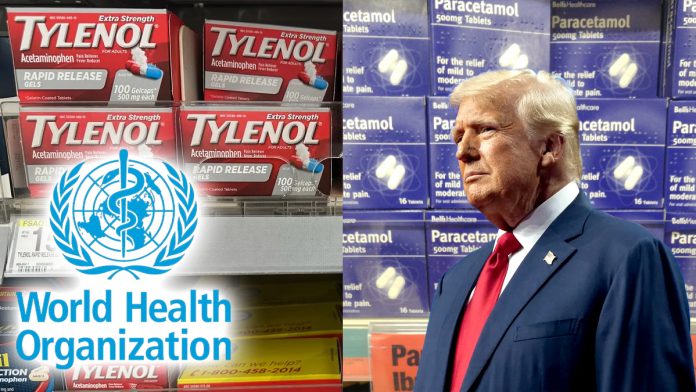
The World Health Organization (WHO) has issued a strong rebuttal to U.S. President Donald Trump’s assertions linking the use of Tylenol (acetaminophen) during pregnancy to increased autism rates. The statement, released earlier today, comes amid a growing controversy sparked by Trump’s remarks on September 23, 2025.
President Trump, during a White House press conference, declared Tylenol, sold under Paracetamol brand outside USA, “not good” for pregnant women, urging them to avoid the common painkiller unless faced with extreme fever. He controversially suggested that communities like the Amish and Cubans, with limited access to acetaminophen, exhibit no autism, a claim unsupported by scientific evidence. Trump also hinted at plans to direct the U.S. Food and Drug Administration (FDA) to update Tylenol labels and launch a public health campaign, citing a disputed Harvard meta-analysis that suggested a 20-30% higher risk of autism and ADHD with prenatal exposure.
In a detailed statement posted on X, WHO countered these claims, asserting that “there is currently no conclusive scientific evidence confirming a possible link between autism and use of acetaminophen (also known as paracetamol) during pregnancy.”
WHO statement on autism-related issues
— World Health Organization (WHO) (@WHO) September 24, 2025
The World Health Organization (WHO) emphasizes that there is currently no conclusive scientific evidence confirming a possible link between autism and use of acetaminophen (also known as paracetamol) during pregnancy.
Globally, nearly 62… pic.twitter.com/EoRH8Eotxl
The global health body highlighted that extensive research, including large-scale studies conducted over the past decade, has failed to establish a consistent association between the drug and autism, despite some correlational findings. WHO emphasized that acetaminophen remains a safe option when used under medical supervision, particularly for managing fever, which can pose significant risks to both mother and foetus if untreated.
WHO stated that the exact causes of autism spectrum disorder, a diverse group of conditions related to development of the brain, have not been established yet, and it is understood there are multiple factors that can be involved.
The organization urged pregnant women to follow their healthcare providers’ advice and cautioned against altering medication use based on unproven claims.
The WHO statement also addressed related concerns raised by Trump, reaffirming that childhood vaccines, including those containing thiomersal or aluminium, do not cause autism. It said, “a robust, extensive evidence base exists showing childhood vaccines do not cause autism. Large, high-quality studies from many countries have all reached the same conclusion. Original studies suggesting a link were flawed and have been discredited. Since 1999, independent experts advising WHO have repeatedly confirmed that vaccines – including those with thiomersal or aluminum – do not cause autism or other developmental disorders.”
WHO reiterated its commitment to supporting autism research and care, with the issue set to be discussed at the upcoming 4th UN High-Level Meeting on Non-Communicable Diseases and Mental Health on Thursday.
