

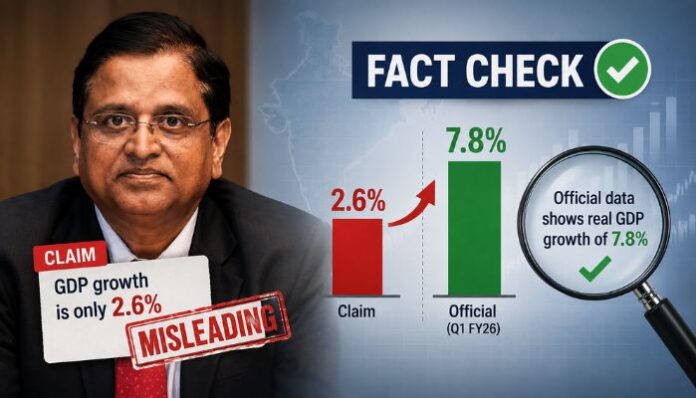
A claim by former Finance Secretary Subhash Chandra Garg that India’s GDP growth was only around 2.6% instead of the officially reported 7.8% went viral on social media. Several users have shared his calculation to claim that the government has manipulated GDP figures to make the economy look stronger than it actually is.
The Congress also picked up the claim to attack the government. In a post on X, the party alleged that the Modi government had “fudged GDP figures” and claimed that, without the alleged manipulation, real GDP growth would have been only 2.6%. But this comparison is misleading because the 2.6% figure being circulated is not an alternative calculation of India’s real GDP growth. It comes from comparing figures from two different GDP series.
𝟕.𝟖% 𝐆𝐃𝐏 𝐆𝐫𝐨𝐰𝐭𝐡 𝐢𝐧 𝐅𝐮𝐝𝐠𝐞𝐝 𝐃𝐚𝐭𝐚, 𝟐.𝟔% 𝐢𝐧 𝐑𝐞𝐚𝐥𝐢𝐭𝐲
— Congress (@INCIndia) September 2, 2026
Former Finance Secretary in the Modi Govt, Subhash Chandra Garg, has exposed how the Modi government has fudged GDP figures.
As per Garg, the government deliberately revised last year's GDP… pic.twitter.com/PB7fCtbwJk
What did Subhash Chandra Garg claim?
Garg questioned the recent revision of India’s GDP numbers and argued that the revision of the previous year’s figures had made the latest growth rate appear much higher. In comments cited by the Congress and media reports, he pointed to the increase in nominal GDP and suggested that, without the revision, growth at current prices could have been around 2.6%.
“The 7.8 per cent figure looks impressive on the face of it, but we should examine the reality behind it,” he said in his interview with NDTV.
However, the claim later gained much traction on social media, as Garg had claimed that India’s real GDP growth was 2.6%. His calculation does not actually support that figure.
The calculation used by Garg compares nominal GDP of ₹88.27 lakh crore in Q1, calculated under the new 2022–23 base-year series, with ₹86.05 lakh crore for Q1 FY26 compiled under the old 2011–12 series. That produces a growth rate of roughly 2.6%.
Why the 2.6% calculation is misleading
According to data cited by several media reports, comparing the two numbers is statistically invalid because one comes from the new GDP series and the other from the old series. Calling 2.6% the ‘real’ growth rate by mixing two incompatible GDP series is not scrutiny; it is simply incorrect arithmetic.
The new GDP series uses 2022-23 as the base year and has updated coverage, sectoral weights, estimation methods, price treatment and data sources. Once a new series is introduced, the historical data is also revised using the new methodology so that comparisons can be made on a like-for-like basis.
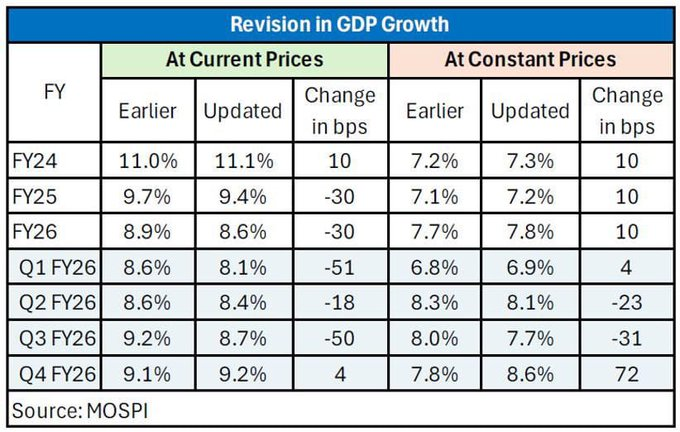
Under the new series, nominal GDP in Q1 FY2026-27 stood at ₹88.27 lakh crore, compared with ₹80 lakh crore in Q1 FY2025-26. That represents nominal growth of 10.3%.
More importantly, real GDP, which removes the effect of price changes, increased from ₹75.46 lakh crore to ₹81.36 lakh crore. This gives the official real GDP growth rate of 7.8% for the April-June quarter. These are the figures released by the Ministry of Statistics and Programme Implementation (MoSPI).
4/ Using same series: Q1 FY26 = ₹80.00 lakh cr, Q1 FY27 = ₹88.27. Nominal +10.3%, real +7.8%.
— Dr. Vidhu Shekhar (@profvidhu) September 2, 2026
It's the first line of the press note. He didn't have to dig! Just reading would have sufficed.
Congress, its leaders and social media posts amplify the claim
The Congress used Garg’s remarks to accuse the government of manipulating economic data. Several social media users also repeated the claim, suggesting that there was “no real growth” in the Indian economy and that the 7.8% figure was created through statistical manipulation.
"Real GDP growth is 2.6%, not 7.8%. The government is good at revising the base-year data so that it can project GDP growth as high as 7.8%."
— 🚨Indian Gems (@IndianGems_) September 2, 2026
— Subash Chandra, Ex Finance Secretary pic.twitter.com/IbiXJ5IOuS
Congress leader Supriya Shrinate also launched a similar attack. Sharing a post on X, she wrote, “India’s former Finance Secretary, Subhash Garg, has raised serious concerns on the GDP growth data. Hard facts about how last year’s current price GDP of ₹86 trillion was revised down to ₹80 trillion to arrive at a 7.8%, which would’ve otherwise been 2.6% “He understands India’s finances and what the economic data throws up better than most people”.
India’s former Finance Secretary – Subhash Garg has raised serious concerns on the GDP growth data.
— Supriya Shrinate (@SupriyaShrinate) September 2, 2026
Hard facts about how last year’s current price GDP of ₹86 trillion was revised down to ₹80 trillion to arrive at a 7.8%, which would’ve otherwise been 2.6%
“He understands… pic.twitter.com/6gJNdUcTQL
Congress leader Pawan Khera also shared a post accusing the government of manipulating the data. Sharing a post on his X account, Khera wrote, “Subhash Garg has punctured the government’s tall claims of 7.8% GDP growth, arguing that India’s real GDP growth is closer to 2.6%. His contention is even more damning: the previous year’s GDP growth was revised downward, making this year’s growth rate look stronger by comparison. His assessment seems far closer to the lived reality of ordinary Indians — rising prices, falling purchasing power, shrinking disposable incomes and savings, stagnant job opportunities, and rising household debt. These claims cannot simply be dismissed.”
Subhash Garg has punctured the government’s tall claims of 7.8% GDP growth, arguing that India’s real GDP growth is closer to 2.6%.
— Pawan Khera 🇮🇳 ಪವನ್ ಖೇರಾ (@Pawankhera) September 2, 2026
His contention is even more damning: the previous year’s GDP growth was revised downward, making this year’s growth rate look stronger by… https://t.co/ejGe8Ea7hR
But the viral posts often leave out an important detail: the 2.6% figure is based on mixing the old and new GDP series. It cannot be directly compared with the official 7.8% real growth rate.
This is shocking 🤯
— Amock_ (@Amockx2022) September 1, 2026
Former Finance Secretary Subhash Garg has said that the real GDP is around 2.6% and nowhere close to 7.8% as reports suggest
Journalist tried a lot to downplay him but he didn't take a step back pic.twitter.com/XpqXCV3uLp
What about the GDP revision?
GDP numbers are periodically revised when better data becomes available and when the statistical system is updated. The recent exercise involved moving to a new base year of 2022-23, along with changes in data sources and estimation methods.
MoSPI’s latest release shows that real GVA grew 8.2% in Q1 FY2026-27, while nominal GVA increased 11.5%. The services sector was a major contributor, growing 10% in real terms, while manufacturing grew 9.2%.
This does not mean every GDP number is beyond criticism. Quarterly estimates can be revised as more information becomes available, and a high GDP growth rate by itself does not tell us how income, employment or growth are distributed across society.
What about inflation and the GDP deflator?
The 10.3% nominal GDP growth and 7.8% real GDP growth imply an overall GDP deflator increase of roughly 2.3%. However, this should not be confused with CPI or WPI inflation.
The GDP deflator covers the wider economy, including consumption, investment, government services, exports and domestically produced output. The new GDP series also uses more detailed price indices and a double-deflation method for manufacturing, where output and intermediate inputs are adjusted separately.
Therefore, the viral claim that India’s “real GDP growth is only 2.6%” is misleading. Garg did raise questions about GDP revisions, but the 2.6% figure being circulated is not a valid alternative real-growth calculation. The official MoSPI estimate, based on the new and consistently applied GDP series, puts India’s real GDP growth in Q1 FY2026-27 at 7.8%.


