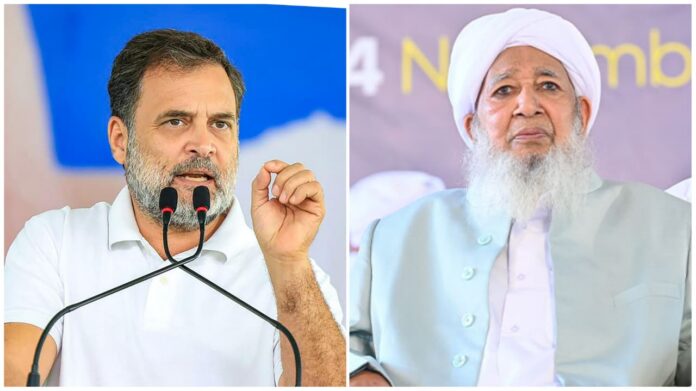
Rahul Gandhi has discovered a new political vocabulary: “Break the cage” and “smash the patriarchy.”
The Congress leader recently told a gathering of young women in Pune that women do not belong to their fathers, husbands or sons, but belong to themselves. He attacked what he called the “Manusmriti mindset” and argued that women must be free to build identities independent of men.
It is a superficially legitimate argument. Women should have agency. They should be free to study, work, participate in public life and determine their own futures.
But there is an obvious question that Rahul Gandhi and the Congress party would rather not answer:
Does this principle apply only when patriarchy can be associated with Hinduism?
Because Kerala has now presented Rahul Gandhi with precisely the sort of test that political slogans are supposed to withstand.
Kanthapuram AP Aboobacker Musliyar, one of Kerala’s most influential Sunni clerics and the tenth Grand Mufti of India, has defended the appalling proposition that women should remain confined to their homes and should not enter the public sphere. He explicitly attributed this position to the Quran and defended the purdah system as a means of preventing what he described as “great destruction.”
He even compared women to gold ornaments that need to be kept safely inside a box.
This was not some anonymous social-media account making an inflammatory post. This was a prominent religious scholar publicly defending a restrictive interpretation of women’s place in society.
And it came days after the Kanthapuram faction of Samastha directed Islamic institutions to ensure that Muslim women and girls do not participate in programmes on stages or in public spaces alongside men.
So where is Rahul Gandhi?
Where is the “smash the patriarchy” campaign?
Where is the lecture about women belonging to themselves?
Where is the demand that women should not be treated as possessions whose movements need to be controlled by men?
The silence is striking precisely because Gandhi has made women’s autonomy and opposition to patriarchal social structures a central part of his recent political messaging.
When discussing Manusmriti, Gandhi was categorical. He described its alleged prescription of women’s subordination as shameful and said the fight was against the mindset that seeks to control women and confine them.
But when a Muslim cleric makes an extraordinarily similar argument about restricting women’s public participation, and explicitly invokes Islam and the Quran, the Congress ecosystem suddenly becomes considerably more cautious.
That is where the charge of selective feminism becomes difficult to dismiss.
Congress’ glaring duplicity exposed
There is an important distinction that needs to be made.
Criticising a regressive interpretation of a religious text is not an attack on every person who follows that religion. Nor does opposing a cleric’s prescription for women require insulting Muslims or denying their right to practise their faith.
In fact, genuine reform requires precisely the opposite: treating Muslims as citizens capable of engaging critically with interpretations of their own religious traditions.
If Rahul Gandhi is justified in criticising Manusmriti over purportedly discriminatory provisions against women, then he should also raise his voice against provisions or verses in the Islamic text that the Grand Mufti of India is citing to defend confinement of women within the four walls of their homes.
In essence, the same intellectual standard that applies to Manusmriti should apply to the Quran when an Islamic cleric cites it to justify keeping women confined to their homes.
Otherwise, “smash patriarchy” begins to look less like a universal principle and more like a political weapon selectively deployed against one religious tradition.
And this is where Congress has a credibility problem.
The party frequently speaks the language of constitutional rights, women’s empowerment, secularism and social reform. Yet when the subject enters the politically sensitive terrain of Muslim personal law or conservative religious authority, its instinct has historically been far more cautious.
The Shah Bano episode remains the most obvious example. After the Supreme Court’s 1985 judgment in favour of maintenance for Shah Bano, the Rajiv Gandhi government enacted legislation in 1986 following intense opposition from sections of Muslim leadership. The episode remains one of the most consequential examples of the Congress party struggling to reconcile its commitment to reform with the demands of organised religious constituencies.
This is precisely why Congress cannot simply dismiss questions about its approach to reform within Muslim society as an attempt to “target Muslims”.
Reform is not targeting a community. Refusing to reform because a community’s religious leadership may be offended is.
Why is Manusmriti fair game, but religious conservatism within Islam treated with kid gloves?
The question Rahul Gandhi needs to answer is remarkably simple.
If a text or its interpretation is being used to tell women that they cannot be independent, should he oppose it?
If the answer is yes, then the principle cannot depend on the religious identity of the person citing the text.
If a cleric says women should stay inside their homes because “the Holy Quran says so”, a politician who has just made “smashing patriarchy” a political rallying cry should have something to say about it.
He could simply say:
No religious interpretation should be used to deny women their constitutional rights, freedom of movement, education, employment or participation in public life.
That would be entirely consistent with the argument he made in Pune.
But that is precisely the uncomfortable part.
It would require Congress to confront conservative Muslim clerics rather than merely invoking women’s rights when criticising Hindu texts.
The Congress’ secularism problem
There is a larger political pattern here.
For decades, Congress has presented itself as the party of secularism. Yet its version of secular politics has often involved treating religious communities differently depending upon the political consequences of confronting their conservative leadership. Minorities, especially Muslims, have often been treated with kid gloves, with Congress leadership often turning a blind eye to Islamic radicalism or contextualising crimes when committed in the name of Islam.
That is not secularism. It is political risk management.
A genuinely secular party should be willing to tell every community the same thing: your faith is your private right, but the Constitution is the common framework within which everyone lives.
If a Hindu priest says women should not work, challenge him.
If a Muslim cleric says women should not appear in public, challenge him.
If a Christian cleric makes a similarly regressive claim, challenge him.
The standard should be the same.
Otherwise, the woman whose freedom is supposedly being defended becomes secondary to the identity of the person restricting her.
And that is the ultimate irony.
Rahul Gandhi has told Indian women that they are not the property of their fathers, husbands or sons. He has urged them to reject a mindset that seeks to confine them and control their choices.
But, he cannot summon the same courage to call out the Grand Mufti of India who has relegated Muslim women to second-class citizens of the country.
A Muslim woman deserves precisely the same freedom.
Not a watered-down version of it.
Not freedom subject to the approval of a religious committee.
Not freedom that disappears whenever a cleric invokes scripture.
If Rahul Gandhi genuinely believes that women belong to themselves, he should have no difficulty saying so when the woman in question is Muslim and the person restricting her freedom is invoking Islam.
That is simply applying the same feminist principle to everyone.
And if Congress is unwilling to do that, people are entitled to ask whether its commitment to “smash patriarchy” is really about women, or whether, once again, electoral arithmetic decides which patriarchy is acceptable to criticise.