

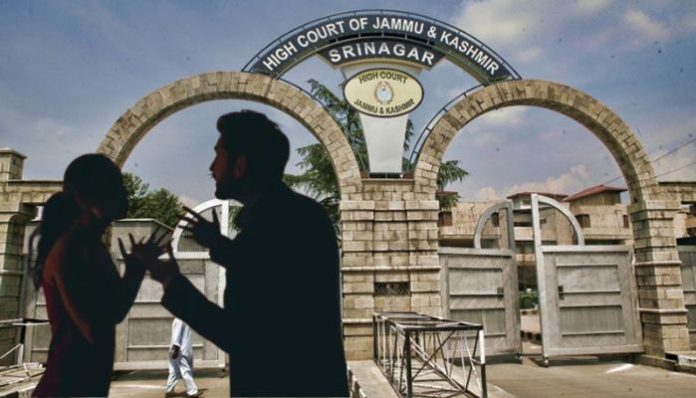
A controversial case has come before the High Court of Jammu and Kashmir and Ladakh, where a woman who had her partner convicted for rape on the promise of marriage later sought interim maintenance from him. The Court has now questioned whether such a claim can stand, pointing out that it would be very difficult to grant her relief in this situation.
Relationship on pretext of marriage leads to rape case
The case began when a woman had accused her partner of raping her on the pretext of marriage, by claiming to be unmarried when they began a relationship. After that, they started a relationship that lasted for almost ten years. During this period, they even lived together as husband and wife and had a child in 2016.
However, when the man refused to formally marry her, the woman filed a case under Section 376 of the Indian Penal Code (IPC), claiming he had sexually exploited her under the pretext of marriage. The court later found him guilty of rape and sentenced him accordingly.
J&K High court questions claim for maintenance
After the conviction, the woman sought maintenance from the man for herself and her child. A trial court initially granted her interim maintenance of ₹2,000 per month for herself and ₹1,000 for the child. But this order was later challenged by the man before a sessions court, which struck it down.
The woman then approached the High Court, arguing that even though they were never legally married, she had lived with the man as his wife for a decade and was therefore entitled to claim maintenance as a deserted partner. She also cited earlier cases where women in live-in relationships were granted protection under Section 125 of the Code of Criminal Procedure (CrPC).
But Justice Vinod Chatterji Koul of the High Court took a different view. He said that if the couple truly lived together as husband and wife for years, then such a relationship could not at the same time form the basis of a rape charge. “The offence of rape would arise when such a relationship is missing,” the court observed.
The Court further explained that since the man had already been convicted for rape under Section 376 IPC on the complaint of the woman herself, it would be difficult to hold that he is also responsible for paying her maintenance.
Cohabitation and rape charge cannot go hand in hand
The High Court made an important observation: relationships that resemble marriage, where both partners live together and cohabit as husband and wife, usually do not fall under the category of rape. It said that calling such a relationship “rape” on one hand and then expecting rights like maintenance on the other creates a legal contradiction.
Therefore, the Court upheld the sessions court’s decision to cancel the trial court’s interim maintenance order. At the same time, it noted that the final verdict on the woman’s application for maintenance is still pending before the trial court. But until then, she would not be entitled to any interim relief.
“Having regard to the facts and circumstances of the case at this stage, while the petition is yet to be decided, she would not be entitled to grant of any interim maintenance under Section 488/125 of the Code of Criminal Procedure,” the High Court said. It added that the trial court had “fallen in error” by granting her interim maintenance in the first place.
With this order, the High Court has drawn a clear line, a woman who accuses her partner of rape under the promise of marriage and gets him convicted cannot simultaneously seek maintenance from him, as the two claims legally contradict each other.
