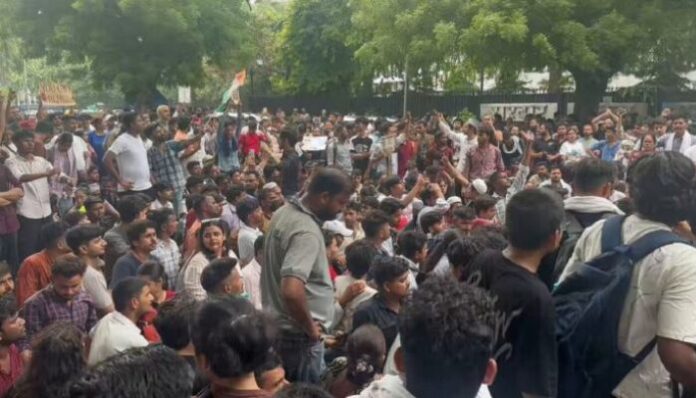
On the 20th of July 2026, Delhi witnessed a near-redux of the 2020 Delhi riots during the Cockroach Janta Party protests. The façade of ‘peaceful’ protests fell apart, and political players desperate to watch the country burn stepped in with their “Nepal bana denge” agenda. Stones were pelted at police officials during the Parliament March, vehicles were vandalised, and police were painted as heartless brutes thrashing ‘students’ at the behest of the Central government.
Latest visuals from Firoz Shah road of CJP mob pelting stones at police personnel. Lying piece of shit. https://t.co/PoioeZqngB pic.twitter.com/3jCcLJgOpt
— Nupur J Sharma (@UnSubtleDesi) July 20, 2026
Anti-Modi leftist elements dominated the weeks-long CJP gimmick, and yet it was framed as an organic ‘student protest’: Inorganic protest, ‘organic’ label
For weeks, the mainstream media, the leftist propaganda factory, and the Cockroach Janta Party itself have painted the protests to seek resignation of Education Minister Dharmendra Pradhan over NEET UG paper leak as an organic ‘student protest’. The framing, however, was in sharp contrast to the reality of Sonam Wangchuk’s weeks-long hunger strike.
Sonam Wangchuk, the Phunsukh Wangdu who never was, became the face of the CJP protest, lending credence to the claims that an ‘education reformer’ is leading the ‘student protest’ and the CJP is fighting for the ‘future’ of India.
However, it has been seen that the CJP protest at Jantar Mantar became a “Jamghat” of anti-BJP/Modi elements from all walks of life.
Since the beginning of the CJP protest, numerous journalists have been nearly assaulted by the protesting cockroaches. In some incidents, police had to intervene and rescue the journalists. A common pattern? “Godi Media” slogans, fury over critical questions, gherao, and near-assault.
Islamo-leftists like Kunal Kamra have delivered derogatory remarks against Maa Sita from CJP’s protest stage; CJP member Vijeta Dahiya has made Hinduphobic remarks; Delhi University professor Nandita Narayan sang “Bas naam rahega Allah ka” and glorified Pakistani poet Faiz Ahmed Faiz’s Islamic supremacist poem “Hum Dekhenge”; anti-national slogans of “Azadi-Azadi” and “Brahmanwad se azadi” have been raised.
"Brahmanism isn't against Brahmins…" Yet the slogan they chant is "Brahmanism Murdabaad."
— OpIndia.com (@OpIndia_com) July 21, 2026
When @RitikaChandola questioned an SFI activist on reservation and caste politics, she responded not with answers, but by shouting "Godi Media." pic.twitter.com/WdkEd4TD7O
In fact, the protesting cockroaches even raised “Modi Murdabad”, “Arvind Kejriwal ki Jai”, and even “Umar Khalid ki Jai” slogans during the protest on 21st July.
CJO mob –
— Nupur J Sharma (@UnSubtleDesi) July 21, 2026
1. Modi Muradabad
2. Arvind Kejriwal ki Jai
And
Surprise surprise
3. Umar Khalid ki Jai pic.twitter.com/O3yMojRaVn
Though offensive, the “Modi Murdabad” slogan can still be excused; “Arvind Kejriwal ki Jai” slogans give away the fact that the CJP protest has little to do with student issues, exam irregularities, or seeking accountability from the government, but about preparing political ground and garnering lost popularity for the Aam Aadmi Party. What further confirms the fact that the CJP protest is not about students is the support of people who back and glorify 2020 anti-Hindu Delhi Riots accused mastermind Umar Khalid.
Cockroaches raising ‘Umar Khalid ki Jai’ slogans are not surprising given CJP’s chief spokesperson, Saurav Das, himself is a big fan of Umar Khalid. In fact, Delhi Riots accused Yogendra Yadav and lawyer Prashant Bhushan have also backed the CJP protest.
Protestor-for-hire, Yogendra Yadav was seen expressing joy over CJP cockroaches successfully “occupying” Jantar Mantar and the streets leading to the Parliament.
Unsurprisingly, Dipke is also a supporter of 2020 anti-Hindu Delhi Riots accused Umar Khalid and has lamented his prolonged incarceration without trial, suggesting that somehow Khalid has been deliberately made to rot in jail.
The supposed organic ‘student protest’ has been joined by left-wing student activism groups like SFI, AISA, bsCEM, and other such entities, who were also active during the November 2025 pro-Naxal protests.
In June this year, the members of the Students’ Federation of India (SFI) were seen actively participating in the gathering. Carrying daflis and dhols, the activists raised slogans such as “Azadi, Azadi,” “Haq Hamari Azadi,” and “Jaan Se Pyari Azadi”, drawing attention from those present at the protest site.
The CJP ‘student protest’ has also received support from rabid Modi haters like Prakash Raj, Swara Bhasker, Shabana Azmi, Arundhati Roy, and Nivedita Menon, who desperately yearn for a ‘revolution’ against the Modi government and actively partake in any such attempts, be it the 2020 anti-CAA protests or the ongoing CJP protests.
The Cockroach Janta Party was created in May 2026, as an online satirical response to CJI Surya Kant’s courtroom remarks about jobless youth, lawyers, journalists and RTI activists. The CJP amassed millions of followers on Instagram within days, winning initial support from a neutral and apolitical populace as well. However, the CJP founder Abhijeet Dipke, a former Aam Aadmi Party worker, began pushing his anti-BJP and anti-Modi government agenda.
The CJP launched its website and carefully embellished the platform with Gen-Z-appealing and ‘cool’ membership criteria like being “unemployed”, “lazy”, “chronically online” and able to “rant professionally”.
To stay relevant and capitalise on the massive following the CJP built on social media, Dipke, still in the US, picked the NEET UG paper leak issue, as what could be better than exploiting a burning issue that directly concerns Gen-Z.
In no time, the online activism pivoted to ground protest with CJP founder Abhijeet Dipke arriving in New Delhi. The CJP launched its ground ‘peaceful’ protest on 6th June, with its core demand being the resignation of Education Minister Dharmendra Pradhan.
Youth-centric issues, particularly those concerning students, are always sensitive. The CJP chose to rely on ‘students’ as their marketing strategy for the protest because, just like ‘women and children’ during Shaheen Bagh, any state action against political hooligans can be painted as an ‘assault on students’, and by extension, an attack on democracy, the Constitution, and whatnot.
It was seen how it was the protesting cockroaches who first attacked the police personnel on duty and even hurled stones during the ‘Chalo Sansad’ protest march on 20th July, and yet when police retaliated with tear gas and batons to bring the situation under control, the left liberal cabal painted it as an ‘attack on students’.
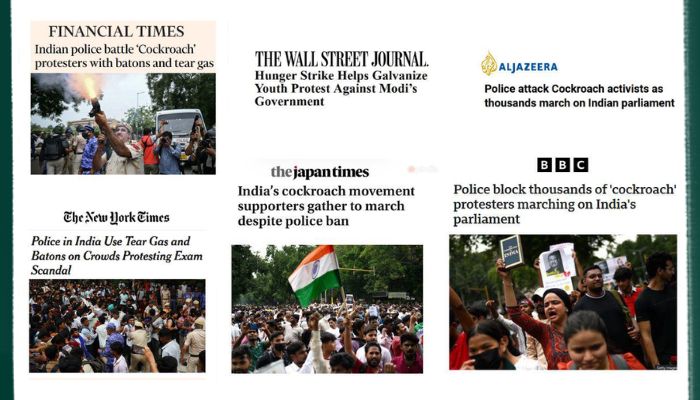
Just as it was seen during the 2019-2020 anti-CAA protests, the international media selectively painted the protesting pro-CJP hooligans as outright victims, and the police as ‘oppressors’ silencing dissent with violence.
Cockroach Janta Party has managed to “stir things up” by making the NEET paper leak issue a melting pot for all genuine and even politically agenda-driven grievances and complaints people have against the government.
The additional aspect that helps paint these politically and ideologically driven protests as organic student-led ire is the Gen Z propaganda, aided by what happened in Bangladesh and Nepal. The violent ‘student’ protest in Bangladesh had also begun with a genuine quota issue but was dominated by political outfits Bangladesh Nationalist Party and Jamaat-e-Islami. By August 2024, protestor violence and anger reached their peak, resulting in Prime Minister Sheikh Hasina’s unceremonious ouster. What followed Hasina’s departure was an Islamist pogrom against the country’s Hindu minorities.
Despite the communal-political nature of the protests, the international media painted it as a “student protest” or even a “revolution” against an oppressive regime. Now the same BNP that was at the forefront of the protests rules Bangladesh.
Similar scenes were witnessed in Nepal last year, when the “Gen-Z” took to the streets against the KP Sharma Oli-led government, over accusations of rampant corruption. Nepali streets witnessed violent protests and police crackdowns; Nepali parliament was burnt, public property vandalised, and the country burnt for days. Eventually, elections were held and the same people, Balen Shah, Sudan Gurung, and others, who spearheaded the ‘Gen-Z revolution’, won elections and rule Nepal.
The violent regime changes in Bangladesh and Nepal rekindled hopes of a despondent political opposition in India. For months, the Congress party has been manoeuvring to sow distrust against the Election Commission of India and the integrity of the electoral process. When this could not deter public trust, the opposition began exploiting caste fissures. However, seeing none of the ‘EVM hacked, VVPAT tampered, Vote Chori’ bogey work, the opposition pinned hopes on violent protests.
In mid-April, when violence and arson broke out during protests by industrial workers in Noida over wages, the Congress party expressed glee over the country finally beginning to “stir”. The party must be the happiest at this point, even though it is the AAP ecosystem that remains unofficially central to the CJP, as this time things have stirred beyond their expectations.
Although, unlike the anti-CAA protests wherein Congress leader Sonia Gandhi directly gave the “aa rya paar ki ladaai” calls to incite violence, Congress has maintained support for the ongoing CJP protests. Even though the possibility of a Nepal-Bangladesh kind of violent regime change in India remains scarce, having the near-invincible Modi government in a tough spot is always a delight and opens doors of opportunity for the opposition.
Despite the apolitical packaging, the CJP protest has essentially been political in nature. Sonam Wangchuk, who is an education reformer by the day and a climate activist by the night, joined the CJP protest not only to seek Dharmendra Pradhan’s resignation. Wangchuk’s core demand has been the Sixth Schedule for Ladakh. The son of a former Congress MLA sat on a hunger strike last year as well for the same demand. Sixth Schedule for Ladakh remains a heated political issue in Ladakh, and even violence had erupted over this in September 2025.
In addition to left student groups and Islamo-leftist ‘prominent citizens’, the CJP protest has also garnered support from anti-BJP political parties.
The Cockroach Janta Party received its first political endorsement from the Aam Aadmi Party. In fact, CJP appears to be a B-team of AAP only. Not to forget, Abhijeet Dipke was AAP’s social media coordinator and a disciple of Manish Sisodia.
During the 2020 Delhi Assembly elections, one media report described him as a 23-year-old from Pune who was behind AAP’s social media transformation. In August 2019, the Legal Rights Observatory filed a complaint against then AAP Pune leader Abhijeet Dipke for “spreading lies of Indian atrocity in Kashmir and provoking ‘hurriyat-like separatism’ among Kashmiris”. It was alleged that Dipke was peddling seditious propaganda after the Modi government scrapped Article 370.
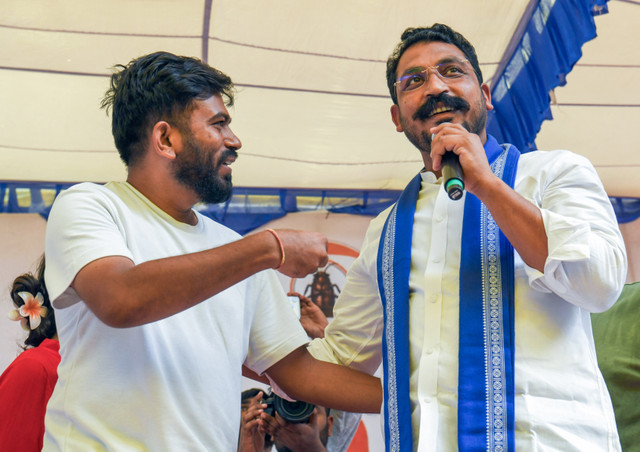
Among the first non-AAP politicians to support the CJP protest were Trinamool Congress MP Mahua Moitra and Congress MP Shashi Tharoor, and Azad Samaj Party MP Chandrashekhar Azad. However, as the protest gained momentum and the parliament session neared, Aam Aadmi Party and Samajwadi Party leaders flocked to Jantar Mantar.
Arvind Kejriwal, Manish Sisodia, Sanjay Singh, and other key AAP leaders expressed solidarity with Abhijeet Dipke and his cockroach comrades recently.
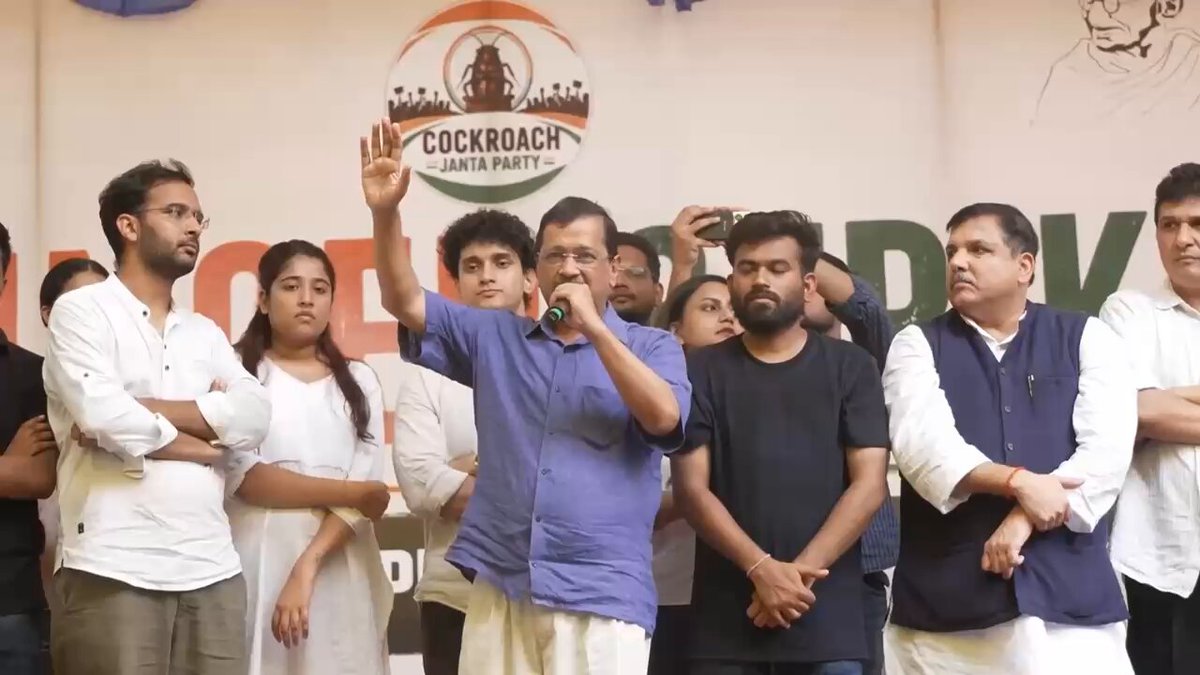
Interestingly, the so-called ‘student protest’ on 20th July was also joined by MACOCA-accused AAP-linked gangster Haji Afzal.
This is Haji Afzal, the first gangster from North East Delhi. A history-sheeter from Seelampur and a former MCOCA accused, Haji Afzal arrived with a large group of young men. What had he come there to do with so many people? pic.twitter.com/C0wmblhT67
— Megh Updates 🚨™ (@MeghUpdates) July 21, 2026
What is even more amusing and concerning at the same time is that AAP has imported its leaders from Gujarat and other states to pretend to be genuine protesters in Delhi. One such AAP leader masquerading as a protester by faking his identity as a businessman is Brijraj Solanki.
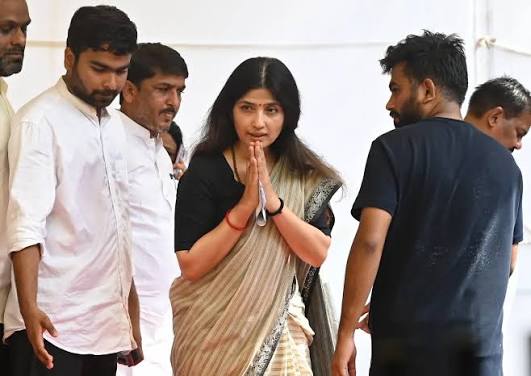
Most prominent of the Samajwadi Party leaders to visit the CJP protest site are Dimple Yadav, the Kannauj MP and wife of SP supremo Akhilesh Yadav. She not only met Sonam Wangchuk but was also seen comforting distressed protestors.
In fact, Samajwadi Party workers and supporters of Chandrashekhar Azad were present in large numbers during the protests on 20th July.
Found another Samajwadi Party goon on the road in Delhi protest.
— Office Of Vijay Patel (@VijayGajeraO) July 20, 2026
Is he Gen Z? https://t.co/XAcVVRsuSk pic.twitter.com/FLiIjNPrxZ
OpIndia ground reports revealed how slogans of ‘Jai Bhim’ echoed at a supposed ‘student protest’.
Our ground reporters observed that the protestors appeared well-organised, as if protestors were trained about to what extent they have to provoke, agitate, and how they have to respond to media questions, etc.
OpIndia ground reporter Anurag Mishra revealed that most of the protestors who joined CJP’s parliament march were from Uttar Pradesh.
During the protest, our ground reporters observed that the violence was led by Chandrashekhar Azad. A day before (19th July), Azad had even said that he could organise as many people as needed for the “Chalo Sansad” protest.
Found another Samajwadi Party goon on the road in Delhi protest.
— Office Of Vijay Patel (@VijayGajeraO) July 20, 2026
Is he Gen Z? https://t.co/XAcVVRsuSk pic.twitter.com/FLiIjNPrxZ
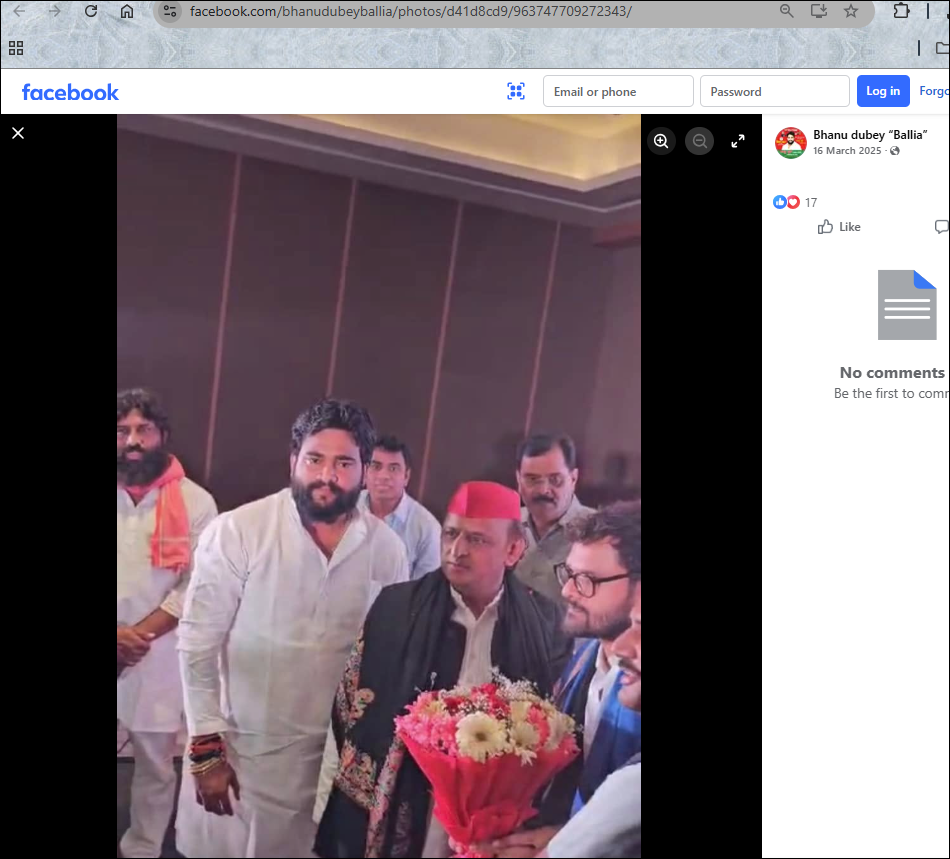
Some of the Samajwadi Party workers like Bhanu Dubey who participated in the ‘student protest’ have been identified.
During the protests, a person openly threatened to “destroy the Parliament” and issued “Nepal bana denge” threats.
These are not Cockroaches,
— Sunanda Roy 👑 (@SaffronSunanda) July 20, 2026
These are viruses. They need vaccine.
Throw these viruses out.
Fraud Cockroach Janta Party pic.twitter.com/782cgTul5L
The man seen in the video has been accused of being associated with the Samajwadi Party.
So-called NEET student from today's violent CJP protest.@DelhiPolice must arrest such miscreants asap. https://t.co/dLdNQp2COh pic.twitter.com/1fk4iimkyT
— Sunanda Roy 👑 (@SaffronSunanda) July 20, 2026
The SP leaders are desperately looking for opportunities to exploit ahead of assembly elections in Uttar Pradesh, and appearing pro-youth by backing CJP protests can significantly help the party sway youngsters in UP.
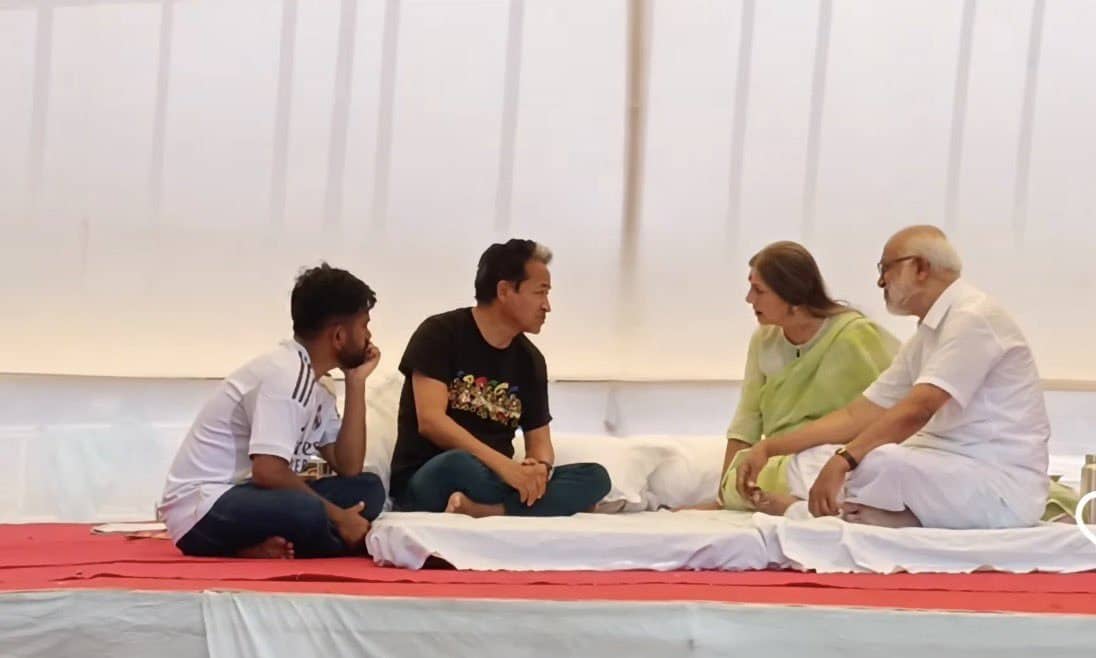
In addition, Communist Party of India (Marxist) [CPIM] leaders M.A. Baby, senior leader Brinda Karat, and Politburo members Vijoo Krishnan, Arun Kumar, and Mariam Dhawale joined the CJP at Jantar Mantar in Delhi on 20th July. The key CPIM leaders had earlier visited CJP’s protest stage and met Abhijeet Dipke and Sonam Wangchuk just a day after meeting Chinese officials at their embassy in Delhi.
Besides politicians, the coaching mafia also played a significant role in inciting violent protests. There are videos of Abhinay Sharma, popularly known as “Abhinay Maths”, giving a speech a few days before the 20th July protest. He was at the Rahul Gandhi rally as well, inciting people and raising Azadi slogans. Abhinay is known for his one-sided criticism of the BJP government under the garb of raising student issues.
Similarly, educators from online coaching giant Physicswallah, “Pankaj Sir”, “Vipin Sir”, and “MR Sir”, among others, attended the CJP protest before the 20th July march and delivered provocative speeches.
Clearly, from politicians, political party workers, caste activists, Hinduphobic leftist student groups, to coaching teachers, etc, had a wider presence at the CJP protest than actual NEET aspirants, the real sufferers of the paper leak, and students angered by exam irregularities.
Foreign media that itched for Nepal-Bangladesh-like violent regime change in India is now painting violent CJP protestors as victimised heroes
For many months since regime change events in Bangladesh and Nepal, there have been several op-eds calling for such regime change in India. From Indian leftist propaganda portals to the UK-based BBC, the left-liberals across the world itched to witness a replication of the Nepal-Bangladesh template of violent Gen-Z-led regime change in India.
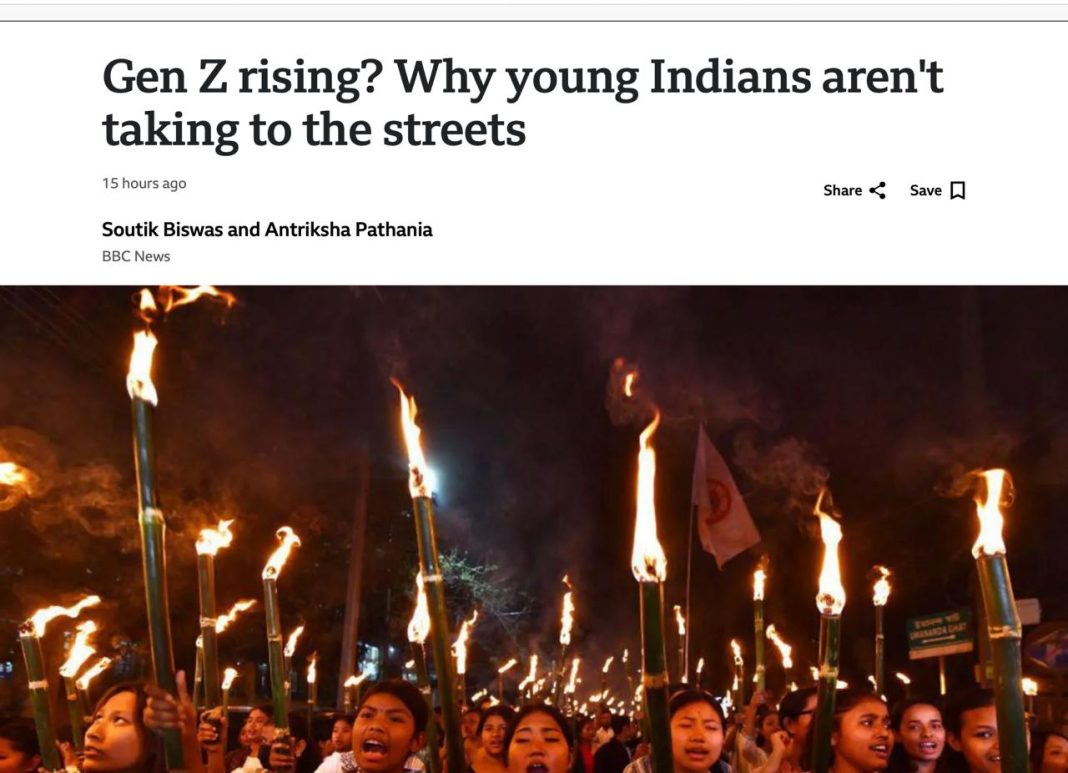
In apparent hopes that the Cockroaches could pull off a Bangladesh-like regime change against the Modi government, the international media is pushing a one-sided victim-oppressor narrative, framing all protesting cockroaches as innocent students and the Delhi Police as ‘oppressors’ brutalising students.
CJP protest was a political plan that followed the anti-CAA protests playbook
The NEET paper leak, its impact on students and overall integrity of exams in India is real and concerning. However, the CJP protest, despite its portrayal as an apolitical, youth-centric marketing, is essentially a political plan and followed the usual playbook. Start by seeding discontent and pick up a genuine issue to mobilise sentiments and then use it for violence and political gains.
It is unmissable that when the CJP protest reached its pinnacle on 20th July, its key faces were missing from the ground for a long time. Sonam Wangchuk was already shifted to hospital as per court orders, Abhijeet Dipke was holed up in a truck and, now-ousted from CJP, Vijeta Dahiya was devouring a burger away from the police lathi charge, Saurav Das and Ashutosh Ranka were playing talks-talks with Health Minister JP Nadda, and while Sonam Wangchuk was in the hospital, pretending to end his fast and then claiming he won’t.
However, there should be no doubt that the Central government is not sacrosanct either. In fact, the Centre could have prevented the entire fiasco by taking the right decisions at the right time.
The NEET UG paper leak is real; lakhs of students suffered due to it, and at least 20 students allegedly committed suicide. In fact, many genuine students and parents of some of the students who allegedly committed suicide after the NEET 2026 paper leak also participated in the ongoing protest. They are not tied to any political ideological agenda but with the hope that the government will not shut the doors of communication in their face and deliver justice and some accountability.
The students, the genuine NEET aspirants, deserved accountability from the government and the National Testing Agency. It is not that the police did not arrest the persons behind the paper leak or the authorities did not acknowledge a leak. Arrests were made, a probe was handed over to the CBI, the paper was cancelled, and new dates were announced. Later, re-NEET was held without leaks and results have also been declared.
However, there were communication gaps and apparent insensitivity.
While NTA director Abhishek Singh had audaciously claimed that the guess paper had “a few questions which were matching with the questions which were asked and not the whole paper was leaked, Education Minister Dharmendra Pradhan did not even care to take media questions about the NEET UG exam paper leak.
The first and foremost step by the Central government should have been ensuring that the Education Minister publicly acknowledged the “ghor paap” of the NEET paper leak that Prime Minister Narendra Modi acknowledged on 21st July. Paper leaks have been a constant issue, and not confined to NEET alone; it was high time for Dharmendra Pradhan to acknowledge the systemic failures and resign. Now a political-ideological ‘movement’ has hijacked a genuine students’ issue and is exploiting it for its own gains while the government is finding it hard to sail its ship through this preventable storm.
Now, if the Central government accepts CJP demands of Dharmendra Pradhan’s resignation, Rs 1 crore compensation to students who died by suicide allegedly due to NEET paper leak, and ‘return’ Sonam Wangchuk, they would be handing a victory to the opposition. If not, the protests will go on, intensify, and likely snowball into a full-fledged redux of the 2020 Delhi Riots.