

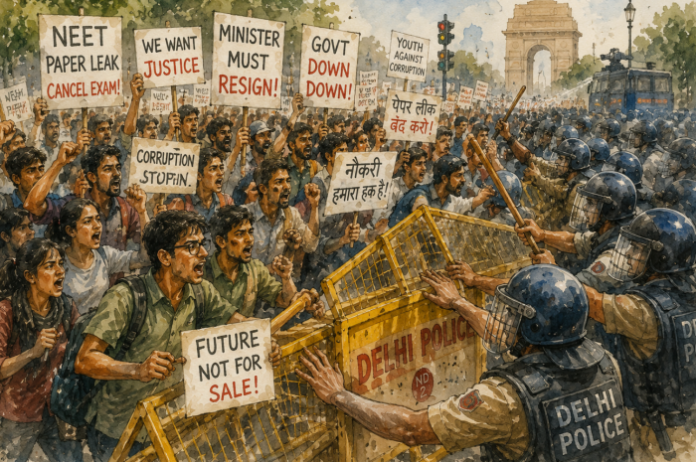
Visuals of young protestors clashing with the police, some throwing stones and getting lathi-charged in return, trying to break barricades and being hit by water cannons have been dominating news screens since yesterday. Some of them are there for politics, some are there to lend support to their peers, some have been genuinely aggrieved by the rampant paper leaks and corruption in recruitment exams. Some may even be there for fun and socialising. All of them are the inevitable victims of the socio-political consequences of their own biological age.
Because that’s how societies work.
“War is young men dying and old men talking.” – Odysseus (in Troy, the movie)
“Every generation imagines itself to be more intelligent than the one that went before it, and wiser than the one that comes after it.” – George Orwell.
This is a pattern so predictable and consistent that it appears less like an accident of history and more like the property of civilisation itself. Every generation believes it is uniquely wise. Every generation also believes its struggles are unprecedented. Yet, if one steps back from the emotional impact and tunnel vision of current events, the pattern makes itself clearly visible.
Delhi Police have registered 5 FIRs so far over violence during the CJP protest march, with more expected as accused are identified through CCTV footage
— Nabila Jamal (@nabilajamal_) July 21, 2026
FIRs cover flying a drone without permission in the New Delhi district during the Parliament session, 2 cases involving… pic.twitter.com/0Cm8erZUyj
The slogans keep changing, ideologies keep changing. But the age factor in power structures hardly changes. Regardless of the era, political, military, financial, and institutional power overwhelmingly rests with the older generation, while the young supply the energy, bodies, and often the blood. They rarely inherit the levers of real control; they get used as pawns and cannon fodder in elite political clashes, then sidelined as the system stabilises itself, transferring power from one set of old men to another.
The reasons behind this tragedy are also rather simple, if one thinks about it. The pattern is not some grand conspiracy of older folks against the young of their society. It is the inevitable dividend of accumulated resources, networks, institutional knowledge, and risk aversion that the older folks gather in the course of ageing.
Power is also sticky; it attaches itself invariably to wealth, alliances and established bureaucratic systems.
The script is same, though centuries
Across eras, youth fuel disruption while elders direct and ultimately consolidate outcomes. From ancient Troy to the World Wars and countless wars in between, it is the young blood that is spilt, while older generals sit and decide their fate under orders from even older politicians. Revolutions, no matter how romanticised, follow the same pattern. French radicals and sans-culottes ignited change and flooded the streets, only for the monarchy to be dislodged by anarchy and terror under the likes of Robespierre, followed by the corrupt Directory and eventually a Napoleonic dictatorship.
Russian Bolshevik youth helped topple the Tsar, yet Lenin and Stalin built the new authoritarian elite. India’s long struggle for independence was no different; it saw fiery young martyrs like Bhagat Singh executed, popular leaders like Netaji Subhash deliberately sidelined while established older Congress leaders negotiated the transfer of power.
Whatever political benefit the CJP protestors and the so-called students are hoping for, it will inevitably be reaped by the Congress, AAP, Samajwadi Party, or even Chandrashekhar Ravan, to be used as capital for their next elections. Whether the ‘cockroaches’ admit it or not, the political narrative and outcome of their protest are already hijacked by powers that are older than them. Pun intended.
Coming back to more recent times, the so-called student leaders led from the front to clash with government forces of Sheikh Hasina, only to be ruled by a geriatric Mohammad Yunus and eventually paving the way for the old political family of Khaleda Zia to come back to power in the form of Tarique Rahman. The same story got repeated in Nepal, Sri Lanka, Kenya, and even in the Arab Spring.
Spanning across generations and decades, across borders, the ‘system’ always wins. When it does, the foot soldiers, the blood and energy givers, the cannon fodder are invariably sidelined. The system is old, pun intended again.
This makes sense and has been proven even from an evolutionary perspective. Human societies have always evolved around an asymmetry of resources rather than an asymmetry of physical capability. The young march, the old negotiate. The young fight, the old rule.
This is how the wheel turns
Survival is always rewarding. Age comes with wealth, institutional memory, political networks, and social legitimacy. The young have kinetic energy; the ones who survive into old age adapt to consolidate potential energy among their peers. In the thermodynamics of politics, the former is always converted into the latter, and the latter instigates the former whenever it wants. This is how the wheel turns.
Orwell’s generational delusion sustains the cycles of the wheel; each group believes it will finally break the pattern through superior insight or technology. Gen Z outrages over boomer or Millennial failures on climate, debt, and social injustice. But they fail to realise that the real power will continue to ‘stick’ to old systems. The old may enjoy the benefits of political unrest, but they forget that the very system that empowers them can be swept away from under their feet if the young blood protesting on the streets reaches a critical mass. The power discrepancy keeps the wheel turning.
All of this may sound rather depressing, but it is not. This is how societies stay functional. The streets of Delhi are today flooded with CJP protestors. Tomorrow there will be some other group. Violence may look all good and revolutionary for Insta handles, but jail cells are harsh. The rich kids will escape arrest and find foreign colleges to flex their revolutionary credentials. The not-so rich will suffer for a while before either losing interest and carrying on with their colleges and jobs. A certain kind of young men and women, who believe too much in heroes and ideals, will stay longer. Another kind of youngsters will just enjoy the free food and attention while it lasts.


