


In the past few days, several social media users have complained that videos and posts related to the Cockroach Janta Party’s protests are being forced into their feeds. The content is reportedly appearing even to users who do not follow CJP accounts, do not regularly consume such political content or have recently created their accounts.
In a post, X user Mohini said, “Over the past few days, we have seen systematic manipulation of algorithms to push the CJP narrative on Meta’s social media platforms. On Instagram in particular, there appears to be a funded campaign to spread anarchy and unrest among the younger generation.”
@PMOIndia @narendramodi @AmitShah @HMOIndia
— 🇮🇳Mohini🇮🇳 (@mohini23451) July 22, 2026
Over the past few days we have seen that there has been a systematic manipulation of algorithms for pushing the CJP narrative on social media platforms of @Meta particularly on @instagram there appears to be an funded campaign for…
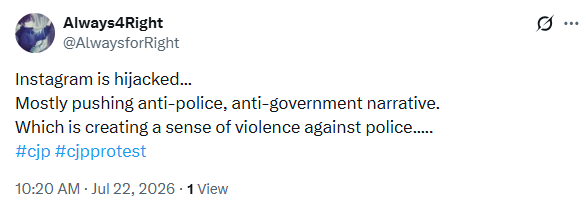
Another user, Always4Right, said, “Instagram has been hijacked. It is mostly pushing an anti-police and anti-government narrative, which is creating a sense of violence against the police.”
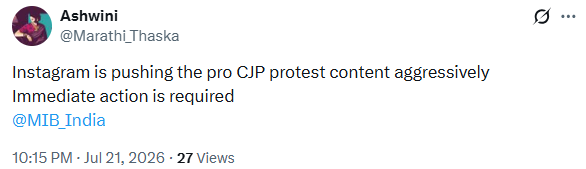
X user Ashwini said, “Instagram is aggressively pushing pro-CJP protest content,” and urged the government to take immediate action.
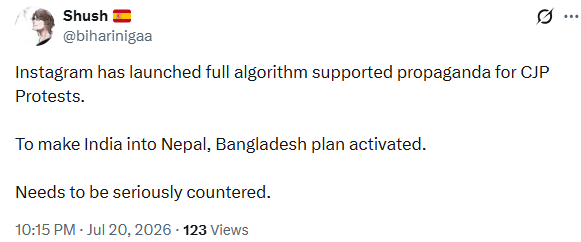
Another user, Shubh, said, “Instagram has launched full algorithm-supported propaganda for the CJP protests. The plan to turn India into Nepal or Bangladesh has been activated. It needs to be seriously countered.”
Detailed posts by RevolutionMonk stated that even when Instagram users do not follow or interact with any CJP accounts, these reels keep appearing in their feeds. He said, “That is because CJP has a network of state-wise social media coordinators who actively collaborate with Instagram influencers.” He further said that such posts were being made in exchange for money, starting from Rs 5,000.
Have you noticed Instagram flooded with CJP reels lately?
— Revolutionary Monk (@RevolutionMonk) July 21, 2026
Even if you don’t follow or interact with any CJP accounts, these reels keep appearing in your feed.
That’s because CJP has a network of state-wise social media coordinators who actively collaborate with Instagram… pic.twitter.com/28TQsuhpNN
In follow-up posts, he shared screenshots of multiple Instagram accounts sharing similar content to support the theory.
🚨 CJP Paid Insta collab exposed 🚨 Part 2
— Revolutionary Monk (@RevolutionMonk) July 21, 2026
CJP has rolled out paid collaborations with tens of thousands of Instagram creators, big or small, purely to manufacture an organic-looking wave.
They were instructed to shoot reels pretending they were heading to Delhi, pushing lines… pic.twitter.com/aFsR7KMB5C
The repeated appearance of the same political narrative on Facebook, Instagram and even X raises an obvious question. Is the content becoming viral entirely because people are looking for it, or are recommendation algorithms actively taking it beyond its natural audience?
The answer lies in how social media platforms are designed. Facebook and Instagram do not merely show users posts from accounts they follow. Meta decides which political content is eligible for recommendations, whose posts are placed before non-followers, and which behavioural signals are enough to conclude that someone may be interested in a political campaign.
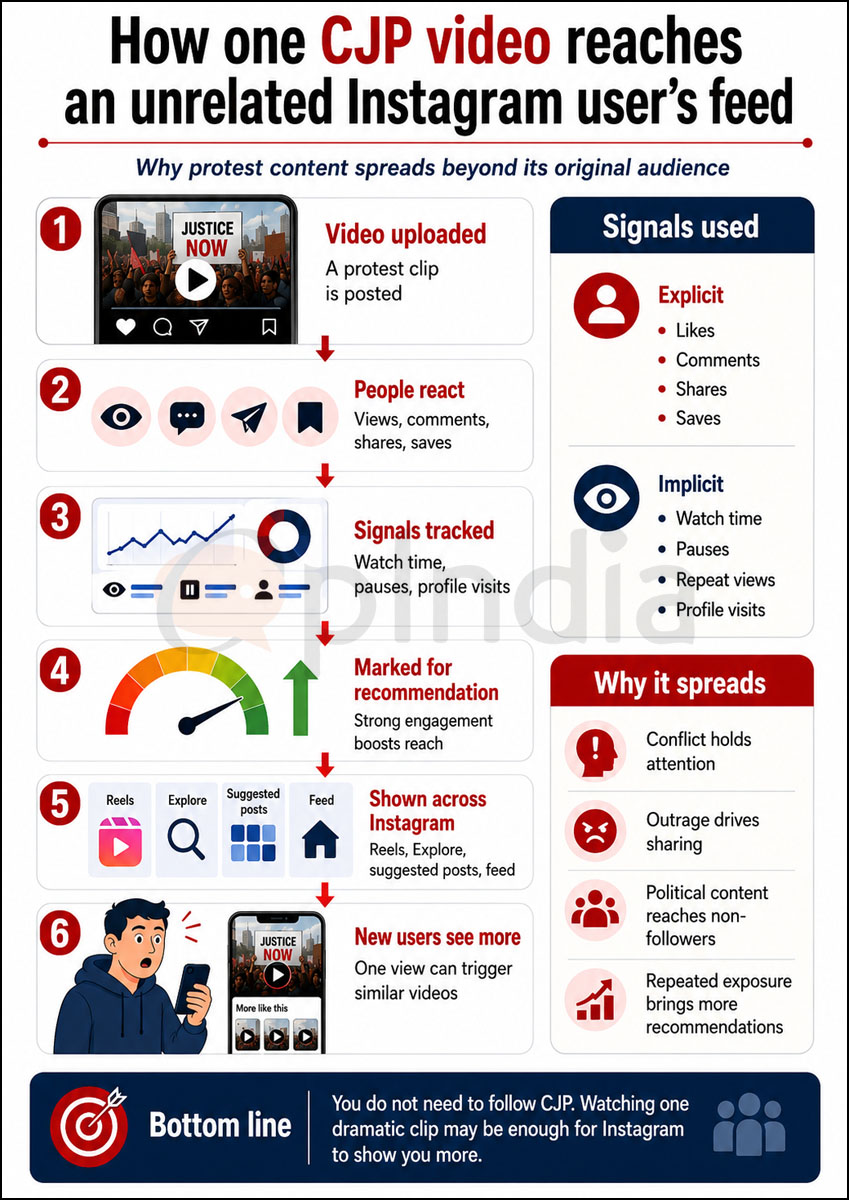
The company has changed these rules several times. More importantly, Meta has itself acknowledged that it is once again recommending more political content on the basis of both explicit and implicit signals. To make the terminology clearer, a like is an explicit signal, while simply viewing a post is an implicit signal.
Therefore, a user does not have to support CJP, follow its accounts or deliberately search for its protest. Stopping to watch one dramatic video may be enough for Meta to begin filling the person’s feed with similar material.
Meta has openly admitted that it recommends political content to users
In 2021, Meta began reducing the political and civic content shown on its platforms. It later reduced the importance given to comments and shares while ranking political posts. The company said users did not want political content to dominate their feeds.
That position changed significantly in January 2025. Meta announced that it would begin phasing political content back into Facebook, Instagram and Threads through a “more personalised approach”. It said political material would be ranked using explicit signals such as likes and implicit signals such as merely viewing a post. Meta also said it would recommend more political content based on these signals.
What Meta said in 2025 is crucial to understanding how and why CJP videos may reach unrelated accounts.
A person may watch a video because the police are being attacked. Another may watch it because he is shocked by the behaviour of protesters. Someone else may pause because he wants to identify where the incident occurred. Meta’s systems cannot reliably determine why each person watched the clip. They only register that the content captured attention.
Once the user has paused, watched, opened the comments or visited the account, the platform has received multiple signals. It can then recommend another protest video, followed by another account discussing the same mobilisation.
Meta’s own Help Centre says Instagram’s suggested posts are selected using a user’s previous activity, connections, information about the post and the popularity of the account sharing it. It specifically considers how other users are interacting with a post. Suggested content can appear in the main feed, Explore and Reels.
In other words, viral CJP content does not have to wait for users to find it. Meta delivers it to them.
An algorithm does not understand whether a user supports or condemns the protest
Social media companies often present recommendations as a neutral response to user interest. However, the definition of “interest” is dangerously broad. A user angrily commenting on a CJP video is still commenting. A person sharing the clip to condemn protesters is still sharing it. Someone repeatedly watching a violent confrontation to understand what happened is still increasing its watch time.
For the recommendation system, each of these actions may indicate that the post is valuable enough to show to more people.
Research conducted during the 2020 US presidential election found that replacing Facebook’s and Instagram’s algorithmic feeds with chronological feeds substantially reduced the amount of time users spent on the platforms and their overall activity. It also significantly changed the type of political material they encountered. The researchers did not find a corresponding short-term change in political attitudes, but they demonstrated that algorithms materially alter what users see and how they behave on the platform.
Another study involving aggregated data from 208 million Facebook users found that ideological segregation increased as the researchers moved from content that users could potentially see to what the algorithm actually showed them and finally to what they engaged with.
The point is simple. Meta’s algorithm does not merely reflect a political environment. It restructures that environment by deciding which content receives visibility.
CJP propaganda may begin with its organisers and supporters. However, it gains a much larger audience after dramatic footage generates enough early engagement to be picked up by recommendation systems.
Meta designs the algorithm and can change the political outcome
It is misleading to speak about “the algorithm” as if it were an independent machine over which Meta has no control.
Meta decides which signals matter. It determines whether comments, shares, viewing time, negative feedback or survey responses should influence political recommendations. It also decides which categories of content are eligible to reach people who do not follow the original account.
In 2022, Meta said it had globally reduced the weight given to comments and shares on political content. By 2023, the company said it was attempting to move away from engagement-based ranking and give greater weight to surveys concerning what users considered informative or meaningful.
In 2024, Meta limited proactive recommendations of political content from unfollowed accounts on Instagram and Threads. It then reversed direction in 2025 and made political recommendations more personalised. The current Facebook political-content control is enabled by default. A user must change the setting to see less political material.
These changes prove that the visibility of political content is not an unavoidable product of public interest. It is a corporate policy choice.
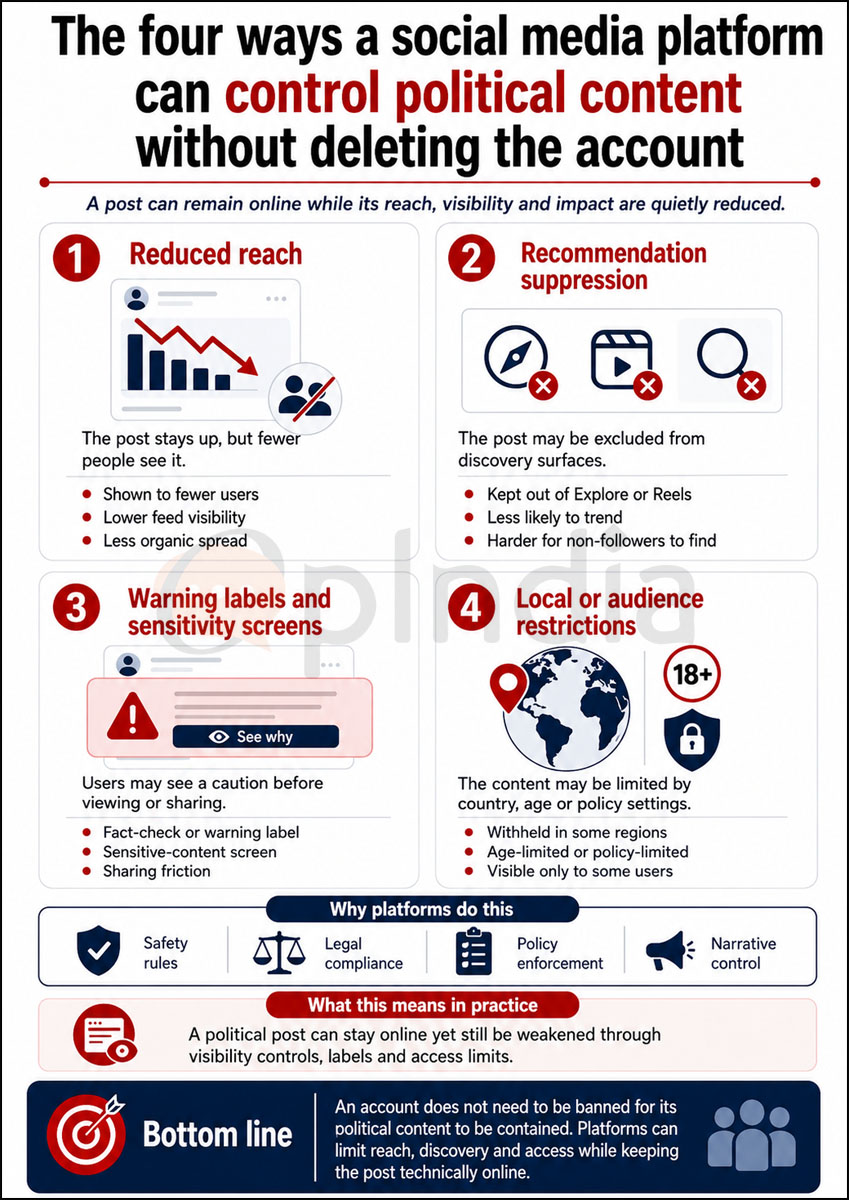
Meta does not need to issue an order saying that CJP must be promoted. It only needs to classify its videos as recommendation-eligible political content and allow engagement signals to push them into unrelated feeds.
Why footage portraying the police as aggressors receives an inherent advantage
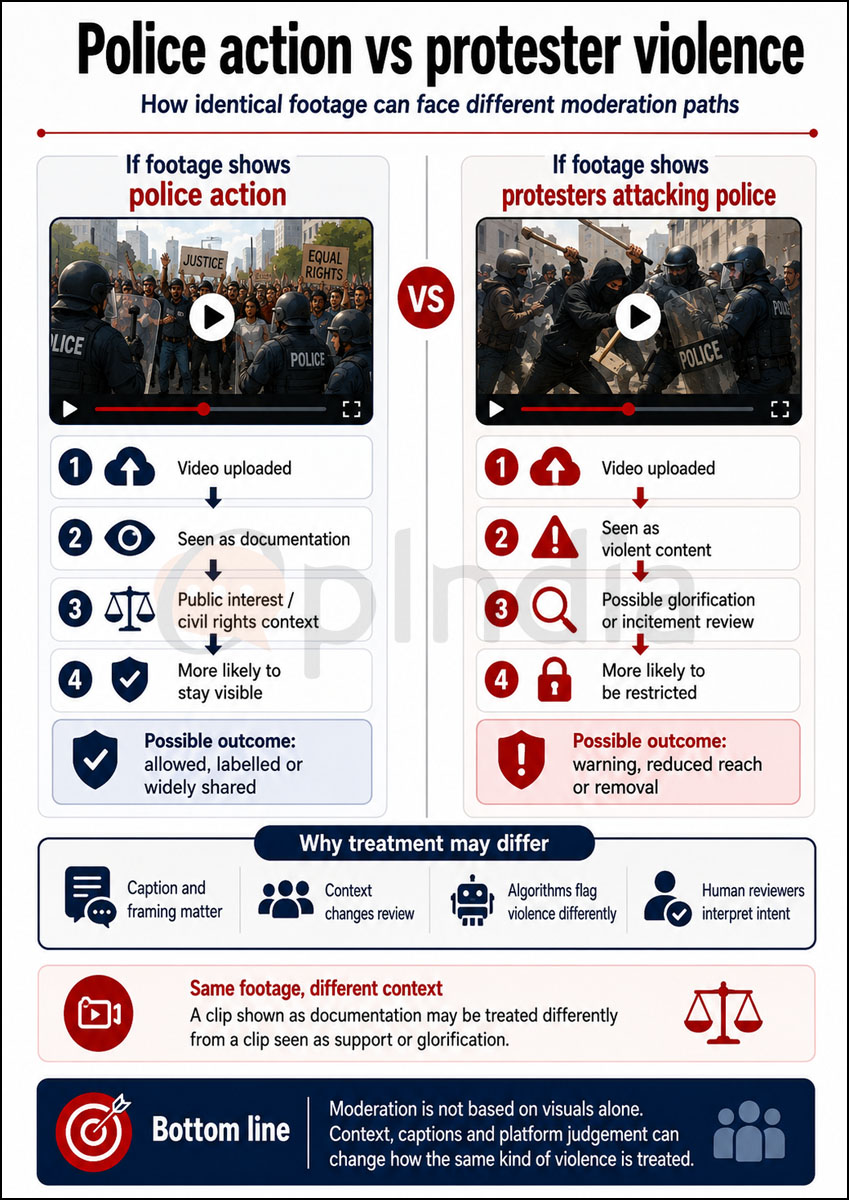
There is another layer to the controversy. The same act of violence can receive different treatment depending on who is shown committing it and how the post is framed.
A video showing police personnel using force against protesters can be presented as evidence of police brutality, a civil rights violation or state repression. It is therefore more likely to be defended as newsworthy documentation.
However, footage showing protesters attacking police personnel may be flagged as violent content. If a separatist or extremist organisation appears in the video, the post can also enter the far more complicated territory of glorification, support or representation of a dangerous organisation.
Meta’s Dangerous Organisations and Individuals policy allows reporting, condemnation and neutral discussion. Yet the boundary between reporting and glorification is often interpreted badly by automated systems and human reviewers.
The Meta Oversight Board examined one such case involving an Urdu-language newspaper report about the Taliban. Meta’s systems removed the post. Two human reviewers also classified it as a violation. The platform imposed a strike and restricted the administrator’s access to features.
The case was placed in a system intended to identify incorrect removals. However, it was never reviewed there because Meta had fewer than 50 Urdu-speaking reviewers assigned to that queue and did not consider the post a high priority. Meta restored it only after the Oversight Board selected the case. The company then accepted that the post constituted permitted news reporting.
This example demolishes the claim that contextual exceptions are always applied accurately. The rules may permit journalistic reporting on terrorism or political violence. The machines and reviewers enforcing those rules can still punish the journalist rather than the terrorist.
Meta itself admits that its systems censored legitimate political speech
Meta has effectively admitted that its moderation machinery was not simply imperfect but routinely overreached. In January 2025, the company said it had developed increasingly complicated systems under societal and political pressure. It acknowledged that this approach had gone too far. According to Meta, too much harmless content was censored, and too many users were wrongly subjected to enforcement.
Meta further disclosed that it removed millions of pieces of content every day in December 2024. It estimated that between one and two out of every ten enforcement actions may have been mistakes.
Those are not insignificant errors, especially when millions of decisions are made each day. Even the company’s lower estimate translates into an enormous amount of legitimate content facing wrongful action.
Meta also admitted that third-party fact-checking had attached intrusive labels to legitimate political speech and reduced its distribution. It said the programme had too often become a tool for censorship because fact-checkers brought their own biases and perspectives to the process.
Therefore, allegations of ideological bias cannot be dismissed as conspiracy theories. Meta’s defence is no longer that over-enforcement never happened. Its defence is that it is now trying to reduce it.
Algorithms do not act alone, human reviewers also shape the narrative
The social media ecosystem is not governed solely by automated systems. Meta said in 2024 that it had around 15,000 content reviewers working across Facebook, Instagram and Threads in more than 80 languages. Political decisions also involve policy teams, engineers, legal departments, public-policy officials and election-specific operations centres.
Human beings determine whether a post condemns violence or glorifies it. They decide whether the context is journalistic, activist, satirical or supportive. They also interpret captions written in Indian languages that may contain political references unfamiliar to reviewers outside the country.
Bias can enter at every stage. It can enter while the policy is drafted. It can enter when an organisation is placed on a dangerous-entities list. It can enter when a reviewer interprets the tone of a report. It can also enter when organised users repeatedly report content produced by their ideological opponents.
Meta’s own Taliban case showed that two human reviewers could uphold a clearly incorrect decision. It also showed how a shortage of reviewers familiar with a language can prevent a wrongful removal from being corrected.
OpIndia has experienced Meta’s selective enforcement first-hand
For OpIndia, the question of discriminatory enforcement is not theoretical.
In 2020, OpIndia documented how the reach of its Facebook page fell from around 20 lakh per day to approximately 1.71 lakh. Facebook cited content-quality concerns and claimed that artificial intelligence decided whether posts violated its rules. However, a report removed from OpIndia’s page remained available on another website with the same image.
In September 2024, Facebook blocked users from sharing OpIndia’s 187-page dossier on Wikipedia. The platform classified it as spam and accused the publication of using misleading methods to obtain engagement. The dossier itself did not require users to like a page, encounter deceptive pop-ups or click a disguised link.
In March 2026, Meta removed an OpIndia video challenging a BBC narrative about alleged Islamophobia faced by a Kashmiri journalist seeking accommodation in Delhi. OpIndia reported that the Facebook upload was banned within seconds of publication.
Further more, content related to Khalistan groups, Punjab insurgency and Khalistani terrorists posted by OpIndia often get blocked or removed.
Taken together, these incidents show that removal, reduced distribution and recommendation eligibility are not separate from politics. They determine which political argument reaches the public and which one disappears before it can build an audience.
The ideological concerns surrounding Meta’s oversight structure
Concerns about Meta’s political orientation also extend to its Oversight Board. OpIndia reported in 2020 that an investigation had found that 18 of the then 20 board members had collaborated with or were linked to organisations funded by George Soros’s Open Society Foundations. OpIndia also documented the controversy surrounding board member Tawakkol Karman and her association with Yemen’s Muslim Brotherhood-backed Islah Party.
It is concerning that a board presented as ideologically diverse was overwhelmingly drawn from institutions operating within the small liberal international ecosystem. The concern becomes more serious when the board influences how political speech, nationalism, separatism, Islamist organisations and state action are interpreted across countries.
Zuckerberg admitted that government pressure influenced moderation
Meta’s political interventions have not occurred in isolation. In an August 2024 letter to the US House Judiciary Committee, Mark Zuckerberg said senior officials from the Biden administration had repeatedly pressured Meta to censor Covid-related content. This included humour and satire. Zuckerberg said the pressure was wrong and expressed regret that Meta had not been more outspoken against it.
He also said the company had made decisions that it would not make again with the benefit of hindsight and new information. This was not an accusation made by an outside critic. It was an admission by Meta’s founder.
It established that governments and political actors can pressure platforms. It also established that Meta could change its enforcement decisions in response to that pressure.
Once this is accepted, it is no longer intellectually honest to describe every act of amplification or suppression as a politically neutral output generated by code.
Meta does not need an official alliance with CJP to amplify its propaganda
Meta may not have produced an internal memo ordering employees to promote the CJP protests. However, the system designed by the company recommends political content using viewing behaviour. It rewards posts that hold attention. Its rules make fine distinctions between documentation and glorification. Its automated systems have wrongly censored millions of posts. Its human reviewers have repeatedly failed to understand context. Its founder has acknowledged political pressure. This creates a natural advantage for CJP’s propaganda.
Videos portraying the police as aggressors can circulate as civil rights documentation. Clips showing violence by protesters can face restrictions. Every outraged response to a CJP video can increase engagement. Every minute spent watching it can convince the algorithm to recommend another.
The result may be described as personalisation by Meta. For the user who never asked to see the propaganda, it looks far more like political content being pushed into his feed.
That is the real power of Big Tech. It does not have to openly declare support for a movement. It can decide which side becomes unavoidable and which side becomes invisible.


