

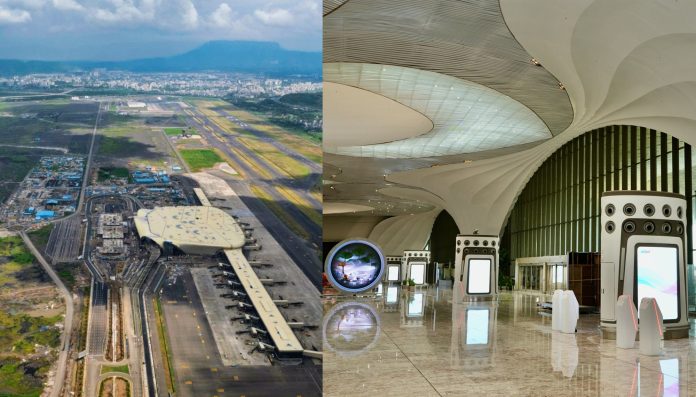
Prime Minister Narendra Modi today inaugurated the Navi Mumbai International Airport (NMIA), one of India’s most ambitious infrastructure projects and a defining milestone in the nation’s aviation journey. Speaking on the occasion, the Prime Minister said that Mumbai’s long wait was over as the city had now received its second international airport. He added that the Navi Mumbai International Airport would play a major role in establishing the region as Asia’s biggest connectivity hub, and that this airport will play a major role in establishing the region as one of Asia’s largest connectivity hubs.
“The Navi Mumbai International Airport is a project that exemplifies the vision of a developed India,” said the PM Modi after inaugurating the airport. He further said, “It is built on the land of Chhatrapati Shivaji Maharaj, and its design, resembling a lotus flower, makes it a living symbol of culture and prosperity. This new airport will connect Maharashtra’s farmers directly with the international supply chain, including supermarkets in Europe and the Middle East. This means that the farmers’ freshest produce — fruits, flowers, vegetables and the products of our fisherfolk — will be able to reach the global market rapidly. For the small and micro-scale industries in the area, this infrastructure will reduce logistical costs. It is set to attract increased investment, fostering the creation of new industries and ventures. I extend my heartiest congratulations to all the people of Maharashtra and Mumbai on the establishment of this airport.”
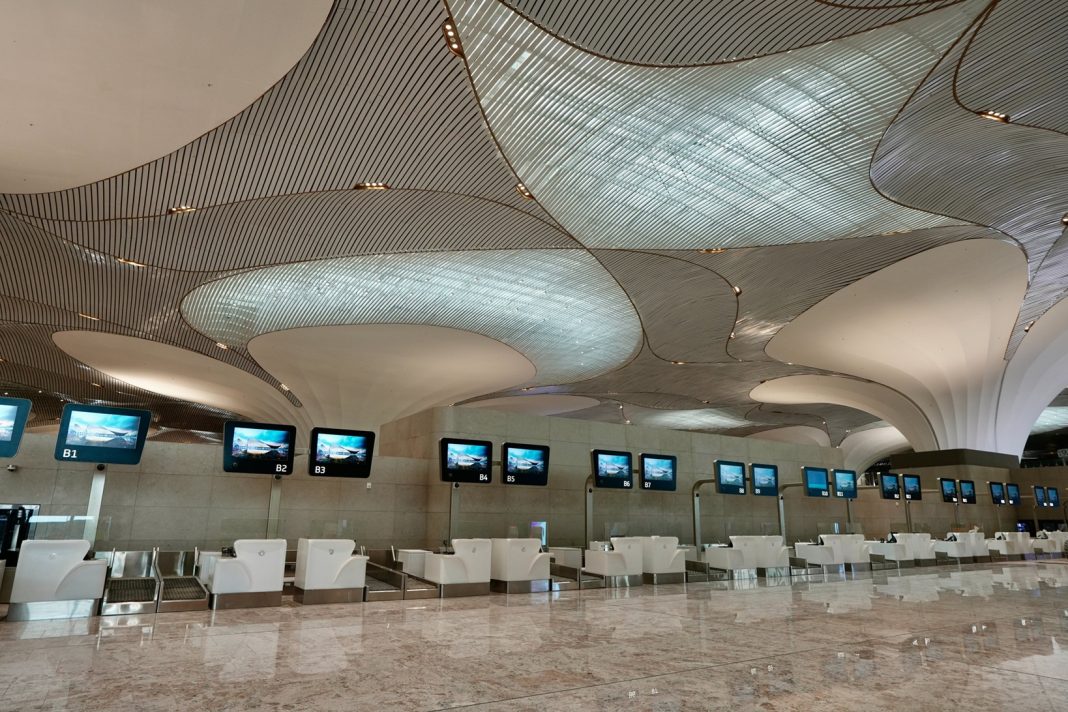
Ahead of the formal inauguration, the Prime Minister toured the airport and reviewed its facilities. He was accompanied by Maharashtra Governor Acharya Devvrat, Chief Minister Devendra Fadnavis, Union Minister for Civil Aviation Ram Mohan Naidu Kinjarapu, Deputy CMs Ajit Pawar and Eknath Shinde, Union Minister of State for Civil Aviation Murlidhar Mohol and Adani Airports Director Jeet Adani. Prime Minister Modi also viewed the airport master plan and he was shown the various tech aspects of the terminal.
The new airport in Navi Mumbai will enhance connectivity and boost urban infrastructure in the Mumbai metropolitan region. Glad to have inaugurated Phase-1 of the airport today. pic.twitter.com/6upf7aPCbh
— Narendra Modi (@narendramodi) October 8, 2025
Navi Mumbai International Airport has been developed as a landmark public-private partnership (PPP) between Mumbai International Airport Limited (MIAL), a subsidiary of Adani Airport Holdings Limited (AAHL), and the City and Industrial Development Corporation (CIDCO). The project represents a major stride in India’s infrastructure-building vision, reflecting the Government’s agenda of Viksit Bharat 2047.
Envisioned as part of a dual-airport system for the Mumbai Metropolitan Region (MMR), NMIA will complement Chhatrapati Shivaji Maharaj International Airport (CSMIA). With an initial capacity of 20 million passengers per annum (MPPA), the airport will eventually expand to manage 90 MPPA, making it one of the largest passenger-handling airports in India.
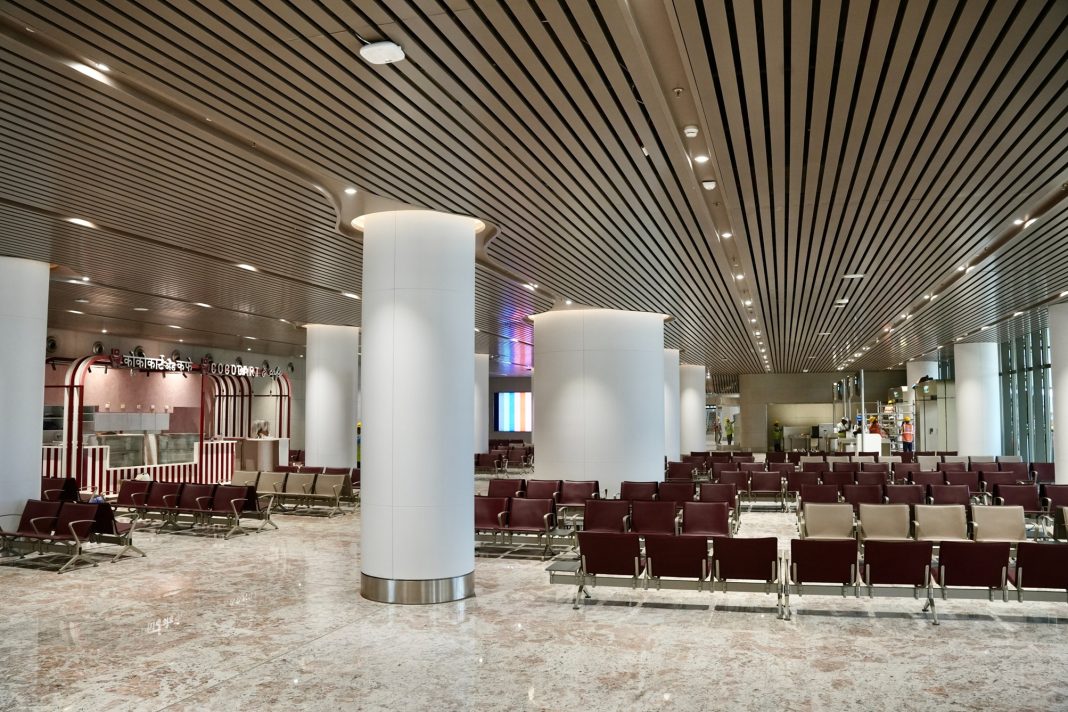
Designed as a multimodal hub, the airport will be seamlessly connected to the Mumbai Trans Harbour Link, Navi Mumbai and Mumbai Metro, suburban rail networks and planned waterways. This integration will reduce travel times, enhance regional connectivity and strengthen cargo and passenger movement across the vast hinterland of western India.
In its first two phases, NMIA will operate with a single runway and terminal capable of handling 20 MPPA. Over time, the airport will scale to four runways and multiple terminals, with a dedicated cargo terminal and state-of-the-art facilities for perishables and express cargo, boosting India’s trade and logistics ecosystem.
The airport spans 1,160 hectares and is designed to accommodate up to 90 million passengers annually after it is completely built. It will work in synergy in a twin airport system, easing pressure on Mumbai’s Chhatrapati Shivaji Maharaj International Airport, while extending connectivity to Thane, Pune, Raigad and the Konkan belt.
From blueprints to skylines, from dreams to runways, today India soars higher as Hon’ble PM Shri @narendramodi ji inaugurated the Navi Mumbai International Airport. My deepest gratitude to Shri @Dev_Fadnavis ji, Shri @RamMNK ji and all the GoI-GoM officials for their steadfast… pic.twitter.com/jDnL3wMn2z
— Gautam Adani (@gautam_adani) October 8, 2025
With the Atal Setu offering a 20-minute link from South Mumbai, strengthened by the Sion–Panvel Highway, NMIA will be at the heart of an integrated transport network.
Navi Mumbai International Airport is the result of nearly two decades of effort, beginning with the Union Cabinet’s approval in 2007 to relieve congestion at Mumbai’s existing airport. The project navigated significant hurdles between 2011 and 2017, including complex resettlement, environmental clearances, and engineering challenges. In 2021, the Adani Group took over the ₹ 16,700 crore PPP, ensuring a single operator for Mumbai’s twin-airport system. Construction accelerated following the land handover in 2022, with Zaha Hadid’s lotus-inspired terminal design unveiled in 2023. Test landings on its runway were done in 2024.
The airport is designed as a logistics hub, with cargo as a core focus, capable of handling 0.5 million tonnes annually in its first phase. The airport is introducing several firsts in Indian air cargo, including a fully automated terminal with AI monitoring that can cut turnaround time by 40%. It also features a Pharma Excellence Centre with GDP-compliant cold zones and a dedicated perishable cargo village. Crucially, its proximity to the Jawaharlal Nehru Port Trust creates an integrated logistics cluster for sea-air transshipment. This dual-engine strategy is expected to support key sectors like agriculture and pharmaceuticals.
The airport also has major plans for non- aeronautical revenue, which can account for up to 40% of revenues at global hubs. NMIA plans 110 retail and Food & Beverage (F&B) outlets, including 1,800 square metre of duty-free shops in both arrivals and departures. The landside area will offer entertainment and dining zones accessible to non-passengers, expanding the customer base.
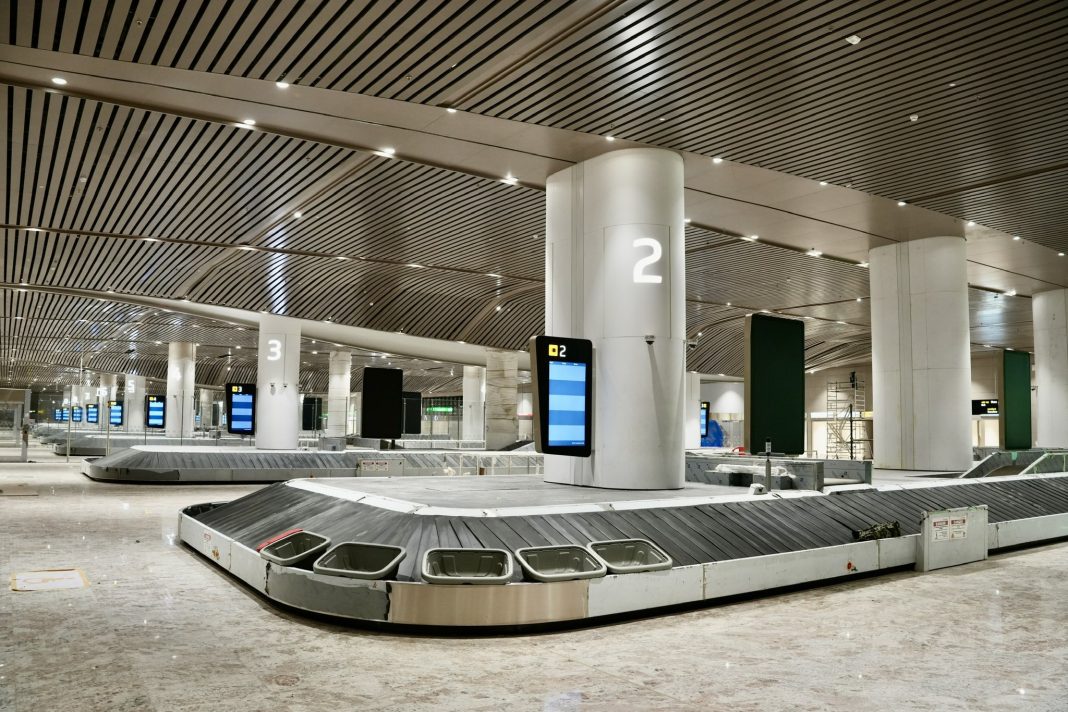
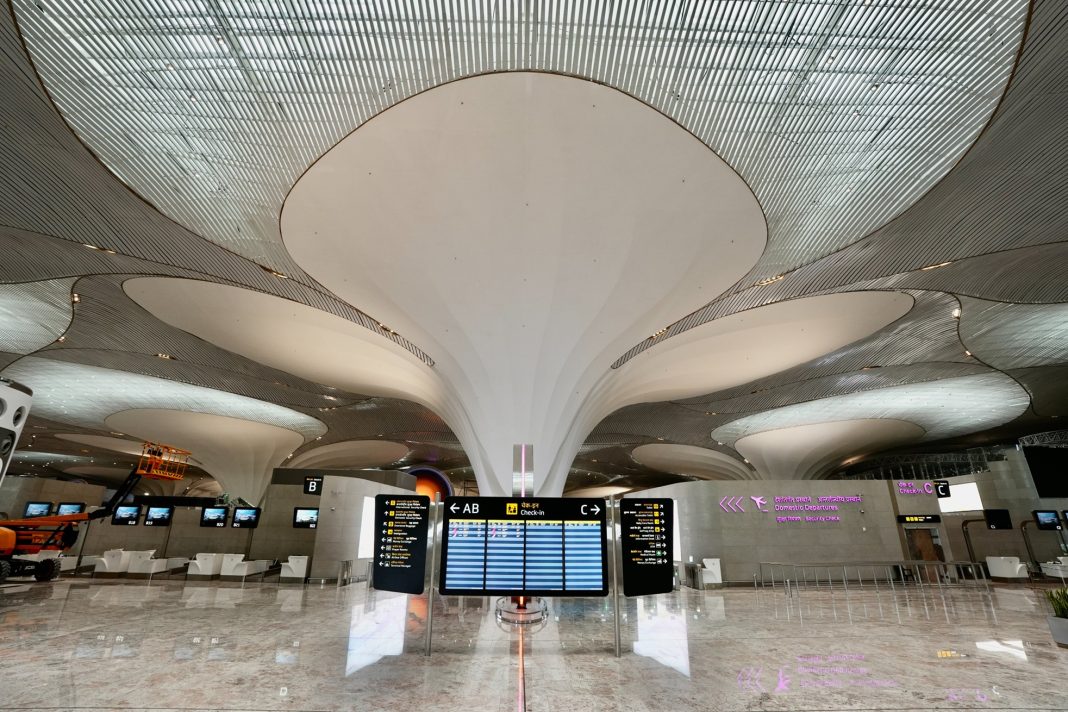
Designed by Zaha Hadid Architects, the airport is an engineering and cultural landmark rooted in the lotus flower metaphor. The structure features a dual column system: 12 sculptural feature columns guide passenger movement and allow natural light to cascade through, while 17 robust mega columns support the immense lotus roof. This innovative system creates vast, open spaces, with the roof appearing to float above the terminal. The roof is also designed to manage rainwater and reduce wind resistance.
