

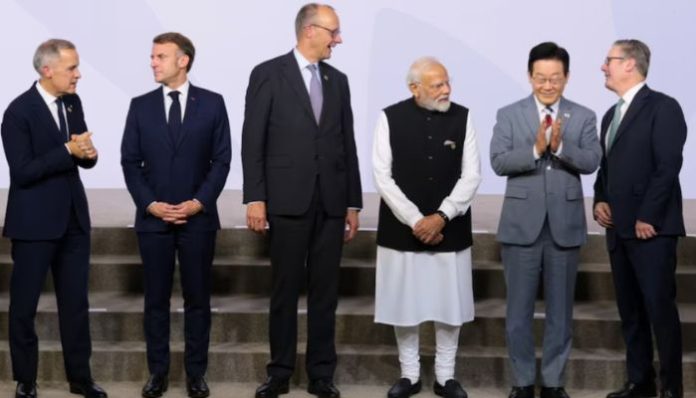
Prime Minister Narendra Modi proposed six big global initiatives during the G20 Leaders Summit in Johannesburg, as India’s strong influence was reflected in the joint statement released by the member countries.
The three-day summit started on Saturday (21st November), with Prime Minister Narendra Modi arriving in Johannesburg a day earlier.
PM Modi held key discussions with global leaders upon his arrival, including a bilateral meeting with Australian counterpart Anthony Albanese.
“Landed in Johannesburg for the G20 Summit-related engagements. Look forward to productive discussions with world leaders on key global issues,” PM Modi said in a post on X.
Landed in Johannesburg for the G20 Summit related engagements. Look forward to productive discussions with world leaders on key global issues. Our focus will be on strengthening cooperation, advancing development priorities and ensuring a better future for all. pic.twitter.com/o4KL5W5l53
— Narendra Modi (@narendramodi) November 21, 2025
Strong Joint message on border integrity, human rights and terrorism
The G20 countries issued their joint statement much earlier than usual, which was perceived to be a signal that the overall global situation, especially conflicts, rising militarisation, and economic instability, prompted the leaders to send a strong message as soon as possible. It said no country should threaten or use force to alter internationally recognised borders, seen by many as a key signal to countries like Russia, Israel, and Myanmar, where territorial disputes and conflicts have drawn global attention.
The second session at the G20 Summit in Johannesburg focussed on building a resilient world in the face of disasters, climate change and ensuring energy transitions that are just as well as robust food systems. India has been actively working on all these fronts, building a… pic.twitter.com/Iqvh81CxUj
— Narendra Modi (@narendramodi) November 22, 2025
The joint declaration has strongly condemned terrorism in all its manifestations. The leaders drew particular attention to the fact that human rights and basic freedoms have to be respected irrespective of race, sex, religion, or language. This unity, according to political observers, reflected deep concern over ongoing crises around the world.
India played a major role in shaping the summit’s discussions and highlighted six important initiatives meant to support global development. These included the Global Traditional Knowledge Repository, Africa Skills Multiplier Initiative, Global Healthcare Programme, Initiative to Combat Drug-Terrorism Network, Open Satellite Data Partnership and Critical Minerals Circularity Initiative. PM Modi described these proposals as India’s contribution to building a more secure and sustainable world.
Focus on Africa’s development
PM Modi stressed that Africa’s progress is essential for global growth and said India has always stood by the continent. He announced the Africa Skills Multiplier Initiative, which will work on a “train-the-trainer” model. Under this plan, India aims to help train one million certified trainers in Africa over the next decade.
These trainers will then train millions of young people across African nations. PM Modi said this initiative will create long-term capacity, strengthen local communities and help Africa take larger strides in development.
Global healthcare team for emergencies
Another key proposal from PM Modi was the formation of a G20 Global Healthcare Response Team. He said the COVID-19 pandemic proved that countries are stronger when they work together during health emergencies. He suggested building a team of medical experts from G20 nations who can respond quickly to future pandemics or natural disasters.
“Our effort should be to form a team of trained experts who can handle any major global health crisis or disaster,” Modi said during his address.
Plan to tackle drug-terror nexus
PM Modi also drew attention to the growing drug-trafficking problem and its links with terrorism. He suggested a dedicated G20 initiative to counter this issue by coordinating efforts related to finance, governance and security.
He warned that deadly substances like fentanyl are becoming global threats and said joint action is necessary to weaken the drug-terror economy.
Sharing satellite data with developing Nations
He proposed an Open Satellite Data Partnership wherein satellite data collected by G20 space agencies can be shared with developing countries. This information can be particularly useful in agriculture, fisheries, climate monitoring, and disaster management. Modi added that such cooperation would help bridge gaps in technology access for smaller nations.
India is fully committed to sustainability and clean energy, which is why we propose a G20 Critical Minerals Circularity Initiative to promote recycling, urban mining, second-life batteries and related innovations.
— Narendra Modi (@narendramodi) November 22, 2025
Recycling of critical minerals
The Prime Minister also pitched the Critical Minerals Circularity Initiative to strengthen supply chain security. These include recycling, urban mining, and second-life battery projects to reduce dependence on limited mineral resources. Modi said these steps will help countries become more self-reliant and protect themselves from global supply disruptions.
