

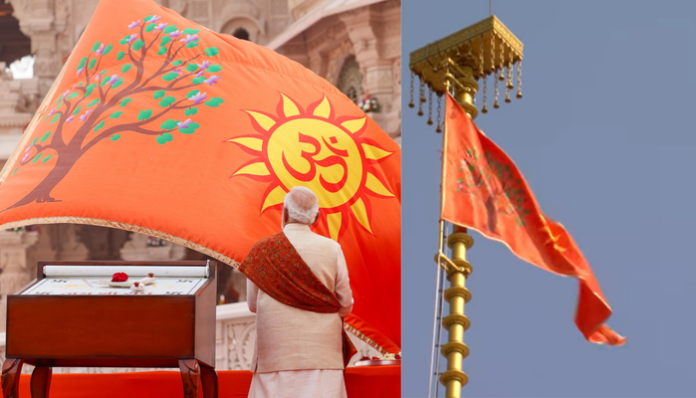
Prime Minister Modi hoisted the ‘Dharma Dhwaj’ atop the Ram Mandir in Ayodhya on Tuesday (25th November) in a grand ceremony, marking the completion of the temple. The Dharma Dhwaj, a saffron-coloured right-angled triangular flag, measures 10 feet in height and 20 feet in length. The flag bears two sacred symbols, linked with the Lord Ram, the image of the glowing Sun with ‘Om’ inscribed on it and the image of a Kovidara tree placed next to it. The flag is said to represent the ancient flag of the Ayodhya kingdom.
The man credited for rediscovering the flag is Indologist Lalit Mishra. Speaking to the media about the design of the flag, Mishra said that he spotted the flag of the ancient kingdom of Ayodhya in one of the paintings in the Mewar pictorial Ramayana. Explaining the symbols on the tree, Mishra said that the Sun represents the Suryavansha lineage of Lord Rama, the Kovidara Tree represents royal power, righteousness, and Ayodhya’s ancient heritage, and the Om symbol denotes the eternal, primordial sound, expressing spiritual continuity and cosmic order.
“I found the reference to this flag in Valmiki Ramayana’s Ayodhya Kand… The tree on the flag is a hybrid of the Mandar and Parijat trees, created by Rishi Kashyap, which could have been one of the earliest experiments in plant hybridisation. I faced a difficult time in establishing the identity of the Kovidar and Kachnar tree as both had similar biological names. I am glad the flag is back to the place it originated from after such a long time,” Mishra said.
#WATCH | Greater Noida, UP | On the flag hoisting ceremony at Shri Ram Janmabhoomi Temple, Indologist Lalit Mishra says, "This flag was discovered unintentionally… I saw Ayodhya's flag in one of the paintings of the pictorial Ramayana of Mewar… I found the reference to this… pic.twitter.com/0JEwIxLbQV
— ANI (@ANI) November 25, 2025
The Indologist said that he had a hard time identifying the tree and that he initially confused it with the Kachnar tree because of its similar biological name. He expressed joy that the ancient flag has been rediscovered, marking a link with the ancient roots of the country. Kovidara tree is a hybrid of the Mandar and Parijat trees, which was created by Rishi Kashyap. The tree is an example of ancient plant hybridisation.
“In a long tradition of many thousands of years, we lost it. The thing is, we lost the knowledge of the flag after the Mahabharata war. What happened in the Mahabharata war, Ayodhya’s king Brihadbal participated. And from the Mahabharata, we know that he was killed. So after he was killed, Ayodhya was ruined and forsaken. And I think by that time, because it was ruined, the tradition had lost the memory of the flag and the tree also,” Mishra added.
“So what happens is that a tracing point comes in the period of Kalidasa. So Kalidasa describes the beauty of the flower and the tree. But he does not remember the same tree that is featured on Ayodhya’s flag. Because the tradition was broken, the memory of the plant and the flag did not survive. So that’s why, in all the subsequent, some 299 Ramayanas, there is no mention of this tree or the flag. So now I am very happy that it has been discovered and it has found its place,” he added.
