

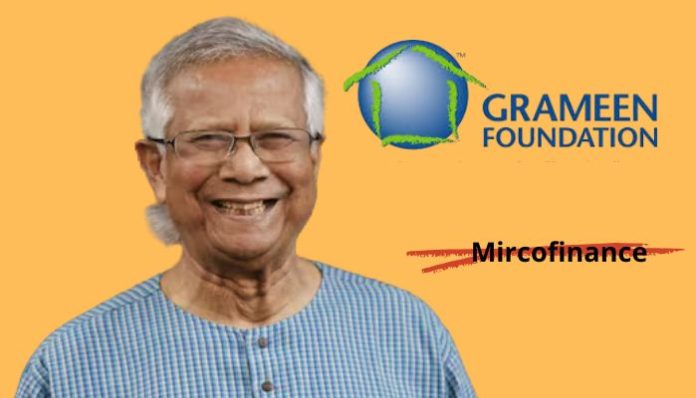
The ‘chief advisor’ to the interim government of Bangladesh, Muhammad Yunus, has come under the scanner over his claims of being the Father of ‘microfinance’ in the country.
Yunus founded the Grameen Bank in 1983. His claim to fame was that his bank provided small loans to poor people without the need for a collateral.
For this reason, Yunus was also awarded the Nobel Peace Prize in 2006. However, it has not come to light that the ‘microfinance’ model was a research programme at the University of Chittagong, which was subsequently hijacked by the ‘chief advisor’ to the interim governemnt of Bangladesh.
The revelations were made by Aminul Hoque Palash, a former intelligence officer of Bangladesh, through his Facebook account. He had shared archival documents from 1976 to 1983, which directly challenge claims of Yunus about microfinance.
It has come to light that a research project on mircofinance was led by junior researchers at Chittagong University, which was hijacked by Yunus during his tenure as Professor at the varsity.
The ‘chief advisor’ conveniently passed off the work of junior researchers as his own. “The same man who stole a rural research project now governs an entire country with the same appetite for capture,” Amnil Hoque Polash pointed out.
As per the documents, research scholars Shapan Adnan, Nasiruddin and H.I. Latifee. ran the first action-research project on micro-lending in Jobra village of Bangladesh. It was part of Rural Economic Programme (REP) launched through a grant of the Ford Foundation in 1976.
Bangladesh Bank was the first to adopt the ‘microfinance model’ much before Muhammad Yunus came up with the scheme through his Grameen Bank.
Key excerpts of the documents
The documents shared by the former intelligence officer highlight the following –
“RSP designed and introduced Nabajug Tebhaga Khamar (Three-share Farming) in the neighbouring village of Jobra to transform an idle deep tubewell into a rallying point for two-fold and three-fold increase of total paddy production in the village…
…Already success of the project has persuaded many non-believers that the poorest of the poor, and particularly the doubly oppressed segments of the society are certainly credit-worthy and cre it can provide then a means to stand on their feet. “Jobra-type Banking”, the name it is popularly known by, has become a familiar word to all the bankers in the country.
Already two banks, Bangladesh Krishi Bank and Sonali Bank are collaborating with the REP and covering two unions around Chittagong University under this type of banking services. Bangladesh Bank is going to launch a project in Tangail district to replicate this model in a wider area.“
One of the documents dated 6th June 1983 and addressed to one Dr Abdul Aziz Khan acknowledge a grant of $1,57,000 to the University of Chittagong to support the micro-lending programme.
Muhammad Yunus accused of violating labour laws, received money without govt permission
In January 2024, a labour court in Dhaka found him guilty of violating the labour laws of Bangladesh. He was convicted, sentenced to 6 months of simple imprisonment and fined Tk 30000 (~$260).
Yunus and three other directors at ‘Grameen Telecom’ violated labour laws by failing to create a welfare fund for the workers in the company.
The labour court Judge, Sheikh Merina Sultana, noted that 67 Grameen Telecom employees were supposed to be made permanent in the company which did not happen.
As per the company’s stated policy, it is supposed to share 5% of the dividends with the staff, which failed to materialise. Muhammad Yunus is currently facing 100 other charges for graft and labour law violations in Bangladesh.
He was earlier fired as Managing Director of Grameen bank for violating retirement regulations of the Bangladeshi government.
Yunus was also on trial for receiving money in 2013 for receiving money without government permission. He was infamously called a ‘bloodsucker’ by Sheikh Hasina for giving out loans to the poor at extremely high interest rates.
