

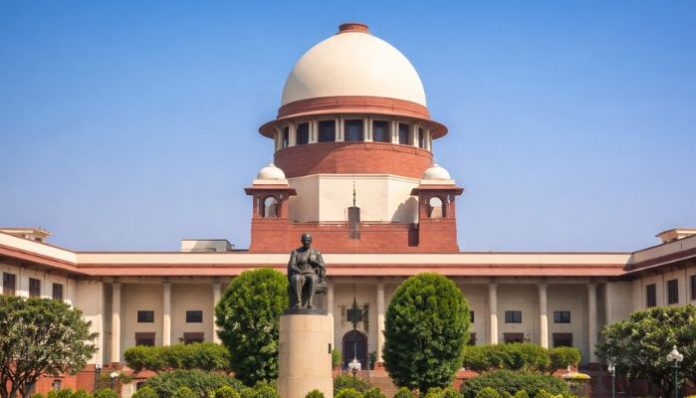
The Supreme Court of India has taken suo motu cognisance of concerns surrounding the definition of the Aravalli Hills. A Special Bench headed by Chief Justice of India Surya Kant will hear the matter on 29th December. The matter has been taken up by the apex court even as the Government of India has already imposed a ban on the grant of new mining leases in the Aravalli region. The government has reiterated its commitment to the long term protection of the ecosystem as a continuous and ancient geological ridge.
Suo motu case on definition of Aravallis
The case titled “Definition of Aravalli Hills and Ranges and Ancillary Issues” stemmed from concerns flagged over how different states have historically applied varying definitions of the Aravalli landscape. The mountain range spans across Delhi, Haryana, Rajasthan and Gujarat. It plays a vital ecological role and acts as a natural green barrier against the eastward expansion of the Thar desert.
Earlier, the apex court had observed that inconsistent definitions had weakened regulatory enforcement, specifically in cases linked to mining and land use.
Committee report and elevation based criteria
While hearing matters related to illegal mining in the Aravallis in May 2024, the Supreme Court constituted a committee under the Ministry of Environment, Forest and Climate Change to examine the issue. In October this year, the panel submitted its report and recommended a uniform, elevation linked definition.
In its report, the committee proposed that any landform in Aravalli districts with an elevation of 100 metres or more from the local relief should be classified as an Aravalli Hill. The committee further defined the Aravalli Range as two or more such hills located within 500 metres of each other. The range is to be measured from the outermost boundary of the lowest contour line.
Court’s earlier acceptance and mining safeguards
A Bench led by former CJI BR Gavai had accepted the committee’s recommendations in November this year. The Bench also accepted the proposed measures aimed at sustainable mining and stricter action against illegal extraction.
Notably, the court declined to impose a blanket mining ban, citing the risk of mafias and criminalisation. However, it endorsed the identification of core, ecologically sensitive and conservation critical zones where mining would remain prohibited.
The court had also directed that until a Management Plan for Sustainable Mining is finalised by the MoEFCC through the Indian Council of Forestry Research and Education, no new mining leases should be granted, a restriction the government has already put in place.
GoI banned issuance of new mining leases
On 24 December, the Union government, through the MoEFCC, imposed a complete ban on the issuance of new mining leases across the entire Aravalli landscape that stretches from Gujarat to the National Capital Region.
The directive applies uniformly to all Aravalli districts and is aimed at preserving the range as a continuous geological ridge, curbing unregulated extraction, and protecting its critical ecological functions, which include groundwater recharge, biodiversity conservation, and prevention of desertification.
Furthermore, the Centre also tasked the Indian Council of Forestry Research and Education to identify additional ecologically sensitive zones where mining must remain prohibited and to prepare a comprehensive, science based Management Plan for Sustainable Mining for the entire Aravalli region.
The plan will assess cumulative environmental impacts, ecological carrying capacity, conservation critical areas, and restoration needs, with a draft to be placed in the public domain for consultation. Existing mining operations will continue only under strict compliance with environmental safeguards and directions issued by the Supreme Court of India, with further restrictions envisaged to ensure sustainability.
29 December hearing
The three judge Special Vacation Bench will now examine if the accepted definition and safeguards sufficiently address ecological concerns while ensuring regulatory clarity across states. The outcome of the case is expected to have significant implications for environmental governance, mining regulation and long term conservation of the Aravalli ecosystem.
