

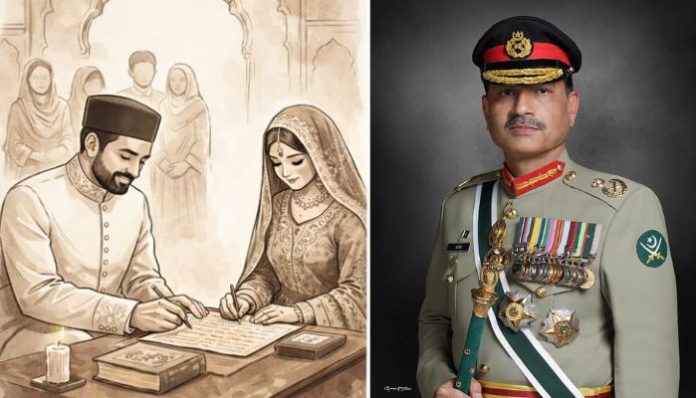
In Pakistan, marrying within the family is a common and widely accepted part of social life. The issue has once against gained spotlight after Pakistan’s Army Chief Syed Asim Munir’s daughter Mahnoor got married to her first cousin Captain Syed Abdul Rehman Qasim, who is Munir’s brother’s son.
Field Marshal Asim Munir' gets his daughter married to the son of Qasim Munir who is Asim Munir"s brother. Both paternal cousins tied the bond in Rawalpindi.
— Raja Muneeb (@RajaMuneeb) December 29, 2025
While the wedding itself was a private event, it drew attention because of the invovlement of one of the most powerful families in the country that has access to the best education and healthcare facilities.
Studies show that around 60% to 70% of marriages in the country take place within the family, mostly between first cousins. This is far higher than the global average of about 10%. For many households, this practice has continued for generations and is seen as normal and practical.
Health experts have been raising concerns about cousin marriages for many years. Children born to first cousins face almost double the risk of birth defects compared to the general population. When such marriages continue across generations, inherited genetic disorders become more common.
Pakistan already has a high number of people affected by diseases such as thalassaemia, cystic fibrosis and intellectual disabilities, especially in regions where cousin marriages have been common for decades.
According to the World Health Organisation, about 30% to 40% of infant deaths in Pakistan are linked to consanguineous marriages. In Punjab alone, thalassaemia affects roughly one in every 10,000 births. Many of these children depend on lifelong blood transfusions, which creates serious emotional and financial stress for families and also puts pressure on the healthcare system.
Recent research has further supported these concerns. A 2023 study from Khyber Pakhtunkhwa found that children born from cousin marriages had a 2.5 times higher risk of chromosomal disorders. Genetic experts explain that repeated marriages within the same family reduce genetic diversity, which slowly increases health problems over time.
Despite these risks, many people continue to support cousin marriages for cultural, religious and practical reasons. Marrying within the family is often seen as a way to protect property, keep family ties strong and avoid social disputes. In a society where women often depend on extended family networks for support, these reasons still hold importance for many families.
Several Muslim-majority countries have taken steps to reduce the health risks linked to such marriages. Iran introduced compulsory premarital screening for thalassaemia and managed to cut cases by around 70%. Saudi Arabia now requires genetic counselling before marriage. Pakistan has made smaller attempts, including a pilot screening programme launched in Islamabad in 2024, but these efforts remain limited and weakly enforced.
Because the military has a strong influence in Pakistan, personal choices made by its top leadership often carry symbolic meaning. The Munir family wedding has therefore sparked a wider discussion across the country.
With nearly half of Pakistan’s population under the age of 25, experts say the health of this young generation depends not only on hospitals and doctors, but also on the willingness to rethink long-followed customs. Many believe that protecting the family should also mean protecting future children from health problems that can be prevented.
