

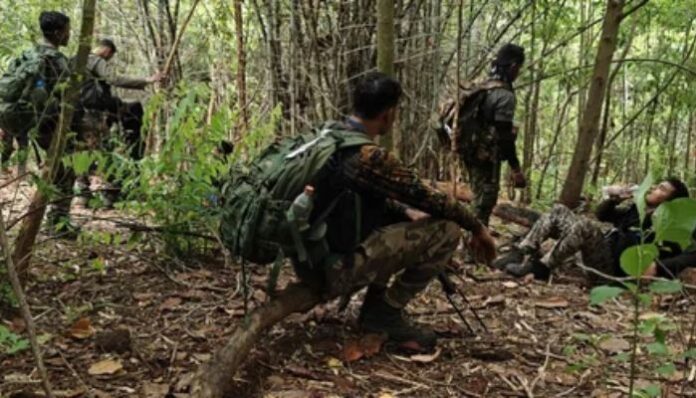
At least 11 security personnel were injured on Sunday (25th January), after a series of improvised explosive device (IED) blasts hit an ongoing anti-Maoist operation in Chhattisgarh’s Bijapur district. The injured jawans were later airlifted to Raipur for advanced medical treatment, police officials confirmed.
The incident took place during a joint operation carried out by the District Reserve Guard (DRG) and the CRPF’s elite Commando Battalion for Resolute Action (CoBRA). Acting on intelligence inputs about the presence of Maoists in the western part of Usur area in Bijapur, security forces had launched the operation on Saturday, 24th January.
STORY | 11 security personnel injured as IEDs planted by Naxalites go off in Chhattisgarh
— Press Trust of India (@PTI_News) January 26, 2026
Eleven security personnel were injured as improvised explosive devices (IEDs) planted by Maoists went off during an anti-Naxalite operation in Chhattisgarh's Bijapur district, officials… pic.twitter.com/x8mCjOT106
According to officials, six IED blasts went off during the operation, leaving ten DRG personnel and one CoBRA sub-inspector injured. While most of the jawans escaped with injuries to their legs and eyes, a few were reported to be seriously hurt.
Injured jawans airlifted amid difficult terrain
The blasts occurred near the Karegutta Hills, a forested and rugged region located along the Chhattisgarh-Telangana border. Due to the extremely tough terrain and dense forest cover, evacuating the injured personnel proved to be a major challenge for the forces on the ground.
रायपुर, छत्तीसगढ़: बीजापुर में नक्सल विरोधी अभियान के दौरान आईईडी विस्फोट में 11 जवान घायल हो गए। घायल जवानों को इलाज के लिए तत्काल रायपुर लाया गया है, जहां वे रामकृष्ण केयर हॉस्पिटल में भर्ती हैं और उनका उपचार चल रहा है।रविवार रात को इनमें से 12 जवानों को हेलीकॉप्टर से एयरलिफ्ट… pic.twitter.com/SxlSOhiSo1
— IANS Hindi (@IANSKhabar) January 26, 2026
“It was very difficult to move the injured jawans from the blast site because of the terrain. However, all of them were safely rescued and airlifted by helicopter to Raipur for better medical care,” a senior police officer said.
Officials confirmed that all the injured personnel are out of danger. “They are stable, conscious and responding well to treatment,” the officer added.
The injured CoBRA sub-inspector has been identified as G D Rudresh Singh of the 201 Battalion, who suffered a serious leg injury. Among the DRG personnel, Shailendra Ekka and Aiyatu Potam sustained leg injuries, while Sonam Kunjam, Ramesh Hemla and Prakash Miccha suffered splinter injuries to their eyes due to the explosions.
Karegutta Hills: Hotspot of anti-Naxal operation for months
Karegutta hills have been ground zero for major anti-Naxal operations for months. Back in April-May last year, forces pulled off their biggest-ever success, wiping out 31 Naxals, including 16 women, in 21 days of encounters.
No jawans died, despite brutal heat over 45°C, dehydration, and IED threats. Union Home Minister Amit Shah hailed it on X: once a hub of red terror ruled by PLGA Battalion 1, DKSZC, TSC, and CRC, where they trained, plotted, and fabricated weapons, now with pride flying the tricolour.
Karegutta hills, a 60-km-long, steep fortress on Bijapur-Mulugu borders, sheltered 300-350 armed cadres for years. Security teams, CRPF, STF, DRG, used smart intel to smash 214 hideouts, grab 450 IEDs, 818 BGL shells, explosives, and 12,000 kg of rations. They busted four Naxal tech units churning out bombs and guns. Eighteen jawans got hurt by IEDs then, too, but all recovered.
This fits the bigger push: 197 hardcore Naxals down in early 2025, over 500 in 2024-25, mostly in Bijapur. Camps, helipads, and development are shrinking Naxal turf, from 126 districts in 2014 to 18 now.
Union Minister Amit Shah vows a Naxal-free India by 31st March, 2026. Karegutta’s fall shows forces are closing in, splitting big Naxal groups and dominating tough spots like Bijapur’s national park and Narayanpur’s Maad.
