

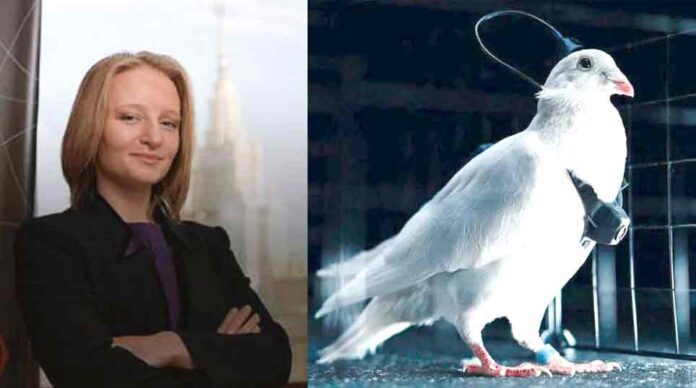
A Moscow-based neurotechnology startup, Neiry Group, has revealed experiments that implant neural electrodes into the brains of pigeons, effectively transforming the birds into remotely controlled “biodrones.” The company is closely associated with an organisation headed by President Vladimir Putin’s daughter Katerina Tikhonova.
According to reports, Neiry has conducted successful test flights of these cyborg pigeons as part of a project codenamed PJN-1. The first public demonstrations reportedly occurred in late November 2025, with birds completing controlled flights from a laboratory and returning to base.
The technology involves surgically implanting custom-designed electrodes into targeted regions of the pigeon’s brain. These electrodes connect to a stimulator and controller housed in a small backpack worn by the bird, which also includes solar-powered electronics, GPS tracking, and in some configurations, a chest-mounted video camera. Operators can remotely dictate flight paths by delivering electrical stimuli to influence the bird’s direction and behaviour, bypassing traditional training methods. A small solar module mounted on the bird’s back powers the entire system.
The stimulator sends pulses that influence the bird’s actions, for example, to turn left or right. The system’s positioning relies on GPS and other methods. Reportedly, faces are blurred and personal data removed from the footage obtained by the drone-pigeon’s cameras.
While trained pigeons have been used by humans as a medium of communication for thousands of years, the biodrones require no training to operate. They are essentially operated like normal drones, an operator needs to conitinously monitor and control their movements.
Neiry Group, founded by entrepreneur Alexander Panov, claims the biodrones offer significant advantages over conventional mechanical drones. Pigeons can fly longer distances- potentially over 300 miles per day, exhibit greater endurance, manoeuvre adeptly in complex urban environments, and blend seamlessly into natural surroundings, making them harder to detect in restricted airspace or for covert operations.
The company said that the birds with brain implants are designed for peaceful applications, such as infrastructure inspection, environmental monitoring, and search-and-rescue missions. However, they acknowledge its potential for broader uses.
The company has close ties with the Institute of Artificial Intelligence at Moscow State University (MSU), which is headed by Katerina Tikhonova, the younger daughter of Russian President Vladimir Putin. The startup has collaborated with scientists from the institution on joint projects.
It has also secured substantial funding from various sources, including a fund linked to sanctioned oligarch Vladimir Potanin. Significant funding also came from investment firms tied to Russia’s sovereign wealth fund, led by Kirill Dmitriev, Putin’s chief negotiator.
These links have fuelled speculation about high-level state support for the project and potential military applications, though Neiry and others maintain that the work is civilian-oriented.
Videos and images released by Neiry show pigeons equipped with visible head wires, backpacks, and cameras taking flight in controlled settings. The company has produced dozens of such modified birds for ongoing trials. After concluding laboratory tests, long-range tests involving flights of tens of kilometers are planned, with some birds potentially deployed far from Moscow.
Alexander Panov, Neiry’s chief executive, has said the system could be adapted to other species capable of carrying heavier payloads or blending into different environments. He said, “Currently, the solution works with pigeons, but any bird could be used as a carrier. To carry more payload, we plan to use ravens. For monitoring coastal facilities, seagulls, and for larger offshore areas, albatrosses.”
