

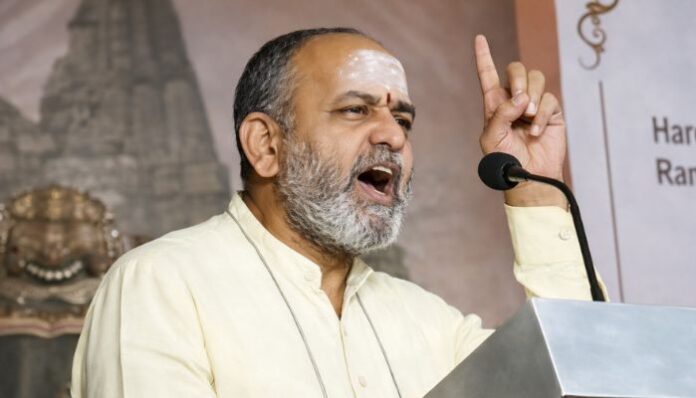
On 23rd February, Madras High Court Justice GR Swaminathan firmly defended the spiritual tradition of revering Gurus as divine manifestations. He asserted that those who mock believers are “rascals, fools and barbarians” and that they cannot claim moral superiority in the name of rationalism.
Justice Swaminathan was speaking at a spiritual gathering in Tamil Nadu. He said that faith in Gurus is deeply rooted in Indian civilisation and cannot be dismissed simply because a section of self-described rationalists disagrees with it.
Rationalism cannot become intolerance
Addressing the ‘Guru Vandana Utsava’ organised by the Hosur Sathsangh, Justice Swaminathan responded to criticism often levelled against devotees who see the Guru as a form of God. He said, “In Tamil Nadu, some people call themselves rationalists. They call us rascals, fools and barbarians because we see the Guru as a form of God. I say that those who say so are rascals, fools and barbarians.”
The judge made it clear that the issue was not rational inquiry but the tendency to ridicule and insult believers. His remarks are in line with a broader argument that rationalism cannot become a shield for cultural derision or intolerance towards spiritual traditions.
Guru as living presence of the divine
Justice Swaminathan explained the philosophical basis behind Guru reverence, noting that while God may be abstract, a Guru represents a tangible and living spiritual guide. He said, “There may be many gurus in mutts, but all of their philosophy is the same. God is abstract, but gurus are God’s living presence.”
Such views are consistent with centuries-old Indic traditions where the Guru is seen not merely as a teacher, but as a conduit of knowledge, discipline and moral strength.
Personal experience reinforces belief
Recounting a personal episode, the judge described how his family car suffered a puncture amid dense fog between Chandigarh and Delhi. With visibility extremely poor, he said he turned to prayer and chanted in devotion to his Guru.
“I chanted and worshipped Guru, and fortunately, we did not face any untoward incidents,” he said, attributing their safety to divine grace. By sharing this experience, Justice Swaminathan emphasised how faith provides psychological strength and resilience during moments of vulnerability.
Courage in public life
The judge also remarked that he has more than four years of service remaining and intends to act with greater courage, drawing strength from spiritual guidance. He stated, “I have more than four years in service and I will take support from gurus for courage.”
Spiritual discourse and Indian ethos
Justice Swaminathan further referred to his recent interaction with a yogi near Tenkasi and discussions around the concept of a spiritual aura, which he said can help individuals overcome personal weaknesses when in close proximity to enlightened masters.
Such reflections, supporters argue, are part of India’s long civilisational discourse where spirituality, philosophy and public life have historically coexisted.
Justice Swaminathan directed lighting of traditional lamp
Recently, Justice Swaminathan directed that a traditional lamp be lit at the Deepathoon, a stone pillar situated near a historic dargah in Thiruparankundram, alongside the customary temple locations. The state government objected to the order and over 100 Members of Parliament moved an impeachment motion alleging bias and departure from secular principles. However, supporters view the judgment as an assertion of continuity of tradition rather than a breach of constitutional duty.
