

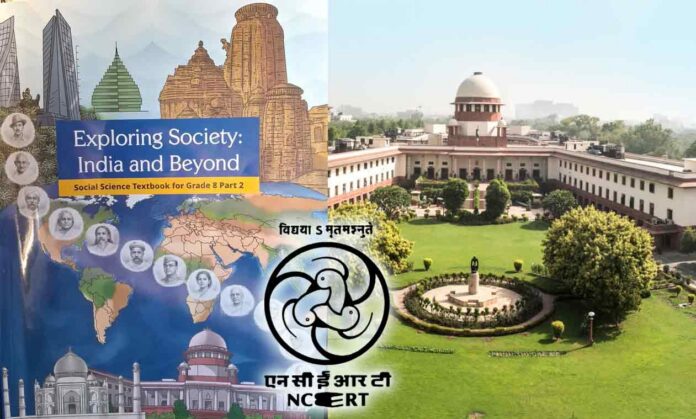
The Supreme Court of India on Thursday imposed a complete blanket ban on the publication, reprinting, and digital dissemination of the newly released NCERT Class 8 social science textbook that contains a chapter on the role of the judiciary, which includes references to “corruption at various levels of the judiciary”.
A three-judge bench, headed by Chief Justice of India Surya Kant and comprising Justices Joymalya Bagchi and Vipul M. Pancholi, prima facie observed that the publication of the book is a serious misconduct, which can come within the purview of criminal contempt of court. The bench also issued a contempt notice to the Secretary of School Education, Ministry of Education and the NCERT Director, ordering them to explain why contempt of court should not be initiated against them.
The controversial book, titled Exploring Society: India and Beyond (Part 2, First Edition), was released by the National Council of Educational Research and Training (NCERT) on 24 February 2026. Chapter 4, “The Role of the Judiciary in Our Society”, lists corruption in the judiciary, massive case backlogs, and a shortage of judges as key challenges facing the institution. It refers to hundreds of complaints received against judges and suggests, by selectively quoting a former Chief Justice of India, that the judiciary itself has acknowledged institutional corruption.
The court described the inclusion of such content in a textbook aimed at high school students as a calculated move to undermine and demean the dignity of the judiciary, adding that it appeared prima facie to amount to criminal contempt by scandalising the institution.
Chief Justice Surya Kant observed that the chapter omitted the judiciary’s illustrious history and its contributions to upholding constitutional morality, the basic structure doctrine, legal aid, and access to justice. He noted that the narrative contained in the book chose not to delve into the transformative initiatives and measures of this court. He further remarked that exposing impressionable young minds to such a biased narrative could create permanent misconceptions, and that the book would reach not only students but also teachers, parents, and the next generation.
The Chief Justice described the publication as part of a deep-rooted, well-orchestrated conspiracy to malign the judiciary and declared that heads must roll. He stated that a gunshot had been fired and the judiciary was bleeding today, while stressing that the court was not seeking to stifle legitimate criticism but to protect the integrity of the national curriculum and the institution’s standing in the eyes of the public.
In a strongly worded order, the Supreme Court directed a complete blanket ban on any further publication, reprinting, or digital dissemination of the book, warning that any attempt to circumvent the order through electronic means or altered titles would be treated as wilful breach and direct interference with the administration of justice. The court also ordered the immediate seizure and removal from public access of all physical and digital copies currently in circulation, including those in storage, retail outlets, and educational institutions.
The court ordered, “It shall be personal responsibility of NCERT Director and the principal of every school where the book has reached to effectuate immediate seizure and sealing of all copies of the book in their premises and submit a compliance report. Ensure that no instruction is imparted based on the subject book. Principal Secretaries of all states are to comply. Compliance to be sent within 2 weeks.”
The court warned that any sharing of the offensive content would be taken seriously, and added that nothing should be taught to the students based on the book. The bench said, “Any attempt to circumvent this order through electronic means or altered titles shall be seen as direct interference, willful breach and defiance of directions.”
The apex court also directed the NCERT Director to submit the names of the persons involved in preparing the offending chapter. As per the order, the original minutes of meetings of the part wherein the offending chapter was deliberated and finalised shall be produced on the next date of hearing.
The court further directed that people who authored and defended the offending chapter will not be associated with the NCERT or any other ministry in future. “That’s very little consequence. They fired gunshot, judiciary is bleeding today,” CJI said.
Notably, NCERT has already halted distribution of the book following the initial controversy and issued a press release describing the content as inappropriate due to an error of judgement. All the books from the distribution have been withdrawn, and the council is attempting to retrieve 32 copies of the book already sold. The chapter is to be rewritten in consultation with appropriate authorities.
However, the bench found NCERT’s press release insufficient, noting that it contained not a single word of apology and that the NCERT Director’s initial written defence of the content was contemptuous and reckless.
Solicitor General Tushar Mehta, appearing for the Centre, tendered an unconditional apology on behalf of the government and NCERT. He stated that only 32 physical copies had been distributed and would be retrieved, assuring that those responsible for the chapter would not be associated with the Ministry of Education or NCERT in future, and undertook to publish a more unqualified public apology.
