

Following strong objections by the Supreme Court over the inclusion of a chapter on judicial corruption in a Class VIII social science textbook, the National Council of Educational Research and Training (NCERT) has halted the distribution of the book. In a press release dated February 25, 2026, the NCERT admitted that there was an “error of judgment” on its part in including the chapter titled “The Role of Judiciary in Our Society” in the book.
“On receiving the textbook, it has been observed that certain inappropriate textual material and error of judgment have inadvertently crept into Chapter No 4, entitled “The Role of Judiciary in Our Society” (pg 125-142),” the press release said, adding that the Ministry of Education has directed to stop the distribution of the book.
“The Department of School Education & Literacy (Ministry of Education) also made a similar observation and directed that the distribution of this book may be kept on strict hold until further orders. The same has been complied with,” the NCERT said.
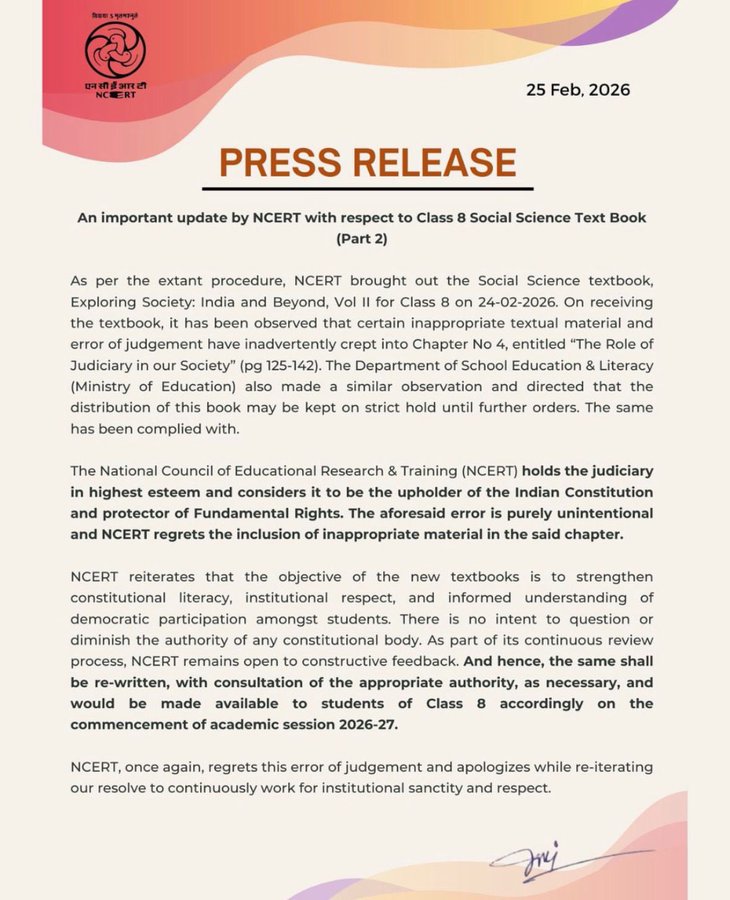
The educational body clarified that it holds the judiciary in the highest esteem and that the error was purely unintentional. “The National Council of Educational Research and Training (NCERT) holds the judiciary in the highest esteem and considers it to be the upholder of the Indian Constitution and protector of Fundamental Rights. The aforesaid error is purely unintentional, and NCERT regrets the inclusion of inappropriate material in the said chapter, ” the NCERT asserted.
On Wednesday (25th February), a Bench led by the Chief Justice of India Surya Kant took suo motu cognisance of the issue and expressed strong displeasure at the introduction of the chapter on corruption on judiciary. Treating it as an attack on the judiciary, CJI remarked that he would not “allow anyone on earth to defame the judiciary.” The CJI termed the chapter as part of a “deep-rooted and calculated conspiracy” to tarnish the image of the judicial institution, and said that the institution continues to enjoy the highest level of public trust.
Notably, the chapter explains the structure of courts and access to justice as well as systemic challenges facing the judicial system, including corruption, a massive backlog of cases, and a shortage of judges. The textbook also presents data highlighting the scale of pendency in Indian courts, estimating that around 81,000 cases are pending in the Supreme Court, about 62.40 lakh in High Courts, and nearly 4.70 crore in district and subordinate courts. The chapter aims to introduce students to the real-world challenges of the justice system.
