

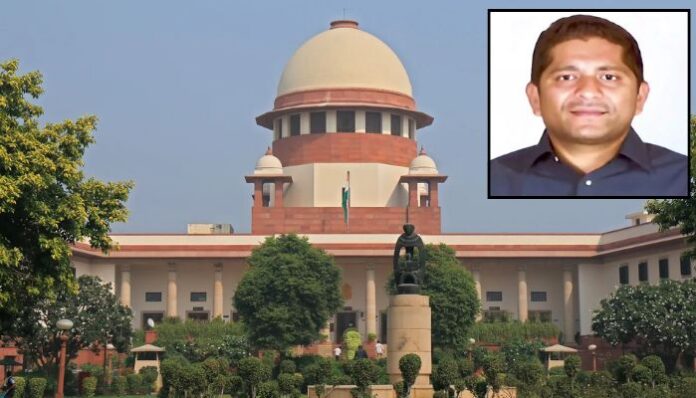
In a significant development, the Supreme Court on Friday, 20th March, granted regular bail to Muppidi Avinash Reddy, one of the key accused in the multi-crore Andhra Pradesh liquor policy case. The case is linked to large-scale irregularities and a well-organised kickback network that operated between 2019 and 2024.
A bench led by Chief Justice Surya Kant, along with Justices Joymalya Bagchi and Vipul M Pancholi, used its special powers under Article 142 of the Constitution to grant relief. Instead of anticipatory bail, the court converted it into regular bail, noting that the accused had already returned to India, surrendered, and spent time in custody.
#NewDelhi | The Supreme Court on Friday granted regular bail to Muppidi Avinash Reddy, a key accused in the multi-crore Andhra Pradesh liquor policy scam.https://t.co/sW5HCJQ7xd
— Deccan Chronicle (@DeccanChronicle) March 20, 2026
“Without expressing any opinion on the merits of the case, we invoke our powers under Article 142 of the Constitution… the appellant is directed to be released on regular bail during the pendency of the trial,” the bench said. The court also made it clear that this order should not be treated as a precedent for similar cases in the future.
Courtroom arguments and observations
During the hearing, senior advocate Sidharth Luthra, appearing for the state, opposed granting bail. However, the bench observed that continuing custody in this case appeared to be more about “ego satisfaction.”
Luthra countered this by stating that the accused had returned as promised and had already been in police as well as judicial custody. He asked the court for more time if required for the investigation, stating that if bail was allowed, it might affect other related cases.
On the other hand, senior advocate Siddharth Dave, who was representing Avinash Reddy, told the court that his client had fulfilled his promise of surrendering before the authorities on 26th February this year. The court was also informed that out of the seven accused, as many as five have already been granted bail, while the remaining five are still in custody.
The court was also told that the accused was related to one of the co-accused and had been accused of handling as well as transferring kickbacks related to the case.
What is the Andhra Liquor Scam case?
The case dates back to the year 2019, when the YSR Congress Party (YSRCP), led by Jagan Mohan Reddy, came into power in Andhra Pradesh. Before the elections, Jagan had promised that he would introduce prohibition in the state, but in a gradual manner. In October 2019, a new liquor policy was introduced.
Under this policy, the government took control of around 3,500 liquor shops, reduced their operating hours, and increased prices. The entire liquor trade was handed over to a state-run body, the Andhra Pradesh State Beverages Corporation Limited (APSBCL).
However, after the Telugu Desam Party (TDP)-led coalition came to power later, it ordered an investigation into the policy. The CID probe found that the liquor procurement process was manipulated to favour certain brands. According to officials, this caused wrongful gains worth around ₹3,200 crore and led to major losses for the state.
Investigators claimed that officials bypassed the automated order system and used manual methods to issue supply orders in exchange for kickbacks. The C-Tel software, which was meant to ensure transparency, was reportedly disabled soon after the policy came into force, allowing discretionary allocation of liquor orders.
Irregularities and system manipulation
Further findings suggested that the system was tilted in favour of select suppliers, while some brands disappeared from the market altogether. A committee formed by APSBCL later submitted a report saying “unfair discrimination” in the procurement process.
The policy also led to unintended consequences. With higher liquor prices, illegal smuggling from neighbouring states like Telangana and Karnataka reportedly increased. At the same time, the shift from digital payments to cash transactions at retail outlets raised further concerns about transparency.
Based on these findings, a formal complaint was filed in September 2024, and a Special Investigation Team (SIT) was formed in February 2025 to investigate the matter further.
