

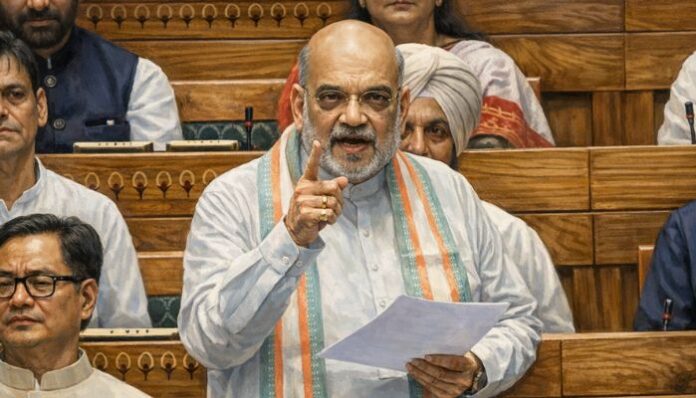
On 30th March, Union Home Minister Amit Shah declared that India has effectively become “Naxal-mukt” while speaking in Lok Sabha on the matter. He termed the eradication of Left-Wing Extremism (LWE) as the most significant achievement of the Narendra Modi government. During his speech, he launched a sharp attack on Congress and accused the party of enabling, legitimising and politically sheltering the Maoist ecosystem for decades.
Replying to the discussion in the Lok Sabha on efforts to eliminate Naxalism, HM Shah said that with only one active member of the CPI (Maoist) central committee remaining, talks are underway. The rest of the leadership has either been neutralised or has surrendered. He asserted that the Centre was on the brink of completely fulfilling its stated deadline of ending Naxalism, that is, 31st March 2026.
Congress rule and expansion of Naxalism
HM Shah stated that the period between the 1970s and early 2000s, when Naxalism expanded, consolidated and spread across multiple states, largely coincided with Congress rule at the Centre. He pointed out that except for a few years, the Congress governed most of this period, during which Maoist ideology grew into a nationwide insurgency covering 12 states and a vast “red corridor”.
He questioned why tribal regions were not developed or even provided with basic infrastructure such as housing, drinking water, schools, banking access and connectivity during the time when Congress was in power. According to HM Shah, the lack of development in these regions was not the cause of Naxalism but its consequence.
Indira Gandhi, Left ideology and political support
HM Shah stated that the roots of ideological accommodation could be traced back to the 1970s, when former Prime Minister Indira Gandhi accepted support from Left-aligned forces during a presidential election contest. He argued that this political alignment allowed Maoist ideology to gain legitimacy and expand during that period.
नक्सलवाद का मूल कारण विकास की कमी नहीं, बल्कि वामपंथी विचारधारा है, जिसे 1969 में राष्ट्रपति चुनाव जीतने के लिए इंदिरा गाँधी ने स्वीकार कर लिया था। pic.twitter.com/irSnkbf7HS
— Amit Shah (@AmitShah) March 30, 2026
He further stated that Naxalism was not a response to injustice or poverty. It was an ideological movement rooted in Left extremism which is aimed at overthrowing democratic institutions through armed struggle.
कम्युनिस्ट पार्टी अन्याय का विरोध करने के लिए नहीं, बल्कि हमारी संसदीय प्रणाली का विरोध करने के लिए बनी। pic.twitter.com/GvoF5YZ2iD
— Amit Shah (@AmitShah) March 30, 2026
NAC, UPA era and alleged policy influence
While speaking on the UPA era, HM Shah targeted the National Advisory Council (NAC). He called it an “extra constitutional” body that influenced policymaking. Notably, NAC was chaired by then Congress leader Sonia Gandhi. HM Shah stated that several members of the council and associated policy ecosystem were sympathetic to Maoist narratives.
सोनिया गांधी की अध्यक्षता में बनी NAC में नक्सल समर्थक भरे पड़े थे। pic.twitter.com/0YgkOIsKkP
— Amit Shah (@AmitShah) March 30, 2026
He named individuals and “activists” linked to the NAC and policy bodies and stated that such ideological influence weakened the state’s fight against Naxalism. He also referred to the inclusion of Binayak Sen in planning processes. He further stated that Congress leaders, including Jairam Ramesh, had intervened in favour of individuals accused of Maoist links, such as Mahesh Raut.
Rahul Gandhi and ‘association’ with Naxal sympathisers
चाहे नक्सलियों से मिलना हो, या उनका समर्थन करना हो, राहुल गांधी हमेशा नक्सलियों के साथ खड़े दिखते हैं। pic.twitter.com/ja7hos72Ef
— Amit Shah (@AmitShah) March 30, 2026
Targeting Leader of Opposition (LoP) Rahul Gandhi, HM Shah stated that he had shared public platforms with individuals and groups linked to Maoist ideology on several occasions. He added that organisations associated with Naxal fronts had participated in the Bharat Jodo Yatra.
Referring to a protest at India Gate, Shah said that slogans in support of Maoist leader Hidma were raised and that a video of the event was shared on social media by Gandhi. He used these instances to argue that Congress leaders had consistently maintained proximity to Naxal sympathisers.
Chhattisgarh government under Congress targeted
HM Shah also pointed out that in Chhattisgarh, the most affected state by Naxalism, the problem persisted due to the Congress government in the state. He asserted that while several other states had largely eliminated Maoist presence before 2024, Chhattisgarh remained affected because the Congress led state government had protected Naxal elements.
He said the situation changed only after the change of government in the state, which enabled coordinated action between the Centre and the state administration.
Salwa Judum, judiciary and political controversy
While recalling the anti-Naxal movement Salwa Judum, HM Shah noted that it was initiated by Congress leader Mahendra Karma. He criticised the Supreme Court judgment that led to the disbanding of the movement’s auxiliary force and argued that withdrawal of arms left local fighters vulnerable and led to targeted killings by Maoists.
He also criticised the later political elevation of Justice Sudarshan Reddy, who was associated with the judgment, stating ideological bias and linking it to Congress support.
‘Urban Naxals’ and intellectual ecosystem
The home minister criticised the “urban Naxal” ecosystem, stating that thousands of articles had been written advocating dialogue with Maoists while ignoring victims of violence. He said that there was a visible “double standard” in public discourse, where sympathy was extended to armed extremists but not to civilians, tribals and security personnel affected by Naxal violence.
Development, security and policy shift after 2014
Highlighting the shift after 2014, Shah credited the Modi government’s “clear policy and strong political will” for turning the tide against Naxalism. He said that a combination of security operations, intelligence coordination, financial crackdown, surrender policies and accelerated development had weakened Maoist networks.
He presented data to support the numbers, stating that in the past three years, 706 Naxalites were killed, 2,218 were arrested and 4,839 surrendered. He added that Naxal affected districts have reduced drastically and that infrastructure expansion, including roads, mobile towers, banking facilities and schools, has reached previously inaccessible regions.
HM Shah also underlined the role of central forces, especially the CRPF’s CoBRA units, along with state police forces, in dismantling Maoist strongholds.
Naxalism as ideological war against democracy
Rejecting the argument that Naxalism was a fight for justice, HM Shah said it was an ideological war against democracy, driven by the belief that “power flows from the barrel of the gun”. He argued that Maoists sought to create governance, security and constitutional vacuums to establish parallel authority.
He further said that India’s Left movements were historically influenced by foreign ideological centres such as Russia and China and questioned their ability to represent Indian interests.
‘Top achievement’ alongside major policy decisions
HM Shah positioned the elimination of Naxalism as a defining milestone for the Modi government and placed it alongside decisions including construction of the Ram Mandir, implementation of GST, enactment of CAA, abrogation of Article 370 and women’s reservation.
