

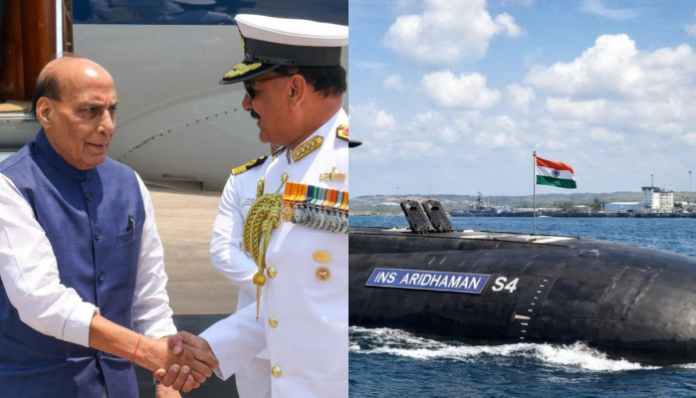
On 3rd April (Friday), India’s sea-based nuclear deterrent capabilities have got a major boost with the induction of INS (Indian Naval Ship) Aridhaman. It is a member of the Arihant-class submarines and the third nuclear-powered ballistic missile submarine (Ship, Submersible, Ballistic, Nuclear vessels or SSBN) in the country. The cutting-edge stealth frigate INS Taragiri was also commissioned by the Indian Navy during a ceremony in Visakhapatnam. “Aridhaman is not merely a word, but power,” Defence Minister Rajnath Singh, who presided over the two induction ceremonies, tweeted early in the morning.
शब्द नहीं शक्ति है, ‘अरिदमन’!
— Rajnath Singh (@rajnathsingh) April 3, 2026
India will have its first three operational ballistic missile submarines at sea with the after the latest developmen under the Strategic Forces Command. This augments the country’s sea-based leg of the nuclear triad and brings it toward attaining perpetual at-sea deterrence. Now, at least one nuclear submarine will be stationed at all times.
Compared to the earlier-commissioned INS Arihant and INS Arighaat, the domestic SSBN is built to accommodate more long-range nuclear-tipped missiles. According to the nation’s nuclear doctrine, it improves both striking potential and survivability.
#WATCH | Andhra Pradesh | Defence Minister Rajnath Singh arrives at Visakhapatnam to attend the commissioning ceremony of the advanced stealth Frigate Taragiri
— ANI (@ANI) April 3, 2026
He will also commission India’s indigenous nuclear Submarine INS Aridaman into the Indian Navy https://t.co/JFxsuXI02M pic.twitter.com/K7p1WcIyxA
The 7,000-ton INS Aridhaman is bigger and more sophisticated than the INS Arihant and INS Arighaat. The submarine, which was developed in Visakhapatnam marks a significant advancement in India’s domestic defence potential. It is crafted for increased endurance and stealth and has an 83 MW Compact Light Water Reactor developed by the Bhabha Atomic Research Centre (BARC). Its underwater detection and survivability are boosted by its sophisticated domestic sonar equipment and acoustic suppression technology.
Its larger missile capacity is an important advancement over previous platforms. The INS Aridhaman can carry up to 24 K-15 Sagarika missiles with a range of 750 kilometres or eight K-4 missiles with a range of 3,500 kilometres because of its eight vertical launch system tubes, which are double that of preceding submarines.
Future K-5 missiles with a range of about 6,000 kilometres are also going to be supported by it. The submarine will be at the highly protected Project Varsha naval complex intended to house India’s nuclear fleet, close to Visakhapatnam.
Additionally, a fourth SSBN is being built, and both will be able to take additional K-4 missiles because of their larger size. With an estimated cost of Rs 90,000 crore, the four platforms are a part of the Advanced Technology Vessel (ATV) project. India can now launch nuclear missiles from land, air, and sea after completing its nuclear triad with the introduction of such platforms. It is presently one of a few countries that have nuclear-powered submarines, along with the United States, Russia, the United Kingdom, France and China.
The Indian Navy intends to commission its first nuclear attack submarine (SSN) that is entirely indigenously designed by 2036-2037 and a second is anticipated to arrive in two years. The first two vessels have already been approved by the Cabinet Committee on Security. Likewise, the Modi government is making headway on other naval capabilities, such as discussions for modern diesel-electric submarines under Project-75 (I) and the projected installation of the Russian Akula-class nuclear-powered attack submarine, Chakra III.
The Navy’s long-term submarine development plan, which was developed in 1999, called for the induction of 24 conventional submarines by 2030 and 6 have been put into service thus far.
Indian Navy welcomes INS Taragiri
Taragiri, the fourth powerful platform of the Project 17A class, is a 6,670-ton representation of “Make in India” with more than 75% indigenous content and the engineering prowess of the nation’s domestic shipyards. Its Combined Diesel or Gas (CODOG) propulsion system provides high-speed, long-endurance performance appropriate for multifaceted marine activities.
⚓️ Legacy Reborn. Power Redefined.
— SpokespersonNavy (@indiannavy) April 3, 2026
Presenting the story of INS Taragiri – a journey of strength, stealth and indigenous excellence, reflecting India’s rise as a formidable maritime power.
From legacy to the future fleet, Taragiri stands ready to safeguard the seas.… pic.twitter.com/T8bigXfQkD
This frigate was constructed by Mazagon Dock Shipbuilders Limited (MDL), Mumbai and has a sleeker shape. Its highly streamlined hull and drastically lower Radar Cross-Section enable it to function with better stealth, reflecting a generational breakthrough in design.
It is fitted with supersonic Surface-to-Surface Missiles, Medium-Range Surface-to-Air Missiles, and a powerful Anti-Submarine Warfare suite, all of which are connected by a cutting-edge Combat Management System for swift threat response. Taragiri’s versatility extends beyond its combat preparedness as it can do both humanitarian aid and disaster relief (HADR) missions alongside high-intensity operations. It is built for multifaceted maritime activities and “High-Speed – High Endurance” agility.
The ship protects the country’s maritime interests and reinforces its Navy’s standing as a combat-ready, independent force. Taragiri is a memorial to ships that were created, constructed, and run exclusively by Indians and serves as a symbol of India’s growing naval might.
