

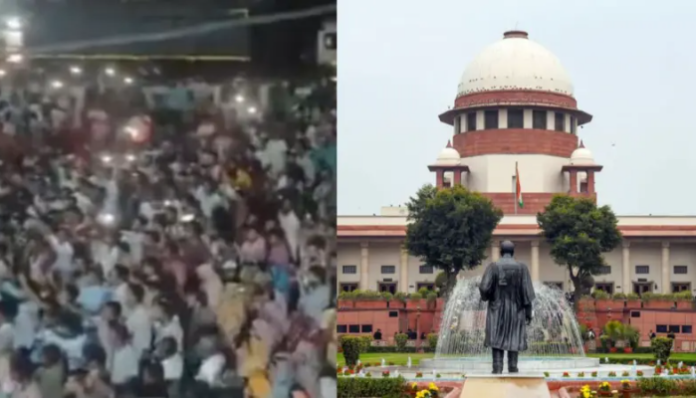
On 6th April (Monday), the pleas contesting the Special Intensive Revision (SIR) of West Bengal’s electoral rolls were heard by a bench led by Chief Justice of India Surya Kant, together with Justices Joymalya Bagchi and Vipul M Pancholi. The Supreme Court also took up the suo motu case concerning the gherao of judicial officers.
“We are informed that the Election Commission entrusted the enquiry to NIA. NIA has filed a preliminary status report in sealed cover. We find that the FIRs mentioned were registered by state police, and there are serious allegations against state/local police. We direct NIA to take over the FIRs irrespective of the reasons therein. Thus, under Article 142, we direct such FIRs to be taken over by NIA irrespective of the reasons. NIA shall be at liberty to register more FIRs if the offence illustratively referred to in our order has involvement of other persons for different consideration,” the court pronounced.
It added, “Let the investigation report be submitted before the NIA court in Kolkata. However, before chargesheet is filed, a status report shall be submitted before this court, giving a report of the investigation from time to time. State/local police are directed to hand over all material to NIA and render all assistance as needed to take the probe to a logical end.”
“One lady judicial officer was held under siege. She was crying and saying please take care of my family if anything happens to me,” Solicitor General Tushar Mehta submitted. Senior advocate DS Naidu urged the court to see the video of the vulnerable official. “Three incidents. One judicial officer was prevented from going to the venue, second was the gherao at the venue,” mentioned Additional Solicitor General SV Raju. He was representing the NIA.
The court came down heavily on state officials
The bench chastised the Director General of Police (DGP) and Chief Secretary of West Bengal for not answering the Chief Justice of the Calcutta High Court’s calls during the shocking event. Justice Kant slammed, “You are so busy that you cannot take the call of the Chief Justice of the High Court,” after which the Chief Secretary defended, “There was no call from any chief justice to me. I had come to Delhi for a meeting. From 2 pm to 4:30 pm, I was on a flight.”
Justice Bagchi added, “It would have been very helpful if your number had been shared with the high court chief justice,” and the senior officer replied, “It was given, but the number is a secure one.” However, the CJI retorted, “Please lower your security a bit so that ordinary minions like the Chief Justice of Calcutta HC can reach you. It is because of your and the police’s failure that the task was given to judicial officers. What kind of credibility is the West Bengal bureaucracy suffering? Please help in improving the image. You compel us.”
Justice Bagchi expressed, “That is why the Election Commission of India also could not be given any information.” Justice Kant remarked, “Even the Home Secretary was not reachable. The way these officials are being pampered. Please apologise before the Chief Justice and redeem what was done.” He then charged, “It was motivated, pre-planned and deeply instigating in nature. We also want to see this to the logical end.”
The Supreme Court had ordered a CBI or NIA investigation into the violence against judicial personnel sent to the Malda area to decide cases marked for logical inconsistencies in the SIR during the last hearing. The agency was told to “submit a preliminary inquiry report directly to this court.” The Election Commission (EC) turned over the inquiry into the incident to the NIA in accordance with the apex court’s order.
The Chief Secretary, Home Secretary, DGP, Malda District Collector, and SSP were ordered by the court to make a virtual appearance to provide an explanation for their failure to ensure the security of the judicial officers. Additionally, the bench ordered the Indian Election Commission to requisition central forces to protect such personnel.
Meanwhile, the SIR case is scheduled to be heard again on 13th April by the court. Justice Kant also read a letter that the Chief Justice of the Calcutta High Court sent him, stating that more than 59 lakh objections had been resolved throughout the state.
Background of the matter
An alarming situation emerged in West Bengal’s Malda district on Wednesday evening (1st April) after a large mob held seven judicial officers hostage at the Block Development Officer (BDO) office in Kaliachak-II, a Muslim-dominated area. The officers, including three women, were deployed to verify documents of voters whose names were marked “under adjudication” during the Special Intensive Revision (SIR) exercise conducted by the Election Commission of India.
An angry mob held the judicial officers, along with a five-year-old child of one of the officers, hostage for about nine hours. The judicial officers were left stranded in the BDO office without access to food and water. The outburst was linked to the deletion of the names of several infiltrators living in the area from supplementary voter lists released recently.
After the collective efforts of the central forces and the police, the judicial officers were rescued past midnight, but the mob did not calm down. As the judicial officers were being escorted, the mob tried to stop their vehicles by placing bamboo poles on the road and pelted stones and bricks at them. The so-called protestors also blocked the National Highway 12 (Kolkata-Siliguri National Highway) in Malda, disrupting connectivity between North and South Bengal. The seven judicial officers had even written to the Malda District Magistrate expressing concerns about their security
