

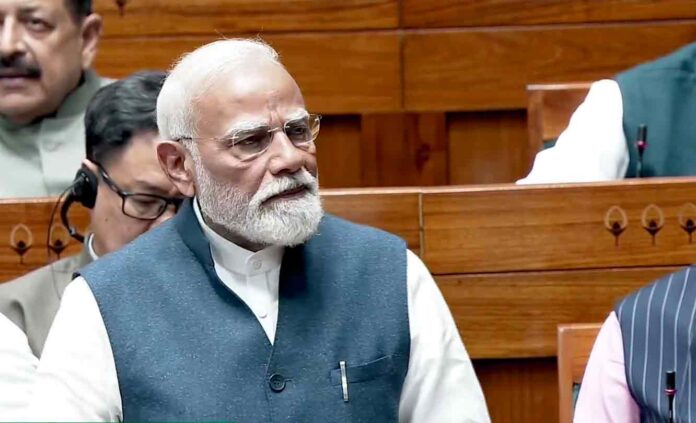
Prime Minister Narendra Modi addressed the Lok Sabha today in the special three-day parliamentary session, strongly advocating for the unanimous passage of three landmark bills: the Constitution (One Hundred and Thirty-First Amendment) Bill, 2026; the Delimitation Bill, 2026; and the Union Territories Laws (Amendment) Bill, 2026. These measures aim to operationalise the 33% women’s reservation in the Lok Sabha and state assemblies starting from the 2029 elections, synchronised with fresh delimitation exercises following the next census. The bills were introduced earlier in the day by Law Minister Arjun Ram Meghwal and Home Minister Amit Shah, amid opposition concerns over delimitation.
In his speech, PM Modi described the occasion as one of the “most important moments” in India’s parliamentary history, calling it a transformative step for inclusive democracy and nation-building. He called on all parties to set aside differences and pass the amendments unanimously, warning that historical opposition to women’s rights carries lasting political consequences.
PM Modi began by acknowledging the ongoing debate and members’ concerns, assuring the House of detailed responses while focusing on the bigger picture. He said, “Discussion on this important bill began this morning. Many members have raised various issues, and we will provide detailed and accurate information to the House on those matters. That is why I do not wish to go into those specifics. There are some important moments in the life of a country. At such a time, the mindset of the society and the capability of the leadership capture that moment and turn it into an asset for the nation, creating a strong legacy. In the history of India’s parliamentary democracy, these are such moments.”
Talking about the bill’s long journey, PM Modi said in the parliament, “The need was that when this idea was first conceived 25-30 years ago, and the need was felt, we should have implemented it, and today we have brought it to a mature stage. According to the need, it is also improved from time to time, and this is the beauty of democracy. Ours is the Mother of Democracy. Our democracy has been a development journey for thousands of years, and all of us in this House have the auspicious opportunity to add a new dimension to this development journey.”
Speaking in the Lok Sabha. https://t.co/AsiBPaaoEg
— Narendra Modi (@narendramodi) April 16, 2026
Reiterating his vision for a developed India, PM Modi emphasised that true progress requires women’s active participation. He said, “I believe that Viksit Bharat does not mean just excellent railways, some infrastructure, roads or some economic progress figures… We are not those with a limited imagination of Viksit Bharat. We want that the mantra of Sabka Saath, Sabka Vikas be included in the policy determination of Viksit Bharat. It is the demand of time that 50% of the country’s population becomes part of the country’s policy determination. We have already delayed, whatever the reason, whoever is responsible. We have to accept this.”
He continued, “Including Nari Shakti in decision-making is key to building a Viksit Bharat… A developed India does not mean only good infrastructure but participation of women in policy making… I said at the outset that we are all fortunate to have the opportunity to participate in such an important, nation-building process involving half the country’s population… We MPs must not let this important opportunity slip away. Together, we Indians are going to give the country a new direction. We are going to make a meaningful effort to infuse our governance system with sensitivity. This will not only shape the nation’s politics, but it will also determine the direction and condition of the country.”
“We are providing a new direction to the country. We are trying to create a positive impact. This will shape a new direction in the political sphere. I feel fortunate to be part of a moment that brings half of the population into policy-making.” He highlighted the rise of women at the grassroots level and asserted: “We must not assume we are giving something to the Nari Shakti; this is their right.”
PM Modi made a pointed appeal for consensus, offering to let the opposition claim full credit, “If you want credit for it, I am ready to give a blank cheque to you for taking credit. Take all the credit, and print whosoever’s photo you want… Let us pass the amendments to women reservation law unanimously.”
He issued a strong reminder about past opposition, “Women have not forgotten those who have stood against their rights… Those who opposed giving this right to women have not been forgiven by the women of this country. They have faced the consequences… Those who oppose the women’s reservation bill today, will have to pay the price for a long long time.”
Advising trust in women voters, he added, “Trust the sisters of the country and their intelligence. Let 33% of them come here and then decide which sections within them will get it.”
Addressing fears over seat redistribution post-delimitation, the Prime Minister gave firm guarantees, saying that there will be no discrimination or injustice in delimitation. He said, “Whether it is the South, North, East, or West; whether small states or large states, the processes being undertaken will not discriminate against anyone… Whatever delimitation was carried out in the past, and the proportions that have been followed since then, will remain unchanged. Any future increase will also be in the same proportion. If you want the word ‘guarantee,’ I am ready to give a guarantee. If you want a promise, I am ready to make a promise… When the intent is clear, there is no need to play with words.”
He acknowledged his own roots in a backward section of society but stressed his duty to take everyone along, noting broad support for the bill except from one party.
PM Modi concluded that the reforms would benefit the nation’s democracy and collective decision-making, not any individual or party: “This will be in favour of the country’s democracy, it will be in favor of the country’s collective decision-making… Neither the Treasury Department nor Modi will be its rightful owner.”
He said the vision of Viksit Bharat does not mean only rail, road or infrastructure. “Viksit Bharat stands for Sabka Saath, Sabka Vikas,” he said.
The Constitution (One Hundred and Thirty-First Amendment) Bill, 2026 seeks to amend the Constitution, including Articles 81 and 82, to increase the strength of the Lok Sabha from the current 543 seats to approximately 850. This expansion is intended to accommodate the one-third reservation for women without reducing the existing representation of other groups. As per the government, 50% seats will be increased in every state and UT, preserving the current proportion of seats of the states and the UTs in the parliament. Of the 850 seats, around 283 will be reserved for women.
The Delimitation Bill, 2026 provides for the constitution of a new Delimitation Commission to redraw parliamentary and assembly constituencies on the basis of the latest population data. It forms a key part of the process to operationalise the women’s reservation law, which was passed in 2023 but requires fresh delimitation to take effect.
The Union Territories Laws (Amendment) Bill, 2026 makes corresponding changes to laws governing Union Territories to align their electoral frameworks with the proposed delimitation exercise and expanded seat allocation.
The special session, which runs from 16 to 18 April, has been convened specifically to debate and pass these measures.
