

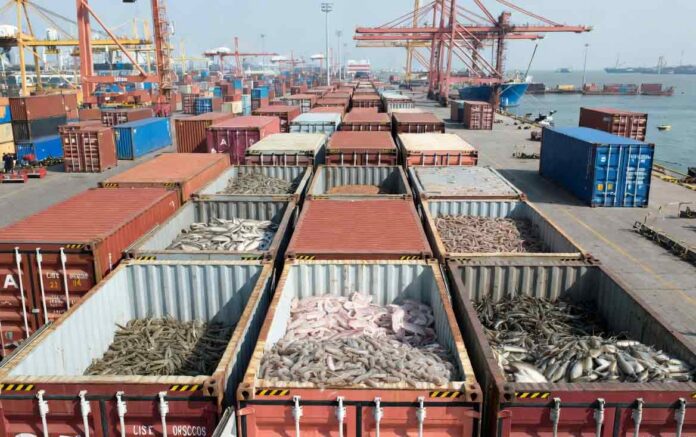
India’s marine products exports achieved a new all-time high in the financial year 2025-26, crossing ₹72,325.82 crore (approximately US$ 8.28 billion), according to provisional data released by the Marine Products Export Development Authority (MPEDA). Export volume also rose to 19.32 lakh metric tonnes, marking a robust performance despite challenges in some key markets.
This represents a significant jump from FY 2024-25, when seafood exports stood at ₹62,408.45 crore with a volume of 16.98 lakh metric tonnes. The value grew by over 15 per cent, while volume increased by about 13 per cent. In dollar terms, the growth was around 11.2 per cent year-on-year.
Frozen shrimp continued to dominate India’s seafood export basket, contributing ₹47,973.13 crore (US$ 5.51 billion), accounting for more than two-thirds of the total earnings. Shipments of shrimp registered a 4.6 per cent rise in volume and a 6.35 per cent increase in value compared to the previous year, underscoring its resilience and global demand.
Other categories, including fish, cuttlefish, squid, and dried items, also contributed to the overall growth. Export of the surimi, fishmeal and fish oil also rose during this period.
While exports to the United States saw a decline amid certain trade issues, this was more than compensated by strong gains in other major destinations. Exports to the European Union saw a sharp rise of 37.9 per cent. Similarly, seafood exports to China, Southeast Asia and Japan grew by 22.7%, 36.1% and 6.55% respectively. This diversification strategy helped India maintain momentum in the global seafood market, even as geopolitical factors and tariff-related concerns affected shipments to one of its traditional buyers.
Despite the fall in export to the US, largely because of tariff imposed by President Trump, US remained the top destination for Indian seafood with imports totalling $2.32 billion.
Officials attribute the record performance to sustained efforts in quality enhancement, disease management in aquaculture, and proactive market exploration. The Commerce Ministry noted that higher shipments to Europe, China, and Southeast Asia demonstrated the sector’s ability to adapt to shifting global demand patterns.
In terms of logistics, the top five ports, Vizag, JNPT, Kochi, Kolkata and Chennai, accounted for nearly 64% of total export value, highlighting their continued importance in India’s seafood export supply chain.
The fisheries and aquaculture sector remains a vital contributor to India’s economy, supporting millions of livelihoods, particularly in coastal states like Andhra Pradesh, Tamil Nadu, Kerala, and Odisha. With frozen shrimp as the mainstay and growing acceptance of Indian seafood in diverse markets, the industry appears well-positioned for further expansion.
This milestone comes as India continues to aim for higher targets in marine product exports, building on policy support, technological interventions in farming, and compliance with international food safety standards.
