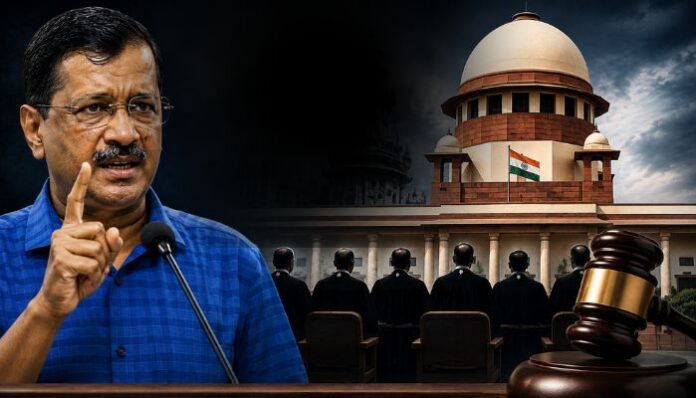
Arvind Kejriwal, former Chief Minister of Delhi and Aam Aadmi Party (AAP) supremo, has launched a direct attack on the integrity of the Indian judiciary. On 9th August, Arvind Kejriwal claimed that judges are in a “tearing hurry” to go to the Supreme Court and insinuated that the Collegium is inducting judges with demonstrated loyalty towards “emperor” Prime Minister Narendra Modi.
Quoting a news report about the Supreme Court Collegium recommending Justice Ashwani Kumar Mishra as the Chief Justice of the Punjab and Haryana High Court, Kejriwal claimed that the appointment of Justice Mishra by “bypassing seniority” makes him “vulnerable to quid pro quo”.
Casting aspersions on the integrity of, apparently, not just Justice Mishra but the entire judiciary, Kejriwal claimed that judges are being elevated to the Supreme Court based on “loyalty to the emperor”. The AAP leader’s remarks framed as ‘questions’ suggested that the Supreme Court Collegium is compromised and filling the apex court with judges ideologically aligned with the Modi government.
“It seems there is a tearing hurry to go to SC. Should judges be allowed SC elevation out of turn, bypassing seniority? That makes him vulnerable to quid pro quo. What is examined before a judge is elevated to SC? Loyalty to the emperor? Should people not know? What face will they show the young gen?” Kejriwal wrote.
Arvind Kejriwal further asserted that opaque elevation of judges should not be allowed, especially in the case of judges who “go out of the way to please the executive”.
“No out of turn, opaque elevation shud be permitted. Esp in such cases who throw law to the wind and go out of their way to please the executive. We should be careful of weaponisation of courts. Integrity of courts is most important for democracy to survive,” Kejriwal added.
It seems there is a tearing hurry to go to SC. Should judges be allowed SC elevation out of turn, bypassing seniority? That makes him vulnerable to quid pro quo. What is examined before a judge is elevated to SC? Loyalty to the emperor? Should people not know? What face will they… https://t.co/B6JY9yJs1b
— Arvind Kejriwal (@ArvindKejriwal) August 9, 2026
Arvind Kejriwal’s statement is not only outrageous but is also replete with factual inaccuracies and hypocrisy.
Has Justice Ashwani Kumar Mishra been elevated to the Supreme Court as Arvind Kejriwal insinuated?
The Aam Aadmi Party leader’s claim that Justice Ashwani Kumar Mishra has been hurriedly elevated to the Supreme Court by bypassing seniority is baseless. The Supreme Court Collegium’s recommendation is for permanent Chief Justice of the Punjab and Haryana High Court, not the elevation to the Supreme Court.
The CJI Surya Kant-headed Supreme Court Collegium made the recommendation to appoint Justice Ashwani Kumar Mishra as the permanent Chief Justice of the Punjab and Haryana High Court on 6th August. Justice Mishra was already serving as the Acting Chief Justice of the Punjab and Haryana High Court. Justice Mishra has not been elevated to the Supreme Court.
Justice Mishra’s parent court was Allahabad, and he was appointed Additional Judge in February 2014 and made permanent in February 2016. Mishra was transferred to the Punjab and Haryana High Court and joined on 21st July 2025. Justice Ashwani Kumar Mishra became the senior-most puisne there (a junior judge or associate justice who sits on a court alongside, but lower in seniority than, a chief justice). Seniority here is based on the date of initial appointment.
After the previous Chief Justice Sheel Nagu was elevated to the Supreme Court, Justice Mishra took over as the Acting Chief Justice in early June 2026 under Article 223.
The Supreme Court Collegium’s permanent Chief Justice recommendation for Justice Mishra followed around two months later. What Arvind Kejriwal dubbed as some sort of alarming ‘weaponisation of judiciary ’ was, in reality, a standard practice for confirming an Acting Chief Justice and there is no question of bypassing seniority within High Court in this case.
Contrary to the allegation Arvind Kejriwal levelled that the Supreme Court is somehow acting at the behest of the ‘emperor’, is also factually incorrect. Firstly, the Supreme Court Collegium is an independent body of senior Supreme Court judges; it has nothing to do with the Executive or the ruling dispensation.
Secondly, Arvind Kejriwal offered not even a shred of evidence indicating that the Supreme Court recommendation for appointing Justice Ashwani Kumar Mishra as Chief Justice of the Punjab and Haryana High Court was “out of turn” in the context of all-India High Court seniority conventions.
From the Nithari Killings case to handling matters pertaining to illegal mining, infrastructure, service law, environment, etc, Justice Mishra’s career exhibits no apparent record of any pro-BJP bias or explicit allegiance to the Modi government or vendetta against the AAP government in Punjab.
Neither has Arvind Kejriwal cited any, nor are there any publicly reported judgements by Justice Ashwani Kumar Mishra involving Kejriwal, AAP or the alleged scams linked to his erstwhile government in Delhi. Thus, Kejriwal’s “throwing law to the wind” or quid pro quo with the executive allegations hold no factual ground and are nothing but a sensationalisation of a routine High Court appointment, for political gains.
Meanwhile, Cockroach Janta Party (CJP) spokesperson Saurav Das, who previously wrote a hit job against former CJI DY Chandrachud, amplified Arvind Kejriwal’s alarmist propaganda.
Much like Arvind Kejriwal, Saurav Das also did not elaborate on how the Supreme Court Collegium’s recommendation for permanent appointment of the Acting CJ of the Punjab and Haryana Court amounted to the weaponisation of the judiciary to meet political ends.
“Scathing comment by an Opposition leader on the state of affairs in the judiciary. Indeed, we should be very alarmed by the manner in which courts are being weaponised to achieve political ends. Our courts should be protected and remain institutions of very high integrity. The Young Gen will ensure this happens. Accountability shall be fixed,” he wrote.
Arvind Kejriwal’s attack was directed at Justice Sheel Nagu? If so, the AAP leader’s allegations are rooted in disdain, not logic
Interestingly, some AAP supporters have claimed that Kejriwal’s post was about Justice Sheel Nagu, who has been recently elevated to the Supreme Court. This interpretation, however, defies timeline, if we go by the post’s content and the quoted material. However, if we go by the Opposition’s record of vilifying judges who ruled against them in specific matters, then it makes sense that Kejriwal’s attack was about Justice Sheel Nagu’s elevation to the Supreme Court.
Arvind Kejriwal directly quoted a Bar and Bench X post, which had a link to its report about the Supreme Court recommendation of Justice Ashwani Kumar Mishra as the Chief Justice of the Punjab and Haryana High Court. If Kejriwal was talking about Justice Sheel Nagu, why would he quote news material about Justice Mishra, and write, “That makes him vulnerable to quid pro quo”, unless Kejriwal was hiding behind ambiguity.
The Supreme Court Collegium meeting was held on 6th August 2026, and the apex court’s statement makes no mention of Justice Sheel Nagu, nor does the Bar and Bench report quoted by Arvind Kejriwal.
Notably, Justice Sheel Nagu served as the Chief Justice of the Punjab and Haryana High Court from July 2024; the Supreme Court Collegium recommended his elevation to the Supreme Court in May 2026. His appointment was notified by the Central government on 1st June 2026, and he assumed office as a Supreme Court judge on 2nd June.
Justice Nagu’s elevation created the vacancy for a permanent CJ to the Punjab & Haryana High Court, leading to Justice Ashwani Kumar becoming the Acting Chief Justice. Naturally, the Acting CJ was recommended to take over as the permanent CJ.
Regarding Justice Sheel Nagu’s elevation to the Supreme Court, Kejriwal’s “out of turn”, “bypassing seniority”, claims, even if directed at Nagu, are simply a political attack on the judiciary as well as the Central government.
While seniority is not completely disregarded, it is not the sole criterion the Supreme Court Collegium relies on while recommending judges for elevation to the apex court. Under the Collegium system, the Supreme Court judges weigh a blend of merit, overall track record, performance, and representative balance of different high courts rather than following a mechanical application of all-India seniority.
The Supreme Court Collegium is not bound to select judges in an unbroken sequence of chronological seniority. Apparently, Justice Sheel Nagu’s extensive tenure and disposal rate in the Madhya Pradesh and Punjab & Haryana High Courts were viewed as impressive in terms of administrative capability and judicial output, and the Collegium might deem him fit to handle the top court’s workload.
Justice Nagu is reported to have written over 499 judgements during his tenure as a Judge at the Madhya Pradesh High Court. Nagu was also a part of the three-judge committee constituted by then CJI Sanjiv Khanna to probe corruption accused Allahabad High Court judge Yashwant Varma.
If seniority alone were a major deciding factor for promotions within the judiciary, the Indian Constitution would not have explicitly permitted the direct elevation of distinguished High Court advocates to the Supreme Court under Article 124(3). The Constitution directs the induction of diverse legal perspectives, bar experience, and specialised expertise even from active practice into the apex court.
However, Arvind Kejriwal appears to be hiding behind seniority, if his post was directed against Justice Sheel Nagu.
Because if departure from seniority criteria when picking Supreme Court judges was Kejriwal’s chagrin, he would have criticised advocate V. Mohana’s elevation to the Supreme Court. Alongside Justice Sheel Nagu, advocate V. Mohana was directly elevated as a Supreme Court judge on 2nd June 2026.
Apparently, Sheel Nagu has been a part of various matters linked to the Aam Aadmi Party. In November 2025, when a row erupted over Panjab University senate elections, the protestors had made it about state versus Centre, ‘RSS Murdabad’ slogans were raised, and AAP was among the key political parties to back the agitation.
At that time, the Punjab and Haryana Court bench led by Justice Sheel Nagu punctured the fear-mongering narrative, and the anti-BJP political parties and non-political elements were peddling regarding the election. The court had ordered the resumption of academic activities and stated that the elections must be held expeditiously, dismissing the need for politically-motivated chaos that was being exploited by AAP and various unions to target the Central government.
In April 2026, a Division Bench of Justice Sheel Nagu and Justice Sanjiv Berry heard the petition filed by former AAP Rajya Sabha MP Rajinder Gupta, who was among the seven AAP MPs who resigned from AAP and joined the BJP.
Following his ‘defection’ to the BJP, the Punjab Pollution Control Board (PPCB) under the AAP government in Punjab had raided the premises of Trident Group’s Dhaula unit. Trident Group’s Chairman Emeritus is Rajinder Gupta. Following the raids, Trident had filed a petition in the High Court alleging political vendetta by the AAP government over his switch to the BJP. Another petition was filed regarding the sudden withdrawal of Gupta’s Punjab Police security cover.
In these matters, the Division Bench of Justice Sheel Nagu and Justice Sanjiv Berry directed PPCB not to take coercive action against Gupta without giving 30 days to rectify deficiencies. It was found that the PPCB failed to demonstrate any environmental threat or presence of any poisonous effluents. Similarly, in the security cover-related plea, the Nagu-led bench directed the state government to ensure the safety of Gupta and his family.
Another matter wherein AAP encountered Justice Sheel Nagu in court was linked to another AAP MP, Sandeep Pathak, who jumped into the BJP. He too had filed a plea seeking interim protection from coercive action. In this case, the Punjab government first said that it had no information regarding the FIRs, and later assured no coercive action would be taken against Pathak without the court’s permission.
Interestingly, now CJP co-convenor Saurav Das who earlier legal investigative reporting had peddled conspiracy theories in connection with these cases and cast aspersions on the integrity of Justice Sheel Nagu. No wonder, many on social media are joking that perhaps Kejriwal’s X post in question was drafted by Saurav Das.
However, despite its purported belief that Justice Sheel Nagu has his loyalty devoted to the ’emperor’, AAP or Arvind Kejriwal have not openly demanded a probe against him nor presented substantial evidence of bias, beyond conspiracy theories. Thus, the “throwing law to the wind” or quid pro quo with the executive allegations, if directed against Nagu, lack serious factual basis.
Clearly, the supposed attack on Justice Sheel Nagu by AAP supremo Arvind Kejriwal is not about judicial integrity but his own disdain for judges who weigh a case’s merit rather than offer blind compliance to AAP.
From saying ‘Supreme Court Collegium functioning smoothly’ to casting aspersions on its integrity: The hypocrisy of AAP and Arvind Kejriwal
It is amusing that Arvind Kejriwal is now casting aspersions on the integrity of the Supreme Court Collegium and claiming that it is acting at the behest of ‘emperor’ Modi to induct his loyalists. Kejriwal and his party AAP had welcomed the Supreme Court verdict that struck down the National Judicial Appointments Commission (NJAC) Act in 2015.
The NJAC Act was brought by the Modi government in 2014 to replace the collegium with a commission comprising the Chief Justice of India, two senior Supreme Court judges, the Union Law Minister, and two eminent persons selected by a panel including the Prime Minister, the Leader of the Opposition, and the CJI.
This framework was enacted with bipartisan legislative support and presidential assent. It was aimed at integrating judicial, executive, and civic perspectives into the appointment process, reflecting a pluralistic approach to constitutional governance. The NJAC Act was a landmark step towards ending the much-controversial and debated monopoly of the Supreme Court Collegium in judicial appointments.
However, the Supreme Court invalidated it in a 4:1 verdict, upholding the collegium on grounds that its primacy was essential to judicial independence, a component of the Constitution’s basic structure.
At that time, the AAP had welcomed the Supreme Court verdict, calling it a positive decision to protect independence of the judiciary. The Aam Aadmi Party had described the verdict as a major blow to the Modi government.
“The AAP is of the firm view that independence of the judiciary and a transparent system for the appointment of judges are of equal importance as both of them are interlinked…But Collegium should ensure greater transparency,” the AAP said in a statement in October 2015.
In December 2022, AAP had opposed a Private Member Bill introduced by MP Shri Bikash Ranjan Bhattacharya on judicial appointments. The National Judicial Commission Bill, 2022, was equated by the AAP to the NJAC Act struck down already by the apex court.
Back then, then AAP Rajya Sabha MP Raghav Chadha had said that the “Collegium system was functioning smoothly”.
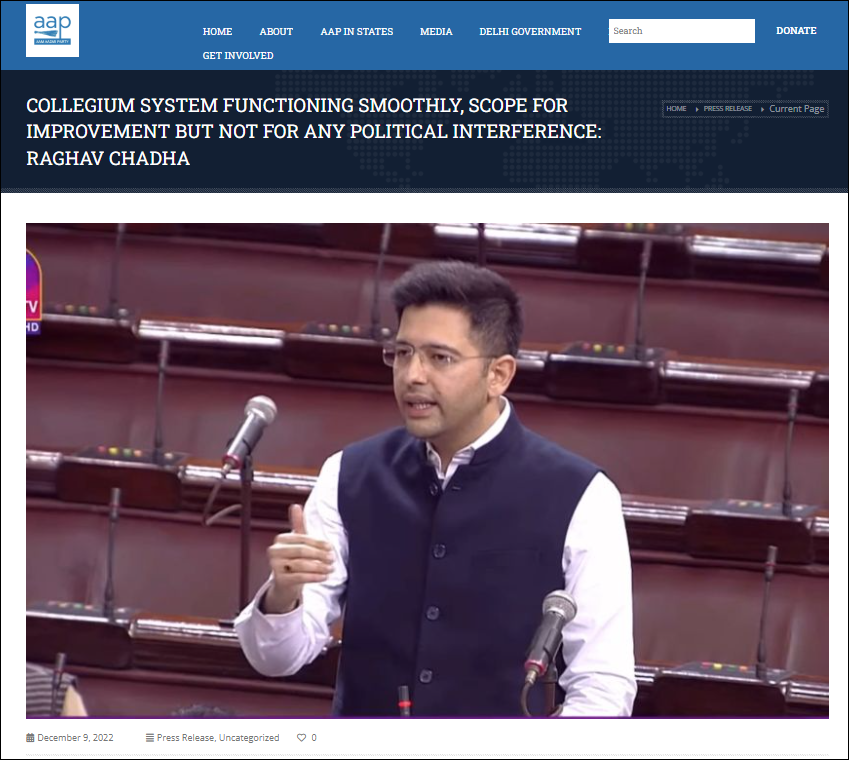
“…Collegium system functioning smoothly, scope for improvement but not for any political interference…I think we are attempting to do a constitutional impossibility. The current collegium system of appointment of judges is functioning smoothly. There could be a scope of improvement, which could be explored after discussions and dialogue with the judiciary.”
Bottomline: The AAP and Arvind Kejriwal are politicising judicial appointments apparently due to their own personal grudges. One can debate whether it was a case of factual inaccuracy in targeting Justice Mishra or a veiled attack on Justice Sheel Nagu; Kejriwal’s attack on the Collegium system was direct and appeared to be aimed at sowing distrust in public against the judiciary by insinuating the Supreme Court Collegium is not independent but being controlled by ‘emperor’ Modi.
From supporting the Supreme Court Collegium to now casting aspersions on its integrity, AAP and Arvind Kejriwal have weaved alarmist narratives around the judiciary to lend credence to their conspiracy theory that the Modi government is somehow taking over the judiciary, although the biggest irony remains that the same Modi government could not get the NJAC Act cleared by the Supreme Court.