

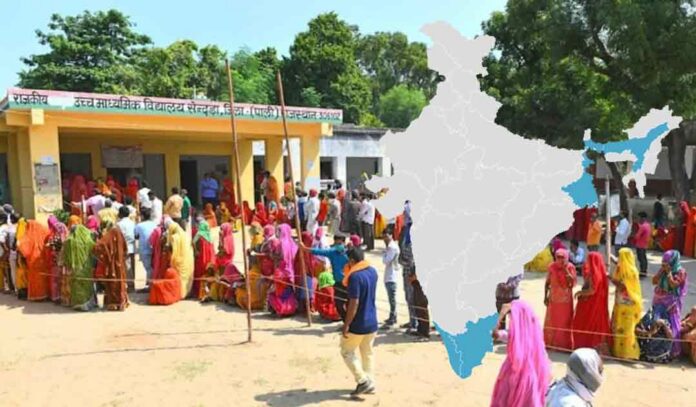
Polling for the high-stakes Assembly elections in five States and one Union Territory, Assam, Kerala, Tamil Nadu, West Bengal, and Puducherry, concluded today amid record voter turnout in several constituencies. With the Election Commission of India lifting the ban on exit polls after 6:30 pm, leading agencies, including Axis My India, People’s Pulse, Matrize, P-MARQ, Chanakya Strategies, JVC etc have released their projections.
These surveys point to a mix of continuity for some incumbents and potential shifts in others, particularly in the keenly watched West Bengal. While exit polls provide valuable trends, they have a mixed track record and the actual results will be declared on May 4 after rigorous counting of votes. The elections tested the popularity of incumbent governments, with issues ranging from governance, development, and welfare schemes to regional concerns such as infiltration in Assam and women’s safety in West Bengal dominating campaigns.
National parties like the Bharatiya Janata Party (BJP) and the Congress, along with strong regional players, vied for power in these diverse battlegrounds that could also influence the broader national political narrative ahead of future Lok Sabha polls.
West Bengal (294 seats, majority: 148)
The All India Trinamool Congress (TMC), under Chief Minister Mamata Banerjee, has governed the State since 2011 and was seeking a historic fourth consecutive term. Banerjee, a veteran leader who has steered the party through multiple challenges, remained the face of the TMC campaign, emphasising welfare schemes and accusing the BJP of interference.
Most exit polls, however, project a closely contested and potentially game-changing outcome, with the BJP-led NDA appearing to hold a slight edge over the ruling TMC. According to the Poll of Polls aggregation by The Times of India, the BJP is projected to secure around 149 seats against the TMC’s 140, with others getting 5. Other agencies echo this trend: Chanakya Strategies (BJP 150–160, TMC 130–140), Matrize (BJP 146–161, TMC 125–140), P-MARQ (BJP 150–175, TMC 118–138), and Poll Diary (BJP 157–171, TMC 113–127). JVC shows a tighter race (BJP 138–159, TMC 131–152). Notably, People’s Pulse emerged as an outlier, predicting a strong TMC victory (178–187 seats) and the BJP at 95–110.
If the majority of projections hold, the BJP could form the government for the first time in the State. Speculation is already rife that senior BJP leader Suvendu Adhikari, a prominent face in the anti-TMC campaign, could emerge as the chief ministerial candidate.
Assam (126 seats, majority: 64)
The BJP-led NDA has been in power for two consecutive terms, with Chief Minister Himanta Biswa Sarma, known for his assertive governance and focus on issues like infiltration and development, at the helm since 2021. Sarma’s leadership has been central to the party’s campaign narrative. Exit polls across the board predict a comfortable retention for the NDA. Axis My India projects the BJP-led alliance at 88–100 seats against the Congress-led opposition’s 24–36. JVC offers a similar range (BJP 88–101, Congress+ 23–33), while broader VoteVibe and Poll of Polls trends also point to the NDA securing around 90–100 seats.
With a clear majority projected, Himanta Biswa Sarma is widely expected to return as Chief Minister for a second term, consolidating the BJP’s hold in the Northeast.
Tamil Nadu (234 seats, majority: 118)
The Dravida Munnetra Kazhagam (DMK)-led alliance, headed by Chief Minister M.K. Stalin, has been in power since 2021. Stalin, son of former DMK patriarch M. Karunanidhi, campaigned vigorously on the party’s welfare and development record while countering opposition charges on issues like the three-language policy.
Exit polls largely favour the DMK alliance’s return to power with a comfortable majority. People’s Pulse projects DMK+ at 125–145 seats, AIADMK+ at 65–80, and the new Tamilaga Vettri Kazhagam (TVK) of actor Vijay at 2–6. Matrize estimates DMK+ at 122–132 and AIADMK+ at 80–100, while P-MARQ gives DMK+ 125–145 and AIADMK+ 60–70.
Although some trends indicate a tighter contest, the broader consensus points to the DMK-led front retaining power. M.K. Stalin is expected to continue as Chief Minister if the projections materialise.
Kerala (140 seats, majority: 71)
The Left Democratic Front (LDF), led by the CPI(M) and headed by Chief Minister Pinarayi Vijayan, has been in office for a decade and was seeking a rare third consecutive term amid anti-incumbency factors. Vijayan’s campaign highlighted the LDF’s achievements in welfare and development.
Exit polls indicate a shift in favour of the Congress-led United Democratic Front (UDF). Axis My India projects the UDF at 78–90 seats and the LDF at 49–62, with the NDA marginal. People’s Pulse estimates UDF at 75–85 and LDF at 55–65, while Matrize gives UDF 70–75 and LDF 60–65.
If the UDF secures a majority, the Congress is likely to form the government after 10 years. The BJP-led NDA is projected to remain a minor player.
Puducherry (30 seats, majority: 16)
The National Democratic Alliance (NDA), led by the All India N.R. Congress (AINRC), has governed the Union Territory since 2021, with Chief Minister N. Rangaswamy at the helm in coalition with the BJP. Exit polls unanimously predict a comfortable NDA retention.
Aggregated Poll of Polls and agencies like Axis My India and People’s Pulse project the NDA at 16–20 seats, with the Congress-DMK-led SPA at 6–12 and others filling the rest. N. Rangaswamy is widely expected to return as Chief Minister, ensuring continuity for the NDA alliance in the coastal enclave.
It is notable that exit polls have shown mixed success in last several elections. While they were proved to be correct in some polls, they were completely wrong in many other elections, including the last Lok Sabha elections.
