

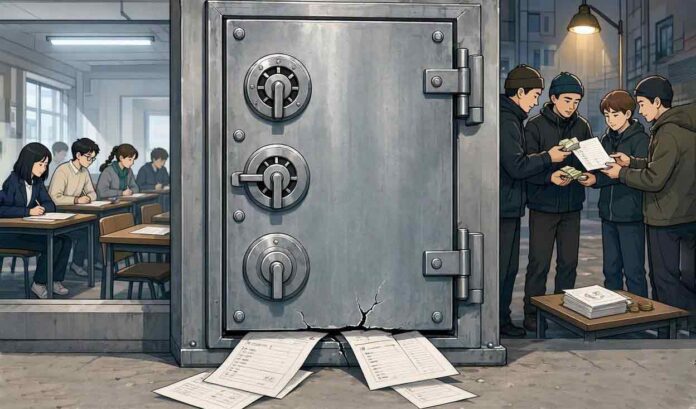
Paper leaks have become a recurring national crisis that strikes at the heart of Indian meritocracy, even as protests over the cancelled NEET-UG 2026 examination begin to fade. While medical aspirants have moved on to counselling after the re-test, agitation continues in Jharkhand over recruitment exams and in Punjab over cheating scandals, showing that compromised public tests have become a stubborn affliction.
The human cost falls hardest on middle-class and lower-middle-class families. For them, education is often the single largest investment of a lifetime. Parents sell jewellery, take loans and spend ₹1–3.5 lakh a year on coaching in places such as Kota and Sikar, treating competitive exams as the only reliable path to social mobility. A leak shreds that unwritten contract. Years of dawn-to-dusk study and family sacrifice are rendered worthless when better-connected candidates buy the questions. Affluent families can fall back on foreign education or private-college quotas; ordinary families cannot. Delays, re-tests and extra years of coaching push many into deeper debt, and despair has in some cases led to suicide.
The problem is long-standing. From the cancelled AIPMT of 2015 through SSC, CBSE and state recruitment scandals, organised networks of middlemen, coaching intermediaries and solver gangs have exploited every weak link. Convictions of senior organisers remain rare.
NEET-UG is uniquely vulnerable. More than two million candidates compete for about 1.1 lakh medical seats, many of them low-fee government places that can change a family’s fortunes for a generation. The pen-and-paper model remains a logistical nightmare. Papers travel from setting and translation through printing, packing, long-distance transport and storage in vaults or school strong rooms. NTA’s thin permanent staff and heavy outsourcing fragment accountability. Encrypted apps then spread a leaked paper nationwide in minutes.
The government has responded with the Public Examinations Act 2024, a 2026 amendment that raised penalties and imposed fast-track timelines, the Radhakrishnan Committee’s recommendations for encrypted just-in-time printing and secure centres, and a new Nilekani task force. Lasting reform requires shortening the physical chain of custody, insulating paper-setters from coaching networks, regulating the coaching industry, and expanding affordable medical seats so that a single exam is no longer a life-changing lottery worth the crime. Until then, every leak will continue to cancel not just an examination but years of honest sacrifice.
You can read the full article on Chapter 1 Magazine.


