

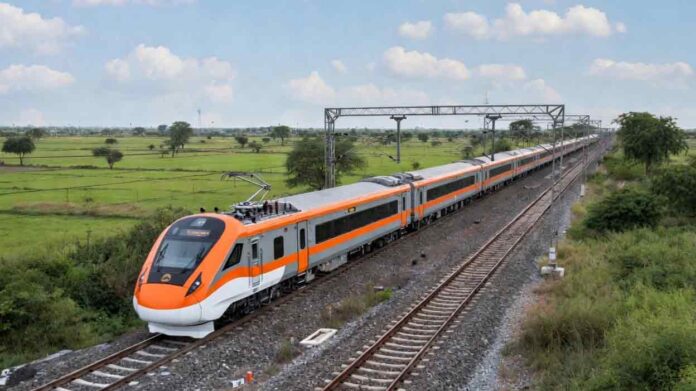
In a significant boost to India’s railway modernisation, the Cabinet Committee on Economic Affairs (CCEA), chaired by Prime Minister Narendra Modi, today approved the Ahmedabad (Sarkhej)–Dholera Semi High-Speed Double Line project. With an estimated cost of approximately ₹20,667 crore, the 134-km broad-gauge double-line corridor will be Indian Railways’ first dedicated semi high-speed rail project, built entirely with indigenously developed technology.
The new line will provide direct, high-speed connectivity between Ahmedabad and the Dholera Special Investment Region (SIR), the upcoming Dholera International Airport, and the Lothal National Maritime Heritage Complex (NHMC). It is expected to drastically cut travel times, enabling comfortable daily commuting and same-day return trips between the two cities. The project aligns with the Prime Minister’s vision of a “New India” by fostering comprehensive regional development, generating employment and self-employment opportunities, and making local communities “Atmanirbhar.”
This semi-high-speed railway would not only bring the two cities closer together but also bring the people living hundreds of kilometres away closer to each other. The corridor will enhance connectivity to around 284 villages with a combined population of nearly five lakh people. As an environment-friendly and energy-efficient mode of transport, it is projected to reduce the country’s oil imports by 0.48 crore litres annually and lower CO₂ emissions by 2 crore kg, equivalent to planting 10 lakh trees.
The project has been planned under the PM-Gati Shakti National Master Plan, emphasising multi-modal integration for seamless movement of people, goods, and services. Completion is targeted by 2030-31.
As India’s first semi-high-speed rail project, it will serve as a pioneer project, acting as a reference model for the phased expansion of semi-high-speed rail across the country. It complements the existing fleet of over 164 Vande Bharat semi high-speed trains, which have revolutionised inter-city travel with faster, modern services.
This approval marks another concrete step in Indian Railways’ ambitious transformation, which has already seen the addition of over 36,000 km of new tracks and near-complete electrification of the network in recent years. The dedicated freight corridors (Eastern and Western) are now fully operational, handling record freight traffic and decongesting passenger lines.
On the full high-speed rail (bullet train) front, India is making rapid strides with the Mumbai–Ahmedabad High-Speed Rail Corridor (MAHSR), the country’s first true bullet train project designed for speeds up to 350 km/h. The first section (Surat–Vapi) is slated to open in August 2027, with the full 508-km line expected by December 2029.
Building on this momentum, the Union Budget 2026-27 announced seven additional high-speed rail corridors: Mumbai-Pune, Pune-Hyderabad, Hyderabad-Bangalore, Hyderabad-Chennai, Chennai-Bangalore, Delhi-Varanasi, and Varanasi-Siliguri. Responsibility for their swift implementation has been given to the National High-Speed Rail Corporation Limited (NHSRCL).
By integrating high-speed passenger services with dedicated freight infrastructure and indigenous technology, the network is poised to reduce logistics costs, cut carbon emissions, and drive economic growth under the PM-Gati Shakti framework.
