

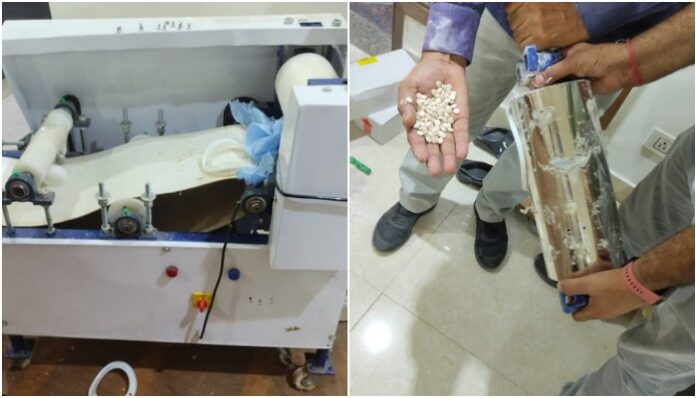
In a significant boost to the Drug-free India campaign, the Narcotics Control Bureau (NCB) has achieved its first-ever seizure of a large quantity of Captagon, the synthetic narcotic substance popularly known as ‘Jihadi drug’, worth over Rs 182 crores.
Union Home Minister Amit Shah announced the breakthrough on Saturday, declaring the success of ‘Operation Ragepill’. He informed that the busting of the drug consignment destined for the Middle East and the arrest of a foreign national stand out as shining examples of India’s commitment to zero tolerance against drugs.
Modi govt is resolved for a ‘Drug-Free India’.
— Amit Shah (@AmitShah) May 16, 2026
Glad to share that through ‘Operation RAGEPILL’, our agencies have achieved the first-ever seizure of Captagon, the so-called “Jihadi Drug”, worth ₹182 crore.
The busting of the drug consignment destined for the Middle East and…
Congratulating the brave officials of the NCB, Home Minister added that every gram of drugs entering India or leaving the country using our territory as the transit route will be traced and clamped down.
What is the ‘Jihadi drug’ Captagon?
Captagon is the brand name for fenethylline, a synthetic amphetamine-type stimulant developed in the 1960s as a codrug of amphetamine and theophylline.
Narcotics Control Bureau (NCB), under Operation RAGEPILL, has successfully unearthed an international drug syndicate involved in the trafficking of Captagon, leading to the seizure of approximately 227.7 Kgs. of Captagon Tablets/Powder and the arrest of one overstaying Syrian… pic.twitter.com/s1PI5Mjq8S
— ANI (@ANI) May 16, 2026
Though it was originally prescribed for ADHD, narcolepsy, and fatigue, it was banned worldwide in the 1980s due to high abuse potential. Illicit versions of the substance, often produced in Syria and Lebanon, typically contain amphetamines mixed with caffeine or other substances to deliver effects of intense alertness, euphoria, suppressed appetite, and the ability to stay awake for days without rest.
Captagon earned its nickname as the ‘Jihadi drug’ in conflict zones of the Middle East. Islamic terrorist groups, including ISIS in Syria, have reportedly used it as “chemical courage.” Media and law-enforcement agencies also link the drug to “pharmaco-terrorism,” with illicit production and trafficking funding armed groups in war-torn regions. Essentially, the drug is both used, and sold by Islamic terrorist groups.
NCB caught around 227.7 kgs of the narcotic substance during its raid. A Syrian national who has been overstaying in India while trying to traffick the drug to the West Asian nations has been arrested. The approximate price of the seized substance in the international markets is estimated to be around Rs 182 crores.
