

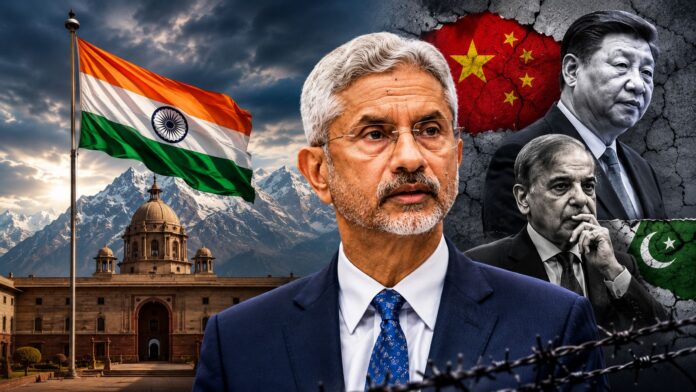
India on Tuesday strongly rejected references made to Jammu and Kashmir in a joint statement issued by China and Pakistan, asserting that the Union Territories of Jammu & Kashmir and Ladakh are integral and inalienable parts of India and that no external country has any locus standi on the matter.
In an official response issued by the Ministry of External Affairs (MEA), spokesperson Randhir Jaiswal said India “categorically rejects” the “unwarranted references” to the Indian Union Territory of Jammu and Kashmir in the China-Pakistan joint statement.
The response, dated May 26, 2026, reiterated India’s long-standing position on Kashmir and underlined that the country’s sovereignty and territorial integrity are non-negotiable.
“India’s position is consistent and well known to the concerned parties. The Union Territories of Jammu & Kashmir and Ladakh have been, are and will always remain integral and inalienable parts of India,” the statement said, adding that no other country has the authority to comment on the matter.
New Delhi also renewed its opposition to the so-called China–Pakistan Economic Corridor (CPEC), portions of which India maintains pass through territory under Pakistan’s illegal occupation. India said it opposes any effort by external actors to legitimise what it described as Pakistan’s “illegal and forcible occupation” of Indian territory.
The MEA noted that India has repeatedly conveyed its objections regarding CPEC-related activities to both Pakistani and Chinese authorities.
The government additionally objected to references in the China-Pakistan statement regarding so-called “trans-boundary water resources cooperation.” India argued that the premise itself is flawed, stating that China and Pakistan do not share a direct boundary in areas claimed by Pakistan.
New Delhi further stated that it has never recognised the so-called 1963 boundary agreement between Pakistan and China, under which Pakistan ceded territory in the Shaksgam Valley to China. India has historically maintained that the agreement has no legal standing because the territory forms part of the erstwhile princely state of Jammu and Kashmir.
India’s response comes amid continuing geopolitical sensitivities surrounding Kashmir and growing concerns over strategic cooperation between China and Pakistan in disputed territories. The latest statement indicates that New Delhi remains firm in opposing any international references or initiatives that, in its view, challenge India’s territorial claims or sovereignty.
