

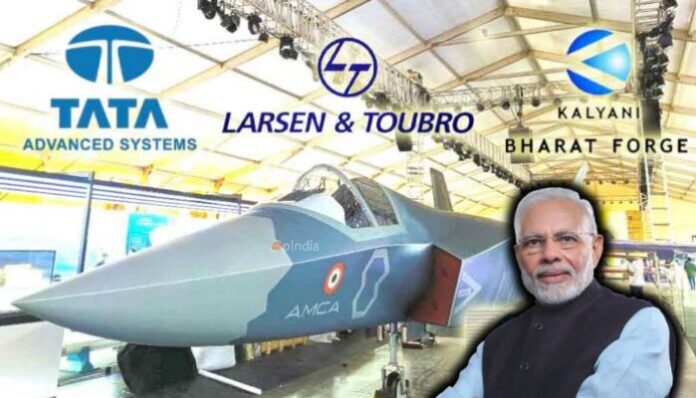
In a historic step for the Indian defence industry, the Central government on 27th May issued a request for proposal (RFP) to three Indian companies to manufacture the indigenous fifth-generation stealth fighter jet, Advanced Medium Combat Aircraft, or AMCA.
This is the first time that the state-owned Hindustan Aeronautics Ltd (HAL) is out of a major fighter jet programme. For the AMCA project, three private manufacturers, Tata Advanced Systems, the L&T-BEL-Dynamatic consortium, and the Bharat Forge-BEML-Data Patterns consortium, have been invited.
Tata Advanced Systems Limited (TASL) is bidding independently, while the other two include Larsen & Toubro (L&T)-led consortium that includes Bharat Electronics Limited (BEL) and Dynamatic Technologies, and Bharat Forge-led consortium in partnership with BEML and Data Patterns.
One of the three shortlisted companies that wins the ₹15,000 crore project will have to build five AMCA prototypes at a new greenfield facility in Andhra Pradesh. The selected industry partner will work closely with the Aeronautical Development Agency (ADA) under the Defence Research and Development Organisation (DRDO) to build the prototypes.
The prototype development phase is estimated to cost around ₹15,000 crore, with the commercial bids expected to play a decisive role in the final selection, which is anticipated in the coming months.
With the AMCA project, the Modi government has opened the fighter jet manufacturing arena for the private sector, giving impetus to India’s resolve for self-reliance in advanced aerospace technology. Earlier, HAL chairman DK Sunil outlined that it would be extremely difficult for the company to operate alone due to the qualifying requirements and circumstances connected with the financial performance of enterprises in the EoI issued by ADA.
The AMCA is designed as a twin-engine, single-seat, multirole stealth fighter featuring supercruise capability, internal weapons bays, advanced avionics, sensor fusion, and low-observable characteristics. It is intended to significantly enhance the Indian Air Force’s capabilities and eventually replace ageing platforms like the Su-30MKI. Prototypes are targeted for delivery between 2028 and 2030, with maiden flights expected in the early 2030s.
After Tejas jets made by HAL, the made-in-India AMCA project is another strong push for “Atmanirbhar Bharat” in aerospace, aiming to foster innovation, create additional production lines, and bring greater efficiency through private sector participation.
