

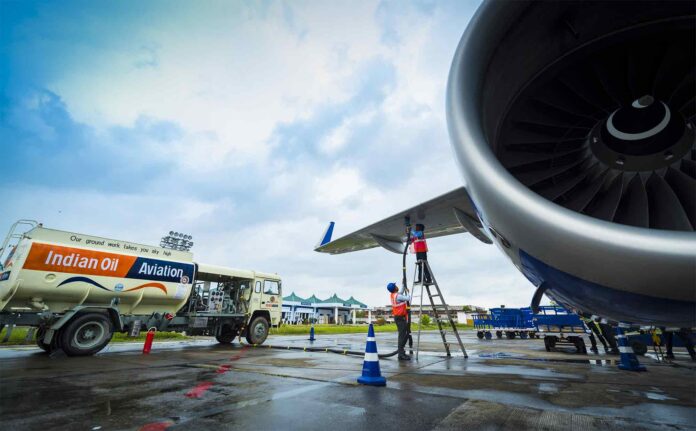
In a significant move to support the aviation sector amid rising fuel costs, the Union Cabinet chaired by Prime Minister Narendra Modi has approved the creation of a Price Stabilisation Fund for scheduled Indian airlines, providing one-time budgetary support of up to ₹10,000 crore to Oil Marketing Companies (OMCs).
The fund aims to offer price stabilisation for Aviation Turbine Fuel (ATF) used in both domestic and international operations of Indian carriers. This intervention comes in response to exceptional volatility in global ATF prices triggered by the ongoing West Asia crisis, which has seen international ATF prices surge sharply from around Rs 60.50 per litre in March 2026 to ₹142 per litre in May 2026. ATF constitutes nearly 40 per cent of an airline’s operating costs and can go up to 60 per cent during periods of extreme volatility.
Under the approved mechanism, the government will extend interest-free advances to OMCs through the Ministry of Petroleum and Natural Gas. These advances will help compensate OMCs for losses when import parity prices exceed a benchmark level, enabling them to supply ATF at more stable rates to airlines. The support will be available to all willing scheduled Indian carriers and will operate through a fixed-price arrangement for greater predictability in fuel costs.
As per the government, the mechanism will provide greater predictability in fuel costs by adopting a fixed-price arrangement for domestic and international operations, thereby reducing airline’s exposure to sudden fuel price spikes.
A key feature of the scheme is the recovery and true-up process. When international ATF prices moderate, the differential amounts will be recovered from OMCs and returned to the Consolidated Fund of India. The arrangement is expected to last for up to 36 months, subject to annual review, or until the advance is fully settled, whichever is earlier.
Participating airlines will procure ATF exclusively from OMCs for the duration under a Memorandum of Understanding, with oversight from a monitoring committee comprising officials from the Ministries of Civil Aviation, Petroleum and Natural Gas, and the Department of Expenditure.
The measure is expected to shield both airlines and OMCs from the adverse impact of fuel price spikes, while reducing the pass-through effect on airfares for passengers. It will help sustain air connectivity, including to remote and regional destinations under the UDAN scheme, support employment in the aviation ecosystem, and promote tourism, trade, and balanced regional development. The decision also addresses additional challenges such as longer flight routes due to airspace restrictions.
The proposed mechanism will provide enhanced stability and predictability in ATF pricing for Indian airlines, enabling better operational and financial planning. Moreover, it will also shield Oil Marketing Companies (OMCs) from losses arising from volatile and elevated ATF prices during the ongoing West Asia crisis.
The measure will help protect and sustain domestic and international air connectivity, ensuring continuity of air services. It will reduce the pass-through of fuel price shocks to passengers, thereby helping to moderate fare volatility. The arrangement will support continued air connectivity to remote, regional, Tier-II and Tier-III cities, promoting balanced regional development and inclusive growth.
Stable airline operations help sustain employment across airlines, airports, ground handling agencies, MROs, travel agencies, hospitality and logistics sectors. Continued air connectivity will facilitates movement of passengers, high-value cargo, business travellers and tourists, thereby supporting economic activity across sectors.
The measure will have positive spill-over effects on tourism, hospitality, trade, exports, regional development and investment. It will help ensure optimum utilisation of airport infrastructure developed across the country, including airports operationalised under the UDAN scheme.
By preserving domestic and international connectivity, the initiative will strengthen India’s integration with global markets and support long-term economic growth.
