

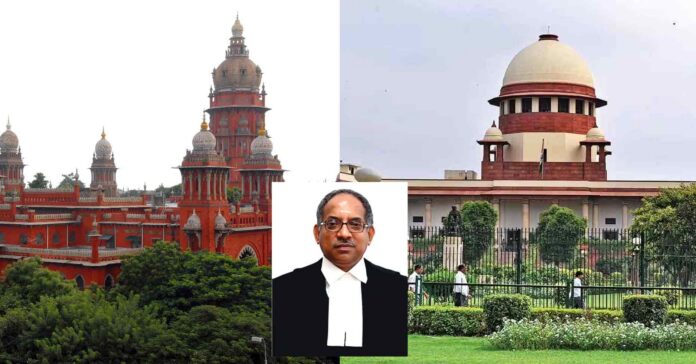
The Madras High Court has strongly criticised the Supreme Court for keeping an election petition relating to the 2016 Assembly elections pending for over six years, observing that such delays could turn India into an autocratic country by undermining electoral democracy.
Justice G. Jayachandran made the remarks while allowing an election petition filed by DMK leader and former Tamil Nadu Assembly Speaker M. Appavu, challenging the election of AIADMK candidate I.S. Inbadurai from the Radhapuram Assembly constituency in Tirunelveli district. The High Court declared Appavu as the duly elected candidate for the 2016-2021 term and held Inbadurai’s election as null and void.
In a sharply worded order delivered on June 3, 2026, Justice Jayachandran described the prolonged delay as a “grave mockery of justice.” He pointed out that the appeal filed by Inbadurai against the High Court’s 2019 order was pending before the Supreme Court from October 2019 and was disposed of only in May 2026, well after the completion of the 2016-2021 Assembly term and after two subsequent Assembly elections in Tamil Nadu.
The judge recalled the Supreme Court’s own observations in the Mohd. Akbar versus Ashok Sahu case (2015) emphasising the need for expeditious disposal of election disputes. He warned, “If courts continue to ignore their own observations made in the Mohd. Akbar case, I fear that this country may also go in the way of other autocratic countries which gained Independence around 75 years ago, along with us.”
The core issue in the case was whether headmasters of government middle schools qualify as ‘gazetted officers’ competent to attest postal ballot papers. The Returning Officer had rejected 203 such postal ballots in 2016, leading to Appavu losing by a narrow margin of 49 votes. He filed an appeal seeking recounting of votes, alleging that valid postal ballots cast in his favour were wrongly rejected and that there were irregularities in the counting of votes recorded in EVMs.
In 2019, the Madras High Court had ruled in favour of Appavu on this point and ordered a recount. The High Court had stated that the rejection of postal ballots was incorrect. The High Court found that middle school headmasters are to be considered ‘gazetted officers’ for the purpose of attesting postal ballot declarations.
Inbadurai challenged the order before the Supreme Court. The Supreme Court permitted the recount to proceed, but stayed the declaration of results. The appeal was finally disposed of only on May 21, 2026, but the Supreme Court left open the legal question on whether headmasters were gazetted officers. The apex court had said that there was no point in deciding the issue after the assembly’s term had ended.
Justice Jayachandran expressed respectful disagreement with the apex court’s approach, saying that it could not abdicate its constitutional responsibility merely because of the passage of time. “With great respect, the Hon’ble Apex Court should have answered this question since this Court has already as Court of first instance/trial Court given a finding in respect of the above question,” he observed.
Following the recount, it was found that Appavu secured 153 of the 203 postal votes, leading to his victory by a margin of 103 votes. The court directed that official records be updated to reflect Appavu as the elected representative for the 2016-2021 term. However, it clarified that I.S. Inbadurai would not face disqualification as the improper declaration was not due to his personal conduct, though he would not be entitled to pensionary benefits for that period.
Referring to Section 86(7) of the Representation of the People Act, 1951, which mandates expeditious disposal of election petitions, preferably within six months, Justice Jayachandran lamented that this statutory requirement had been “conveniently ignored.” He stressed that the judiciary must act in tandem with other constitutional organs to preserve India’s democratic credentials.
